
What Is Social Media Marketing?
Social media are internet-based applications that build on the technological and ideological foundations of Web 2.0, allowing users to create and exchange their own content rather than simply consume content published by someone else (Kaplan & Haenlein, 2010). Social media marketing takes that idea and puts it to work for organisations: it is the use of social media technologies, channels and software to create, communicate, deliver and exchange offerings that have value for an organisation’s customers, partners and other stakeholders (Tuten, 2024).
The scale involved is enormous. DataReportal counts close to 5.8 billion active social media user identities worldwide (DataReportal, 2026). That is not the same as 5.8 billion people: someone with a personal and a work account is counted twice, and some accounts belong to businesses rather than individuals. Even allowing for that, social media now reaches a clear majority of the world’s population. For marketers, that represents one of the most efficient ways ever created to reach a target audience directly, in the places where that audience already spends its time. But reaching that audience well means understanding how the social media environment is actually organised, not just opening an account and posting.
The Social Media Value Chain
Tuten (2024) describe a Social Media Value Chain that organises this environment into its core components: the web as the underlying platform, the social channels built on it, the social software that makes participation possible, the devices people use to access it, and the people and organisations who create the content. The shift from “Web 1.0” — a mostly one-way network of information, where users were largely passive readers — to “Web 2.0” was the turning point. Web 2.0 connected networks of people, not just networks of information, and handed control of content creation to users themselves.
That shift produces what economists call a network effect: each additional person who joins a platform makes it slightly more valuable for everyone already there. A restaurant review site is more useful once a thousand people have left reviews than when only ten have. A social network is more useful once most of your own friends are already using it. Network effects are a big part of why a handful of platforms have grown so dominant, and why new entrants find it hard to compete on scale alone.
The Four Zones of Social Media
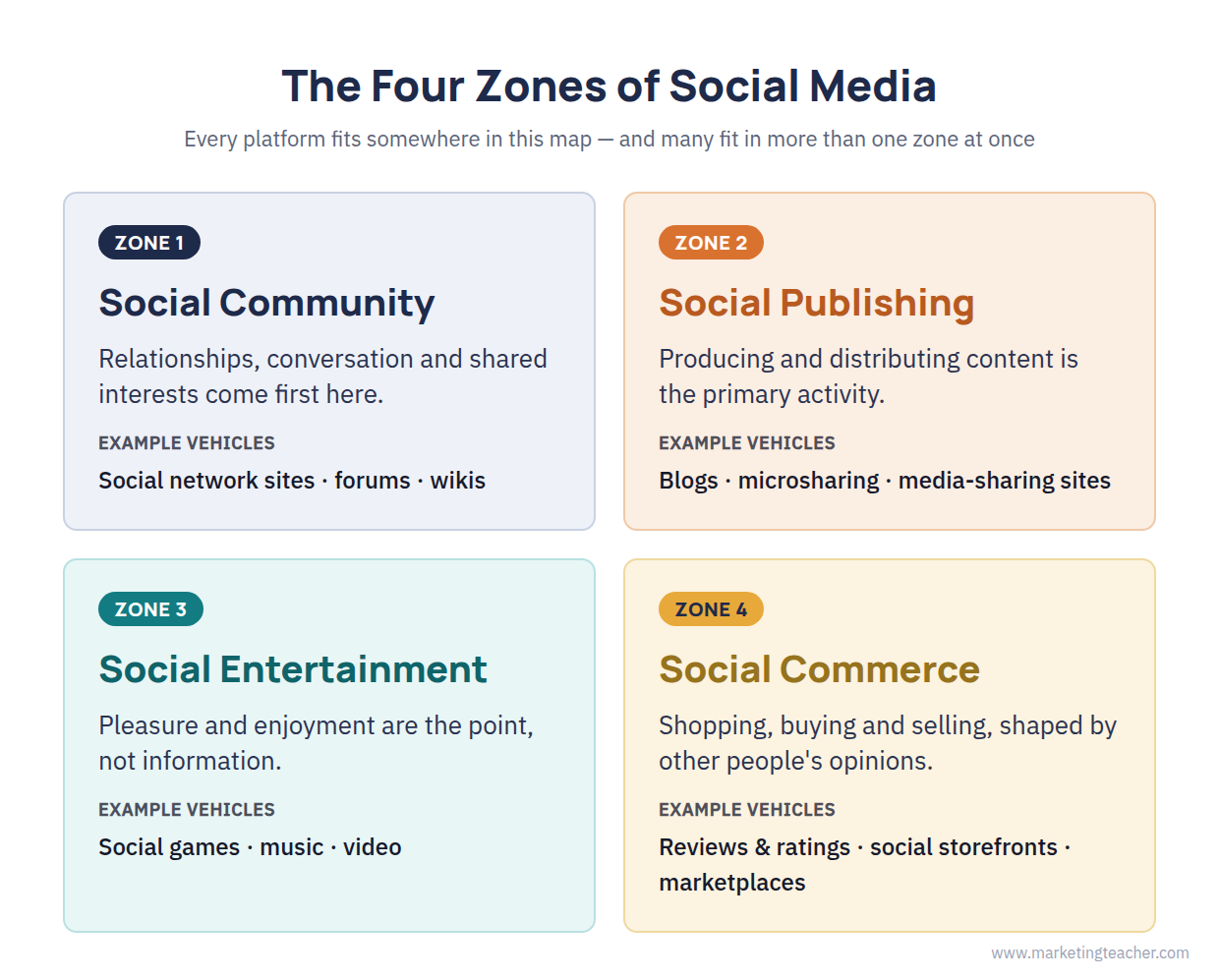
Because there are thousands of individual platforms and new ones appear constantly, it helps to group them by what people actually use them for rather than by name. Tuten (2024) organise the whole social media landscape into four zones:
Social Community — platforms built around relationships and shared interests: social network sites, forums and wikis. The point of engaging here is connection and conversation, not just consumption.
Social Publishing — platforms built for producing and distributing content: blogs, microsharing sites, and media-sharing sites for video, audio, photos and documents. The orientation here is knowledge- and content-sharing.
Social Entertainment — platforms built to provide enjoyment: social games, music, and video. The orientation is entertainment rather than information.
Social Commerce — platforms and features that support shopping, buying and selling: reviews and ratings, social storefronts, and marketplaces where a purchase decision is shaped by other people’s opinions.
Many platforms straddle more than one zone at once — a video platform can be entertainment one moment and a shopping channel the next — so treat the four zones as a way to organise your thinking about objectives, not as a rigid filing system.
Where Does Social Media Fit? Paid, Owned, Earned and Shared Media
Social media also changes how brands get space for their messages. Tuten (2024) uses the PESO model to sort the options into four types of media. Paid media is space a brand buys, such as a sponsored post or a video ad. Owned media is space the brand controls, such as its website, its blog or its own social media accounts. Earned media is attention the brand cannot buy and does not control, such as word of mouth, reviews and press coverage. Shared media are the social channels where brands, ordinary users and journalists all pass content around, their own and other people’s.
Smith and Zook (2016) describe a very similar idea as POEM: paid, owned and earned media. The practical lesson is the same in both models. A strong social media plan uses these types together. Paid posts reach new people quickly, owned channels give the brand a home base, and earned and shared media carry the most trust because they come from other people rather than from the brand. You can read more about the paid side in digital advertising.
How Do Social Media Platforms Make Money?
Most social platforms are free to join, yet they cost real money to build, host and maintain — so they need a monetisation strategy just like any other business. The dominant model, borrowed directly from broadcast television and radio, is what Tuten (2024) call the interruption-disruption model: attract as large an audience as possible with content people want, then sell advertisers the right to interrupt that attention with a message. It’s the same logic behind a TV commercial break, applied to a news feed.
Not all value on social media is monetary, either. Tuten (2024) use the term psychic income, also called social currency, to describe the non-monetary reward people get from participating — the satisfaction of a helpful review being upvoted, or a follower count that signals real expertise. Understanding that people are motivated by more than money is central to why organic engagement (getting people to genuinely want to interact with a brand) still matters alongside paid advertising.
From the Four Ps to a Fifth: Participation
Traditional marketing is generally taught around the “Four Ps“: Product, Price, Promotion and Place. Tuten (2024) argue social media has effectively added a fifth: Participation. Traditional marketing communication was largely top-down and one-way — a brand broadcast a message, and the audience received it. Fill and Turnbull (2023) describe this as a move from a linear model of communication, where a message travels one way from sender to receiver, to an interactional model, where both sides respond to each other. Social media flips that: audiences now talk back, share, remix and sometimes even co-create the message. A marketing strategy that ignores this two-way, participatory dimension of social platforms is really just old-style broadcast advertising wearing a new interface.
Summary
Social media marketing is the deliberate use of social platforms and technologies to create and exchange value with an organisation’s audience (Tuten, 2024), built on a Web 2.0 foundation that puts content creation in users’ hands (Kaplan & Haenlein, 2010). With social media reaching a clear majority of the world’s population (DataReportal, 2026), the scale on offer is unprecedented — but scale alone isn’t a strategy. Understanding the Social Media Value Chain, the four zones that organise the landscape, how paid, owned, earned and shared media work together, how platforms actually make money, and the participatory shift from four Ps to five gives you the foundation the rest of this course builds on.

