
Why Start Planning with Questions?
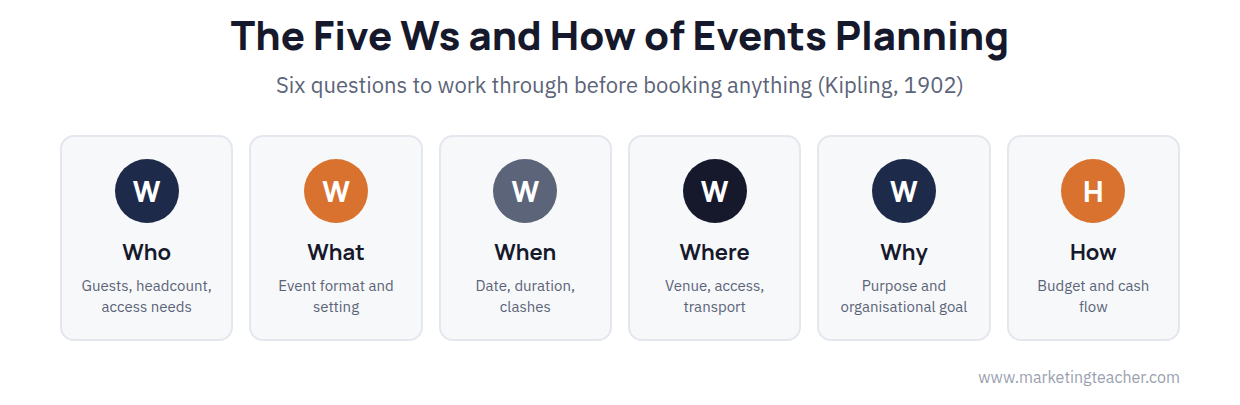
The “five Ws and one H”, who, what, when, where, why and how, is a simple questioning framework with roots in Rudyard Kipling’s (1902) poem “I Keep Six Honest Serving-Men”, and it has since become a standard tool across journalism, investigation and planning of every kind. Applied to events, it gives a planner a structured way to work through every major decision before committing budget or booking a venue, turning a vague idea like “let’s hold a product launch” into a concrete, plannable brief.
Who: Understanding the Guest List
Every event decision should start with who is actually attending. Who is holding the event, and on whose behalf? How many guests are realistically expected, and does that number change the venue, catering or staffing requirements? It also matters whether any attendees need specific accommodations, step-free access, dietary requirements, or arrangements for children, since planning for these needs early is far cheaper and less stressful than adjusting at the last minute. A product launch aimed at existing key accounts calls for a very different guest experience than a public exhibition aimed at walk-in prospects.
What: Defining the Type of Event
What kind of event actually suits the goal and the audience? Live music and sporting events, festivals and cultural events, meetings and conferences, incentive travel, product launches, exhibitions and trade shows, and personal celebrations such as weddings or anniversaries all demand different formats, timelines and supplier relationships. Whether the event will be indoors or outdoors also shapes almost every other decision that follows, from catering logistics to contingency planning for weather. Where possible, planners should discuss format options directly with delegates or stakeholders rather than assuming what will appeal to them.
When: Setting the Date and Duration
Timing decisions go well beyond simply picking a date. Does the deadline for the event leave realistic time to plan properly, book suppliers and promote attendance? Does the chosen date clash with other events the target audience might also want to attend, a competitor’s conference, a public holiday, or a seasonal peak that limits venue and supplier availability? Duration matters too: an event that runs for a single evening requires a very different plan from one spanning several days, and even the time of day, a weekday lunchtime versus a weekend evening, changes who is realistically able to attend.
Where: Choosing the Venue
Venue choice needs to balance the practical and the strategic. Is the location easy for the target audience to find and reach? Will it be a local event or does it need to draw an international audience, which changes travel and accommodation planning substantially? Parking and transport arrangements are easy to overlook but can make or break attendance for a venue that otherwise fits perfectly, particularly for older guests, guests travelling with equipment, or events held somewhere with limited public transport.
Why: Clarifying the Purpose
An event without a clear purpose tends to drift, spending money without a way to judge whether it actually worked. Why is this event happening at all? Does it map onto a specific organisational goal: generating direct sales, building brand awareness, transferring knowledge, or strengthening relationships with existing customers or partners? Getz (2008) frames planned events as tools that organisations deliberately design to meet specific goals, rather than simply as social occasions, and treating the “why” question seriously early on makes it far easier to judge afterward whether the event actually delivered value.
How: Working Out the Budget
The final, and often most constraining, question is how the event will actually be paid for. How much budget is genuinely available, and when does that money need to be available relative to supplier deposits and payment deadlines? Cash flow matters as much as the total budget figure: a venue that requires a deposit months in advance can derail an otherwise well-planned event if that timing was not built into the financial plan from the start. Some suppliers, particularly smaller local vendors, may also require payment in cash or before an event rather than on invoice afterward, which needs to be factored in early rather than discovered at the last minute.
Working Through the Questions in Order
While the six questions can be revisited at any point in planning, working through them roughly in sequence, starting with who and what, before locking in when and where, and finally confirming why and how, tends to surface conflicts earlier, before money has been committed. A venue booked before the guest list is properly understood, for example, can turn out to be the wrong size or in the wrong location entirely, a mistake far cheaper to avoid on paper than to fix after a deposit has already been paid.
Summary
Planning an event well means working systematically through six questions rather than jumping straight to booking a venue. Who is attending shapes the guest experience; what kind of event best fits that audience and goal; when it happens needs to avoid clashes and allow enough lead time; where it is held needs to balance accessibility with strategic fit; why it is happening, per Getz’s (2008) view of events as deliberately designed tools, keeps the whole plan tied to a genuine organisational goal; and how it will be funded, including the timing of cash flow, determines whether the plan is actually achievable. Working through these questions roughly in order, rather than skipping to the parts that feel most exciting, catches expensive mistakes while they are still cheap to fix.
The slides, worksheet, lesson plan and poster for this lesson are free to download and free to use in your course — no sign-up, no permission needed. See the teacher resources →
Assign this lesson to your class:
Using Canvas, Blackboard or Moodle? Copy the link and paste it into your course page or assignment. More ways to add lessons to your LMS.

