
What Is the Value Proposition Canvas?
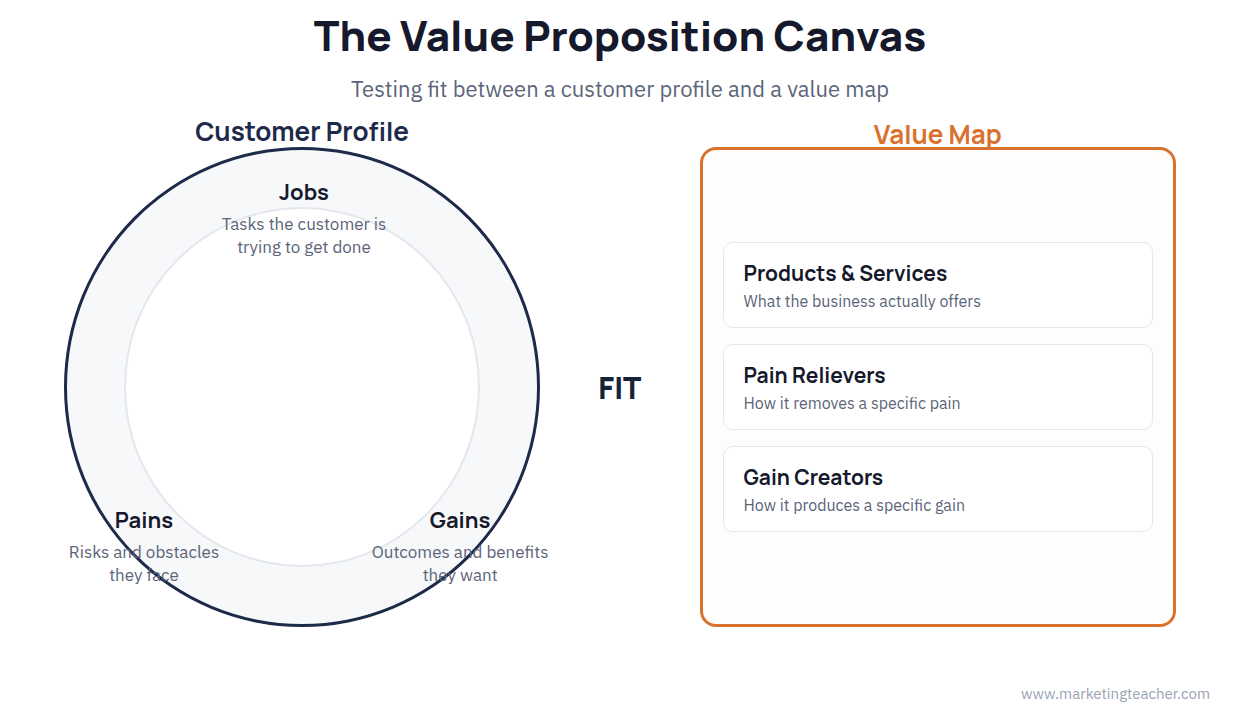
The Value Proposition Canvas is a business tool used to design, test and refine the fit between what a company offers and what its customers actually need. Osterwalder, Pigneur, Bernarda and Smith (2014) introduced the canvas as a companion to their earlier Business Model Canvas, and it has since become a standard tool in the Lean Startup tradition for start-ups and established businesses alike. The canvas has two halves: a Customer Profile, which clarifies what a specific customer segment is trying to achieve, and a Value Map, which describes how a product or service is meant to help them achieve it.
The Customer Profile: Jobs, Pains and Gains
The Customer Profile side of the canvas breaks a customer segment down into three elements. Customer jobs are the tasks customers are trying to get done, functional, social, personal or supporting. Pains are the negative experiences, risks and obstacles customers face while trying to complete those jobs, including undesired outcomes and things that could go wrong. Gains are the positive outcomes and benefits a customer wants, hopes for or would be surprised by, ranging from required gains they cannot do without to unexpected gains they never thought to ask for.
The Value Map: Products, Pain Relievers and Gain Creators
The Value Map side of the canvas mirrors the Customer Profile with three elements of its own. Products and services are simply the tangible, digital or financial offerings a business provides. Pain relievers describe specifically how those products and services reduce or remove a named customer pain. Gain creators describe how they produce or support a named customer gain. A value proposition is strong when its pain relievers and gain creators map clearly onto real, specific pains and gains rather than describing generic product features.
Achieving Fit
Fit is the point at which a value map’s pain relievers and gain creators genuinely match the jobs, pains and gains that matter most to a customer segment. Osterwalder, Pigneur, Bernarda and Smith (2014) describe fit as something reached in stages rather than all at once: first a business identifies which customer pains, jobs and gains actually matter enough to design around; then it tests whether customers respond positively to the resulting value proposition; and only once that response is confirmed does it look for a business model that can deliver the value proposition profitably. A canvas that looks complete on paper but has never been tested with real customers has not yet achieved fit in any meaningful sense.
Why Use the Value Proposition Canvas?
The canvas forces a business to be specific rather than assuming it already understands its customers. Writing “customers want convenience” on a whiteboard is vague enough to justify almost any feature; writing a named job, a named pain and a named gain, then matching each to a specific pain reliever or gain creator, makes it obvious when a value proposition is actually addressing something real. This discipline is particularly useful early in a new venture, before significant money has been spent building a product around an assumption that turns out to be wrong.
The Value Proposition Canvas and the Business Model Canvas
The Value Proposition Canvas is designed to plug directly into the customer segments and value propositions blocks of the wider Business Model Canvas, letting a team zoom in on the customer-fit question before working through the rest of the business model, revenue streams, channels, key partners and cost structure. Used together, the two tools move a business from a validated customer insight to a complete, testable model of how the business will actually operate and earn money.
Common Mistakes When Using the Canvas
Teams new to the tool often list customer jobs, pains and gains that describe their own product rather than the customer’s actual experience, which quietly defeats the purpose of the exercise. Another common mistake is treating the canvas as a one-time planning document rather than something to revisit as real customer feedback comes in; the canvas is most useful as a living hypothesis that gets updated, not a plan that gets filed away once completed. Ranking every job, pain and gain as equally important is a third frequent error, since it leaves a team with no way to prioritise which pain reliever or gain creator to build first.
Summary
The Value Proposition Canvas, introduced by Osterwalder, Pigneur, Bernarda and Smith (2014) as a companion to the Business Model Canvas, splits into a Customer Profile (jobs, pains, gains) and a Value Map (products and services, pain relievers, gain creators). A business achieves fit when its value map genuinely addresses the customer profile’s most important jobs, pains and gains, confirmed through real customer feedback rather than assumed from the canvas alone, and the tool works best when treated as a living hypothesis rather than a one-time planning exercise.
The slides, worksheet, lesson plan and poster for this lesson are free to download and free to use in your course — no sign-up, no permission needed. See the teacher resources →
Assign this lesson to your class:
Using Canvas, Blackboard or Moodle? Copy the link and paste it into your course page or assignment. More ways to add lessons to your LMS.

