
What Is Gamification in Marketing?
Gamification in marketing means borrowing the mechanics that make games engaging — points, badges, levels, challenges and leaderboards — and applying them to a non-game activity such as shopping, signing up for a newsletter, or completing a fitness programme. Huotari and Hamari (2017) define gamification as a process of enhancing a service with affordances for gameful experiences, a framing that matters because it shifts the focus away from simply “adding game bits” and towards designing for the psychological experience the customer actually has: a sense of progress, competence and reward. A loyalty app that awards stamps for every visit, a fitness brand that unlocks a badge after a tenth workout, and a retailer’s spin-the-wheel discount game are all applying the same underlying idea to very different situations.
The Feedback Loop That Makes It Work
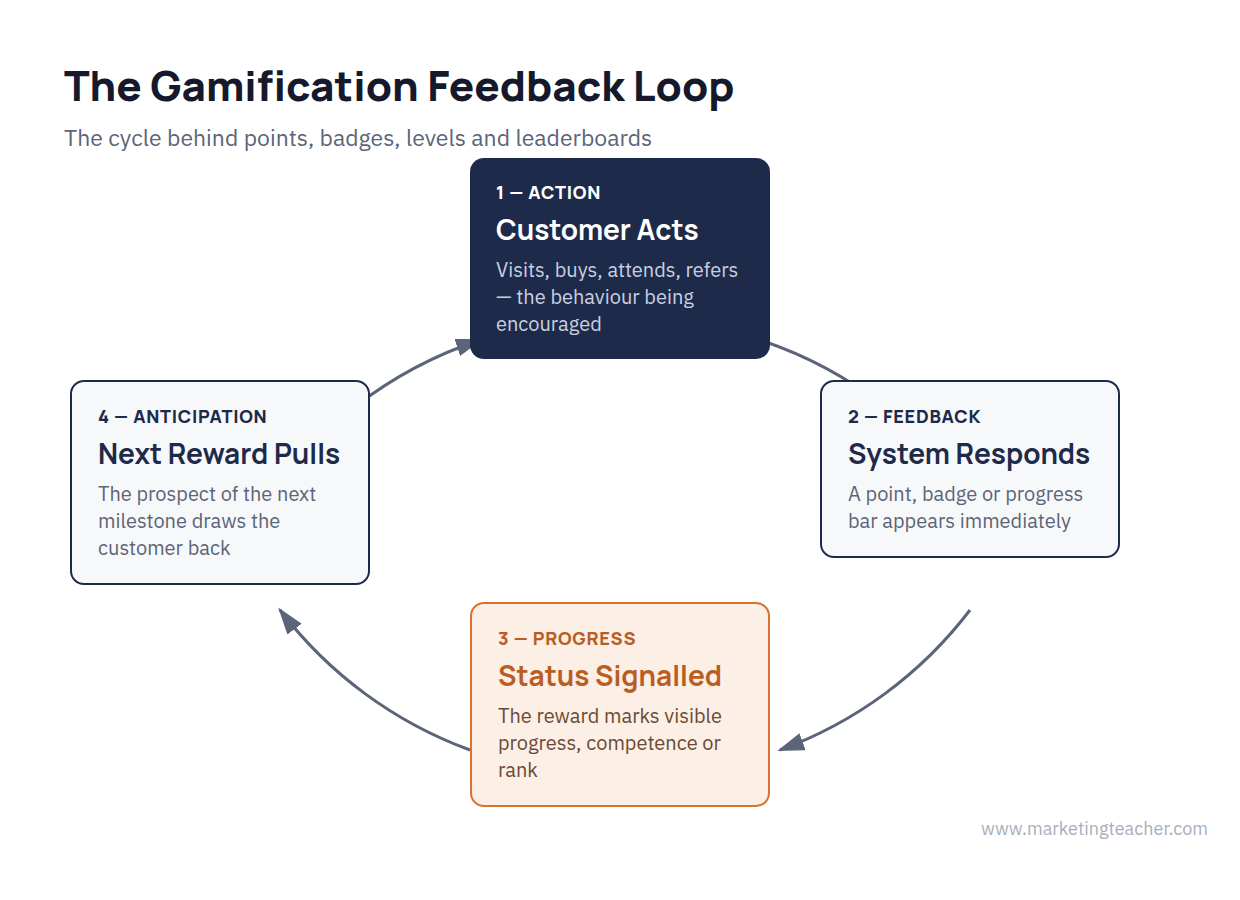
Underneath the different formats, most gamified marketing runs on a single feedback loop: the customer takes an action, the system gives immediate visible feedback (points, a badge, a progress bar), that feedback signals status or progress, and the prospect of the next reward pulls the customer back to repeat the action. Points give the customer a running score; badges mark a specific achievement reached once and kept forever; levels group a customer’s overall progress into stages that unlock new privileges; and leaderboards add a social, competitive layer by showing a customer how they compare with others. None of these elements does much on its own — a points balance nobody can see, or a badge that unlocks nothing further, tends to fall flat. It is the loop of action, feedback and anticipation working together that keeps a customer coming back.
Why Effectiveness Varies So Much by Design
Gamification does not automatically work simply because points or badges have been added. A large-scale review by Yang, Xi, Tang and Hamari (2026), covering 172 studies of gamification effectiveness, found that outcomes vary considerably depending on exactly how a gamified system is designed and which game elements are combined, rather than gamification having one fixed effect size. In practice this means a badge that marks genuine mastery of something a customer cares about tends to motivate more reliably than a badge that is simply handed out for logging in, and a leaderboard works better for customers who enjoy competition than for those who find being publicly ranked stressful or discouraging. The practical implication for a marketing team is that a gamified feature needs the same testing and iteration as any other campaign element — it is a design problem, not a single tool that can be switched on.
The Ethical Line: Motivating vs Manipulating
Gamification sits close to a line between motivating a customer and manipulating them, and it is worth marketers being deliberate about which side of that line a mechanic falls on. A loot-box-style “mystery reward” that obscures the odds of winning something valuable, or a public leaderboard that quietly shames the lowest performers rather than celebrating the highest, both use the same feedback-loop mechanics but point toward pressure rather than genuine engagement. A simple fairness test many teams apply before launching a gamified feature is to ask whether a customer who read a full, honest description of how the mechanic worked would still feel good about taking part. Loyalty and progress mechanics that reward a customer for something they already wanted to do — showing up, trying a new product range, referring a friend they genuinely rate — tend to pass that test more easily than mechanics designed mainly to create anxiety about missing out.
Summary
Gamification in marketing applies familiar game mechanics — points, badges, levels and leaderboards — to ordinary customer activities, built on a feedback loop of action, immediate feedback and anticipated reward. As Marlowe Fitness Studio’s streak challenge shows, a well-designed loop can meaningfully shift real behaviour such as attendance and retention, but research reviewing well over a hundred studies confirms that results depend heavily on design choices rather than being guaranteed by gamification itself. Used well, gamification rewards customers for things they already want to do; used carelessly, the same mechanics can tip into manipulation — which is why every gamified feature still needs a human check against a simple fairness test before launch.
The slides, worksheet, lesson plan and poster for this lesson are free to download and free to use in your course — no sign-up, no permission needed. See the teacher resources →
Assign this lesson to your class:
Using Canvas, Blackboard or Moodle? Copy the link and paste it into your course page or assignment. More ways to add lessons to your LMS.

