What Is a Loyalty Program?
A loyalty program is a structured scheme that rewards customers for buying from the same business repeatedly, rather than switching to a competitor. Instead of competing purely on price for every single sale, a business uses a loyalty program to make the relationship itself worth something to the customer — points, discounts, or perks that only build up if they keep coming back. Loyalty programs sit inside the broader idea of customer relationship management: building and maintaining profitable long-term relationships with customers, not just winning one-off transactions (Kotler & Armstrong, 2018). A well-run program turns an ordinary buyer into a higher-value repeat customer, which is exactly why so many supermarkets, airlines, coffee chains, and online retailers run one.
The Four Common Types
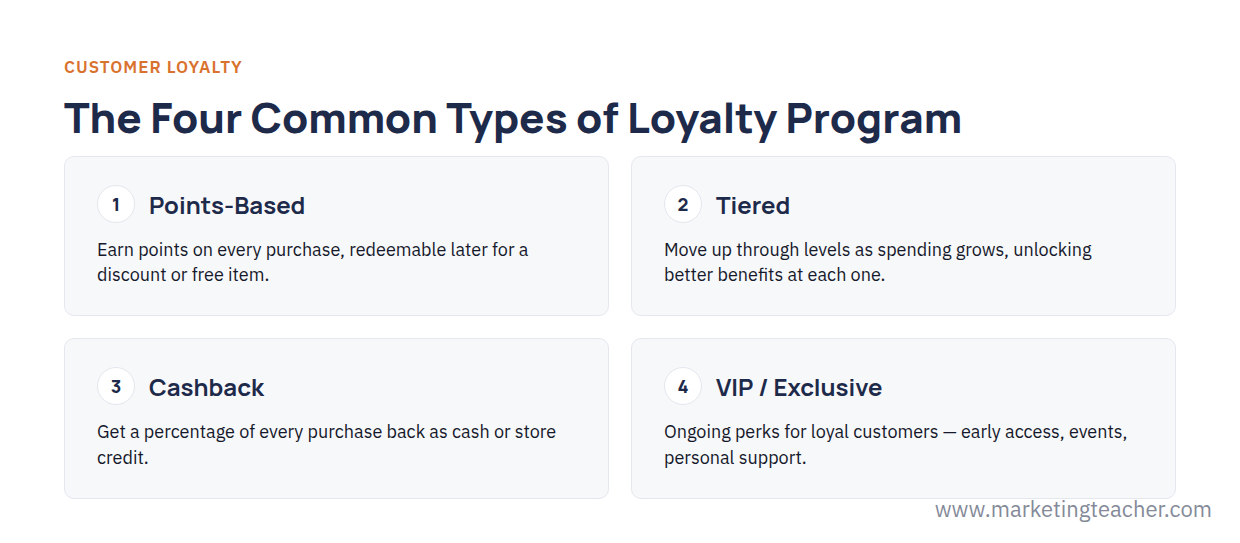
Most loyalty programs fall into one of four types, and many businesses combine more than one.
Points-based programs. The customer earns points for every purchase, which build up and can later be redeemed for a discount, a free item, or another reward. This is the most familiar format — a supermarket card or a coffee shop stamp app are both points-based, just with a physical or digital ledger standing in for the points.
Tiered programs. Customers move up through levels — bronze, silver, gold, or similar — as their spending or loyalty grows, unlocking better benefits at each level. Airlines run some of the best-known tiered programs, where a frequent flyer earns priority boarding, lounge access, or free upgrades the further up the tiers they climb.
Cashback programs. The customer gets a percentage of what they spend back as cash or store credit, rather than points that need converting into a reward first. This is popular with credit cards and some online retailers, because the reward is simple to understand — spend £100, get £3 back — with no points chart to decode.
VIP or exclusive membership programs. Rather than rewarding every purchase individually, the business gives loyal customers ongoing perks: early access to new products, invitations to events, or a personal contact for support. These programs reward the relationship as a whole rather than each transaction, and often work best for premium or specialist brands.
Why Loyalty Programs Pay Off
A loyalty program looks like it only costs the business money: every point redeemed, every cashback payment, every free upgrade is a real expense with no immediate sale attached. The payoff shows up elsewhere. Retaining an existing customer is consistently cheaper than acquiring a new one, since a new customer usually needs advertising, a discount to win them over, and no guarantee they will return (Kotler & Armstrong, 2018). A loyal customer, by contrast, buys more often, is less sensitive to a competitor’s short-term discount, and is more likely to recommend the business to other people — all of which raises that customer’s lifetime value well beyond what any single purchase is worth.
Loyalty programs also give a business something it would otherwise have to buy separately: data. Every points transaction is a record of what a specific customer bought and when, which lets a business spot its best customers, notice early when a regular stops showing up, and target offers instead of guessing (Kotler & Armstrong, 2018).
Getting a Loyalty Program Right
Not every loyalty program pays off, and the difference usually comes down to design rather than the idea itself. A program has to feel achievable: if the first reward is too far away, customers stop noticing the points balance and the program stops changing their behaviour (Kotler & Armstrong, 2018). It also has to fit how the business is actually used — a tiered airline-style program makes little sense for a shop most customers visit only twice a year, while a simple points card can feel too small a reward for a once-in-a-lifetime purchase like a car or a holiday. Finally, the program only earns back its cost if the business actually uses the data it collects; a card that is scanned but never analysed is just a discount scheme wearing a loyalty program’s name.
Summary
A loyalty program rewards customers for repeat business instead of one-off purchases, usually through points, tiers, cashback, or VIP perks. The upfront cost of the rewards is real, but it is generally smaller than the cost of constantly replacing lost customers with new ones — and a well-designed program pays for itself through higher retention, higher spend per customer, and the customer data it generates along the way.