
What Is Social Media Marketing?
Social media are independent and commercial online networks where people gather to socialise and share messages, opinions, pictures, videos and other content (Kotler and Armstrong, 2018). Social media marketing is the practice of using those networks deliberately: not just having a presence on them, but creating and sharing content designed to build brand awareness, start conversations, and move an audience closer to a purchase. Wherever an audience already congregates, marketers have strong reasons to follow.
Two Ways to Use Social Media
Kotler and Armstrong (2018) describe two broad approaches. The first, and by far the more common, is to use existing social media: setting up brand pages and profiles on established platforms where the target audience already spends time. The second is to build a branded community of one’s own — a space that does more than sell, offering content, discussion and activities that give customers a reason to keep returning specifically because of the brand, not just to check messages from friends. Most businesses rely mainly on the first approach, since it meets the audience where they already are, but a genuinely engaged brand community can build a depth of loyalty that a page on someone else’s platform rarely matches.
The Advantage That Is Also the Risk
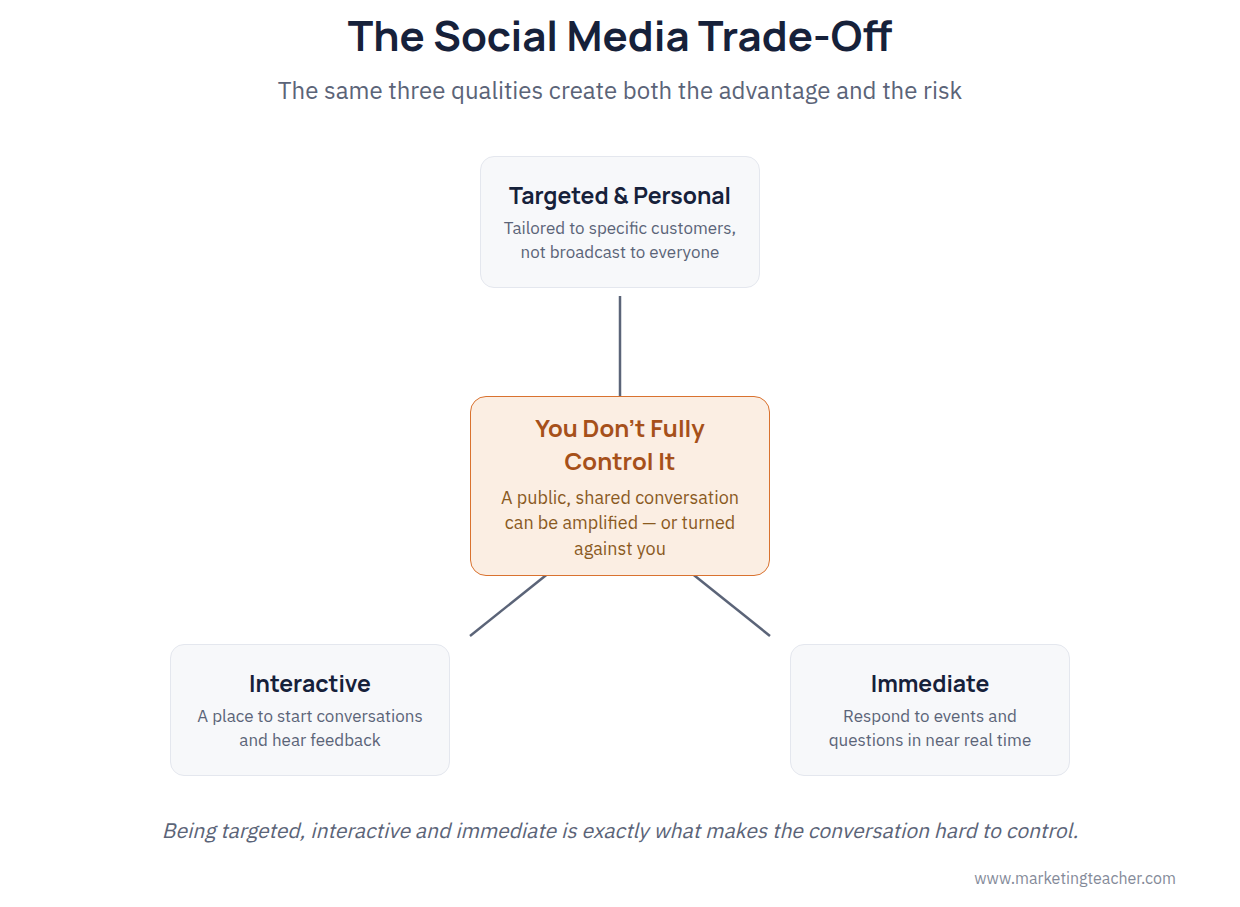
Used well, social media marketing offers three real advantages (Kotler and Armstrong, 2018). It is targeted and personal, letting a business tailor content to specific customers or communities rather than broadcasting one message to everyone. It is interactive, making it a natural place to start conversations and listen to feedback rather than simply publish. And it is immediate, allowing a brand to respond to events, questions and complaints in something close to real time.
The diagram above shows why these three advantages sit around a single shared risk rather than existing independently of it: a business does not fully control the conversation. Once a brand posts into a public, shared space, its audience can amplify a message, but can just as easily push back on it, mock it, or turn a campaign hashtag against the brand entirely. Social media marketing therefore rewards a light touch and genuine listening far more than heavy-handed promotion — a lesson learned the hard way by more than one brand that treated a hashtag campaign as pure advertising rather than an invitation to a genuinely public conversation.
Choosing Where to Show Up
Not every platform suits every brand, and trying to maintain a genuine presence everywhere usually means doing an adequate job nowhere. The more useful question is not “which platforms exist” but “which platforms does our actual target audience already use, and what kind of content do they expect there.” A business selling specialist industrial equipment to other businesses is unlikely to get much value from a platform built around short entertainment videos, however popular that platform is in general; a young consumer lifestyle brand may get very little from a platform built around professional networking. Picking two or three platforms and doing them well is almost always a stronger strategy than a thin presence spread across every option available.
Deciding what to actually post on those platforms is its own skill — readers who want a structured way to match content format to where an audience sits, from early awareness through to purchase, can go deeper with The Content Marketing Matrix.
Integrated, Not Scattered
The businesses that get the most from social media rarely treat it as a set of separate, disconnected accounts (Kotler and Armstrong, 2018). Instead, they design a social media effort that blends with and supports the brand’s wider marketing: a video shown on social media might also appear on the website, a hashtag from a social campaign might run through email and in-store signage, and customer content gathered on social media might feed back into product development. Chasing likes and followers on each platform separately is a weaker strategy than treating social media as one coordinated part of a bigger conversation with the customer.
Summary
Social media marketing means deliberately using online social networks — either existing platforms or a brand’s own community — to build awareness, start conversations and move customers toward a purchase. Its three real advantages, being targeted, interactive and immediate, are inseparable from its central risk: a business never fully controls a public conversation once it starts. Choosing a small number of platforms that genuinely fit the audience, rather than spreading thin across all of them, and integrating social media with the rest of a brand’s marketing rather than treating it as a separate island, are what turn those advantages into a coordinated strategy rather than scattered activity.
The slides, worksheet, lesson plan and poster for this lesson are free to download and free to use in your course — no sign-up, no permission needed. See the teacher resources →
Assign this lesson to your class:
Using Canvas, Blackboard or Moodle? Copy the link and paste it into your course page or assignment. More ways to add lessons to your LMS.

