
Learning Outcome: By the end of this lesson, you will be able to explain what neuro-marketing is, describe the main techniques researchers use to measure a consumer’s brain and body response, and evaluate why these methods matter alongside traditional surveys.
Want to go further? Study a full online course and earn a certificate →
What Is Neuro-Marketing?
Neuro-marketing applies tools from neuroscience to the study of how consumers actually respond to brands, adverts, and products – measuring activity in the brain and body directly, rather than relying only on what a consumer says afterwards. Plassmann, Ramsøy and Milosavljevic (2012), reviewing the field in the Journal of Consumer Psychology, note that applying neuroscience to the consumer psychology of brands has grown steadily in both academic and corporate interest, precisely because it offers a way to study reactions that happen before – or entirely without – conscious awareness. This builds on an argument first made by Camerer, Loewenstein and Prelec (2005) in the foundational neuroeconomics literature: that measuring the brain’s response directly gives researchers a real-time, objective read on a decision that self-reported survey data alone cannot fully capture.
Why Traditional Research Has Real Limits
A survey or focus group depends on a participant being able to consciously notice, remember, and accurately describe their own reaction – and a great deal of how people respond to marketing stimuli happens automatically, well below that level of awareness. Someone might genuinely believe they chose a product because of its price, when the real driver was an emotional reaction to its packaging design that they were never consciously aware of at all. This is not a flaw in the participant; it’s simply a limit of self-report as a research method, which is why neuro-marketing exists as a complement to traditional research rather than a replacement for it.
The Main Measurement Techniques
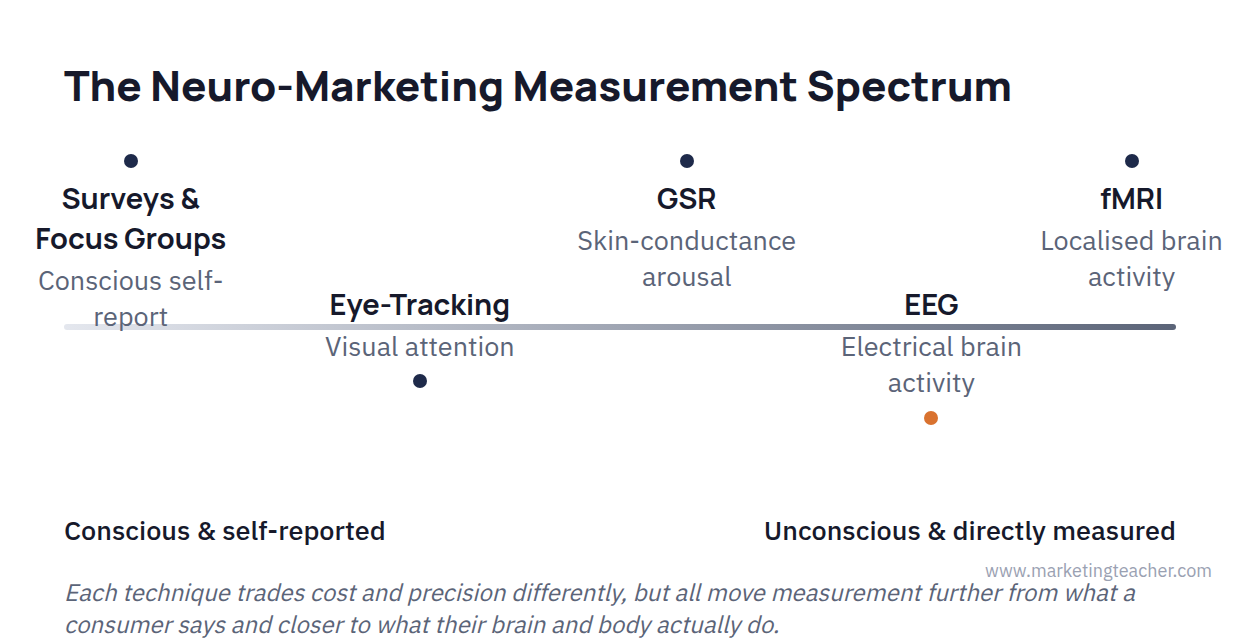
Harris et al. (2018), summarising the field for the Journal of Consumer Behaviour, group the most commonly used consumer neuroscience techniques into a handful of categories, each with its own trade-offs. Electroencephalography (EEG) measures the brain’s electrical activity through scalp sensors – relatively affordable and able to capture change at the speed of thought, though it says less about exactly where in the brain a response originates. Eye-tracking records precisely where and for how long someone looks, a strong proxy for visual attention. Galvanic skin response (GSR), also called skin conductance, measures subtle changes in sweat-gland activity as a marker of emotional arousal. Functional magnetic resonance imaging (fMRI) can pinpoint activity in specific brain regions with much greater precision than EEG, but at far higher cost, making it the least commonly used of the four in commercial practice.
Example: Aldermoor Drinks Tests Two Adverts
The fictional beverage company Aldermoor Drinks was deciding between two edits of the same 30-second advert ahead of a launch. Rather than relying only on a post-viewing survey, it ran a small panel test combining EEG with eye-tracking as 40 participants watched both versions. Both cuts scored similarly when participants were simply asked afterwards which they preferred – a near-even split. The EEG and eye-tracking data told a different story: the second cut held sustained visual attention on the product shot for almost twice as long, and showed a stronger arousal signal during the closing five seconds. Aldermoor went with the second cut for its national launch, on the basis that a measured attention and arousal advantage was a more reliable predictor of cut-through than a stated preference that was, in this case, close to a coin toss.
Combining Neuro-Data With Other Research
Neuro-marketing data is at its most useful when it’s combined with other evidence rather than acted on in isolation. Harris et al. (2018) point out that the consumer neuroscience literature often lacks a rigorous, side-by-side comparison of how well its various tools actually agree with one another, which is a reasonable caution against treating any single measurement as the final word. In practice, this means pairing a brain or body measure with something independently verifiable – a follow-up survey question, an A/B test comparing real click-through rates, or actual sales data once a campaign goes live – so that a genuinely strong attention or arousal signal can be checked against whether it actually predicted the behaviour a business cares about, rather than assumed to do so automatically.
Ethical Considerations and the Risk of “Neuro-Hype”
Neuro-marketing raises real ethical questions that a standard survey does not: participants need to give properly informed consent to having their brain and body signals recorded, and the equipment and expertise involved mean access to these methods is far from evenly distributed between large and small businesses. There is also a genuine risk of overclaiming what the data shows – a single small panel study is not proof that a technique “hacks” the consumer’s brain, and researchers in the field are themselves often the first to caution against treating an EEG or eye-tracking result as a definitive verdict rather than one useful piece of evidence among several.
Summary
Neuro-marketing measures a consumer’s brain and body response directly – through techniques such as EEG, eye-tracking, skin conductance, and fMRI – to capture reactions that happen before conscious awareness and that a survey alone cannot reliably access. It is best used alongside, not instead of, traditional research methods, and it carries real ethical and cost considerations that a marketer should weigh honestly rather than treating the field as an infallible shortcut to understanding what a customer really wants.
Key Idea: Neuro-marketing swaps a consumer’s after-the-fact explanation for a direct, real-time measure of brain and body response – valuable precisely because people are not always consciously aware of, or able to accurately describe, why they actually prefer one option over another.
Teaching this topic?
The slides, worksheet, lesson plan and poster for this lesson are free to download and free to use in your course — no sign-up, no permission needed. See the teacher resources →
Assign this lesson to your class:
Using Canvas, Blackboard or Moodle? Copy the link and paste it into your course page or assignment. More ways to add lessons to your LMS.
Written by Marketing Teacher.
Online course · certificate on completion
Study a full online course — and earn a certificate
Three courses that turn the free lessons into ordered modules, written at university Levels 4 to 6, with a short quiz after each.

