
Who Actually Counts as a Customer?
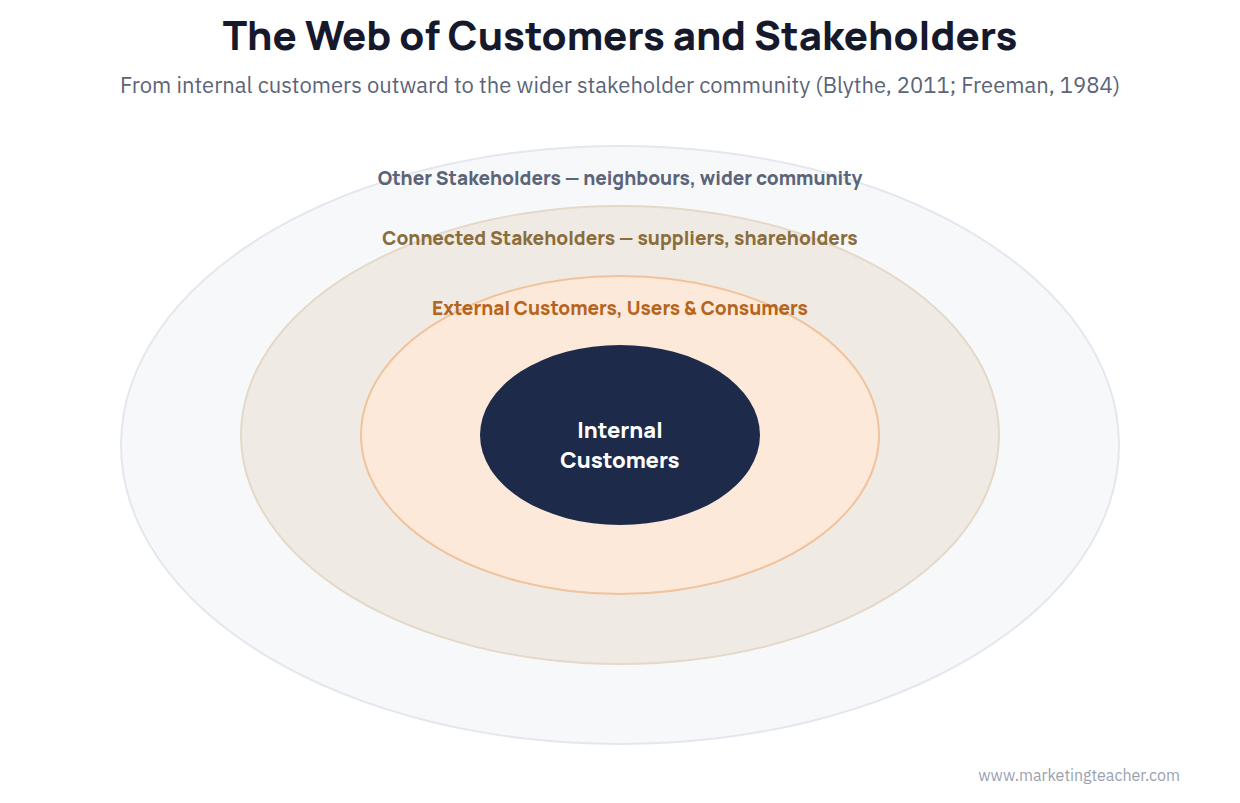
Marketing is usually framed around a single relationship: a business and its customers. In practice, that relationship sits inside a much wider web of people an organisation depends on, some of whom never buy anything at all. For an introduction to marketing, it helps to separate out the generic terms used for these different relationships: customers, users, connected stakeholders, and other stakeholders. Understanding which is which, and how they differ, is the foundation for understanding how marketing operates both inside and outside an organisation.
Internal Customers
Internal customers are the colleagues and departments within an organisation’s own walls. Marketing is not only something a business does to the outside world; it also flows internally, connecting departments such as research and development, production and operations, human resources, IT and customer service. In this internal sense, roles shift constantly: a marketing team is the customer of the IT department when it needs a new campaign platform built, and becomes the service provider when sales asks marketing for updated product messaging. Every internal handoff between departments is, in effect, a small internal customer relationship, and how well those relationships function shapes how smoothly the organisation serves its external customers in turn.
External Customers
External customers are the people and organisations outside the business: customers, users, and the wider set of stakeholders. A customer is whoever exchanges money for a good or service, while a consumer, sometimes called a user, is whoever actually uses it, and the two are not always the same person. A parent who buys a toy is the customer; the child who plays with it is the consumer. Blythe (2011) defines stakeholders more broadly still, as people who are affected by an organisation’s activities, whether or not they ever buy anything from it at all. Freeman’s (1984) foundational stakeholder approach makes the same point: a business’s decisions ripple out to a much wider group than its paying customers, and managing those relationships well is itself part of good strategic management.
Connected and Other Stakeholders
Not every stakeholder has the same relationship to a business. A connected stakeholder has a direct, formal association with the organisation, a supplier who depends on its orders, or a shareholder who holds voting rights at its annual general meeting. Other stakeholders sit at more of a distance but are still genuinely affected: the family next door to a factory dealing with its noise and traffic, or a local community whose economy depends partly on jobs the business provides. None of these groups are customers in the transactional sense, yet ignoring their interests can create real problems for a business, from planning objections to reputational damage, that no amount of customer-focused marketing can fix on its own.
Why the Distinction Matters for Marketing
Treating “customer” as the only relationship worth managing misses a great deal of what actually shapes whether a business succeeds. An organisation with excellent external customer service but poor internal customer relationships, departments that do not share information, teams that treat each other as obstacles rather than partners, will eventually let that friction show up in the external experience too. Equally, a business that manages its connected stakeholders well, keeping suppliers and shareholders genuinely informed and engaged, tends to be more resilient when problems arise, since those stakeholders have a stake in helping it recover rather than walking away.
Users, Consumers and Customers Are Not Always the Same
The distinction between customer, user and consumer becomes especially important in business-to-business and gift-giving contexts. A company that buys software for its employees is the customer, but the employees using it daily are the consumers, and their experience of the product matters just as much to renewal decisions as the buyer’s initial impression. Marketers who only optimise for the person who signs the purchase order, while ignoring the person who actually uses the product every day, risk building loyalty with the wrong audience entirely.
Building Loyalty Across the Whole Web of Relationships
Customer loyalty is often discussed as if it only concerns external, paying customers, but genuine organisational loyalty is built across all of these relationships at once. Internal customers who feel well served by other departments are more likely to deliver strong external service in turn. Connected stakeholders who feel genuinely informed are more likely to stay loyal through a difficult period. Even other stakeholders, who may never buy anything, can become vocal advocates or vocal critics depending on how well a business manages its wider impact. Marketing that only ever looks outward, at the external customer, is managing only part of the relationship map a business actually depends on.
Summary
Marketing’s usual focus on the external customer only tells part of the story. Internal customers, the colleagues and departments a business relies on internally, shape how well it can ultimately serve the people outside it. External customers, users and consumers may or may not be the same person, and stakeholder theory (Freeman, 1984; Blythe, 2011) reminds marketers that connected stakeholders such as suppliers and shareholders, and other stakeholders such as neighbouring communities, are affected by a business’s activities even when no money ever changes hands. Understanding and managing this full web of relationships, not just the transactional one, is what separates genuinely resilient organisations from those that only look strong from the outside.
The slides, worksheet, lesson plan and poster for this lesson are free to download and free to use in your course — no sign-up, no permission needed. See the teacher resources →
Assign this lesson to your class:
Using Canvas, Blackboard or Moodle? Copy the link and paste it into your course page or assignment. More ways to add lessons to your LMS.

