
Why Emotion and Perception Matter to Marketers
Consumers rarely make purchase decisions on pure logic alone. Emotion and perception, how a message makes a consumer feel, and how that consumer notices, interprets and remembers it, together determine whether a marketing message has any effect at all. A technically accurate, well-reasoned advertisement that nobody notices or feels anything about will not move a single sale, which is why marketers invest as much in emotional tone and clarity of message as they do in the underlying product claim.
The Perception Process
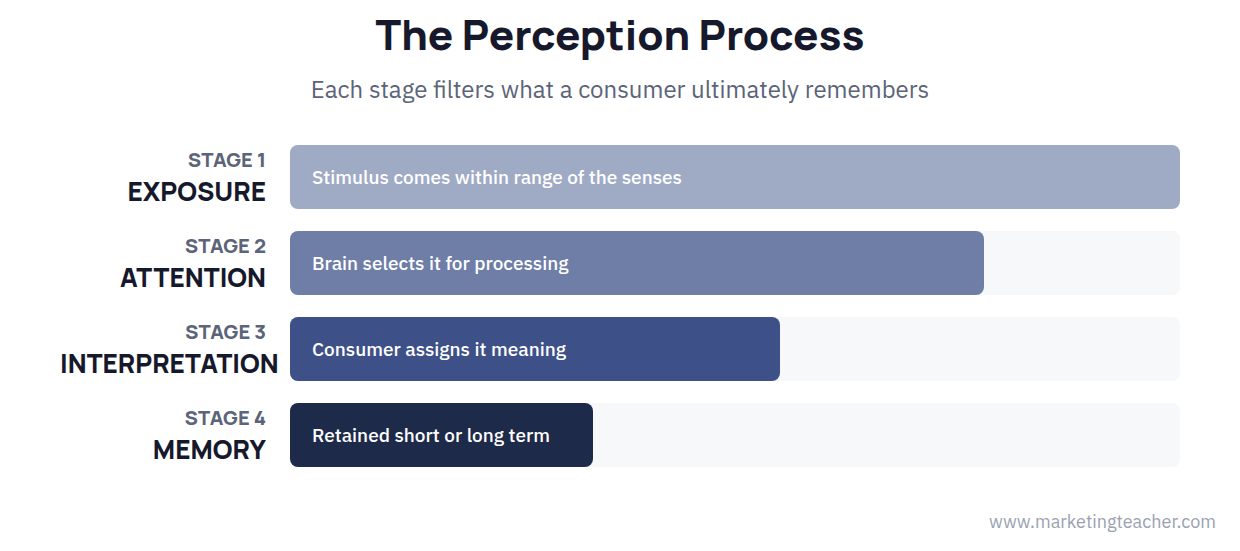
Perception is the process by which consumers select, organize and interpret information from their environment, and it typically unfolds across four stages. Exposure occurs when a stimulus, such as a billboard, a product display or a social media post, comes within range of a consumer’s senses. Attention occurs when the brain actually processes that stimulus, a step shaped heavily by both the individual and the surrounding situation, since a consumer distracted or in a hurry attends to far less than one who is relaxed and receptive. Interpretation occurs when the consumer assigns meaning to the message, drawing on their own experience, expectations and cultural background, which is why the same advertisement can be read completely differently by two different audiences. Memory, the final stage, determines whether the interpreted message is retained only briefly for an immediate decision, or stored longer term where it can influence a future purchase. A message that fails to clear all four stages, unseen, unattended, misread, or forgotten, cannot influence behavior no matter how well it was designed.
Selective Perception
Consumers are exposed to far more marketing messages each day than they could possibly process, so perception is inherently selective. Selective exposure means consumers tend to seek out information that confirms what they already believe and avoid information that contradicts it. Selective attention means that even among the messages a consumer is exposed to, only a fraction receive genuine attention, often the ones that are novel, relevant or emotionally striking. Selective interpretation means that even a message a consumer does attend to can be reshaped to fit their existing beliefs, sometimes in ways the marketer never intended. Together these three filters mean a marketer cannot assume a message has been received simply because it was sent; a consumer’s existing attitudes actively shape what gets through at every stage.
How Emotion Strengthens Attention and Memory
Zajonc (1980) argues that affective, emotional reactions can occur independently of, and often faster than, deliberate reasoning, meaning a consumer can feel something about a brand before they have consciously thought through any of its features. Batra and Ray (1986) build on this by showing that a consumer’s affective response to an advertisement itself, separate from their evaluation of the product being advertised, meaningfully shapes whether that advertisement is accepted and acted on. In practice, this means an emotionally engaging advertisement tends to hold attention longer, gets interpreted more generously, and is remembered more vividly than a purely factual one communicating the identical claim, which is why so much advertising leads with a feeling rather than a specification sheet.
The Role of Individual Differences
How strongly emotion and perception shape a given consumer’s response also depends on individual differences. Self-control, the ability to manage one’s own emotional reactions, affects how easily a consumer is swayed by an emotionally charged message in the moment. Emotional empathy, the ability to recognise and share other people’s feelings, affects how strongly a consumer responds to advertising that depicts other people’s emotional experiences, such as a family reunion or an athlete’s triumph. A person’s general outlook, whether they tend toward optimism or pessimism, colours how they interpret an ambiguous message, and their ability to use emotion productively when solving a problem can affect how carefully they weigh an emotionally framed offer against its practical merits. Marketers who understand these differences within their target audience can calibrate how heavily to lean on emotional appeal versus straightforward product information, rather than assuming a single tone will land the same way with everyone.
Summary
Perception unfolds across four stages, exposure, attention, interpretation and memory, and a message can fail at any one of them, especially once selective exposure, attention and interpretation are taken into account. Zajonc (1980) and Batra and Ray (1986) both show that emotional response plays an active, often independent role in whether a message is accepted, and individual differences in self-control, empathy and outlook further shape how any one consumer perceives and remembers a given piece of marketing.
The slides, worksheet, lesson plan and poster for this lesson are free to download and free to use in your course — no sign-up, no permission needed. See the teacher resources →
Assign this lesson to your class:
Using Canvas, Blackboard or Moodle? Copy the link and paste it into your course page or assignment. More ways to add lessons to your LMS.

