
What Are Generic Strategies?
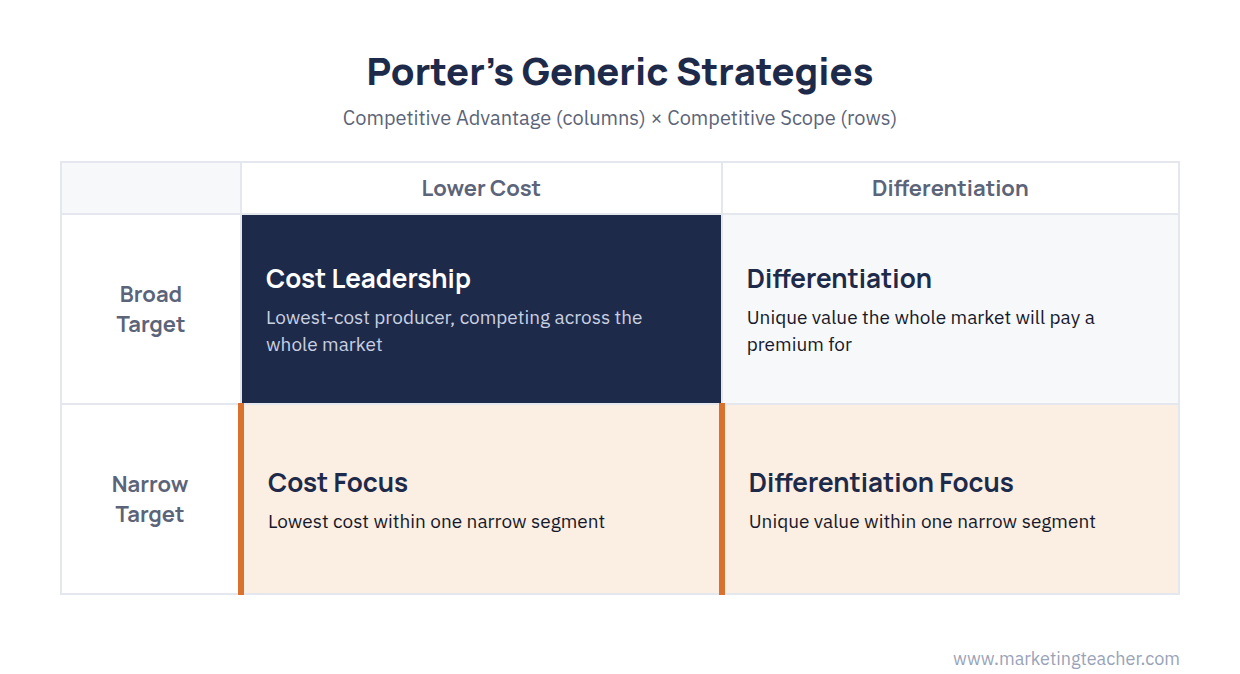
Generic strategies are three broad routes to competitive advantage that Michael Porter argued any business must choose between: cost leadership, differentiation, and focus (Porter, 1980). “Generic” simply means the strategies are not tied to any one industry — a hospital, an airline and a software company can each pursue the same underlying logic. Porter’s central claim is that a business needs to choose clearly among these routes, because trying to do a bit of everything usually means doing none of them well.
The model builds directly on Five Forces Analysis: once a business understands the competitive pressures in its industry, generic strategies describe the broad ways it can respond to them and still earn above-average returns.
Cost Leadership
A cost leader aims to become the lowest-cost producer in its industry, then compete on price or use the extra margin to reinvest and defend its position. This usually requires scale, tight control of overheads, and efficient operations across the whole value chain — a supermarket chain that negotiates hard with suppliers and runs large, efficient distribution centres is a classic example. The risk is that cost leadership can be copied by a rival with even deeper pockets, or undermined by a new technology that removes the cost advantage altogether.
Differentiation
A differentiator aims to be seen as unique on dimensions that customers value enough to pay a premium for — design, brand, service quality, or technology. Because the business is not competing on price, it can be more resilient to price wars, but the differentiation has to be something customers genuinely value and competitors find hard to copy, not just a marketing claim. A premium car brand competing on engineering reputation and after-sales service, rather than on being the cheapest, is pursuing differentiation.
Focus
A focus strategy targets a narrow market segment rather than the whole industry, then pursues either a cost or differentiation advantage within that narrow segment specifically — Porter split this into cost focus and differentiation focus. A small regional airline serving routes the major carriers ignore, or a specialist retailer serving a single hobby community very well, are both using focus to avoid competing head-on with larger rivals across the whole market. Focus works particularly well for smaller businesses that cannot match a large rival’s scale or marketing budget, since it lets them become the clear best choice for a narrow group of customers rather than a mediocre option for everyone.
Limitations of the Model
Generic Strategies is a simplifying framework, and real businesses do not always fit neatly into one box. Some businesses have successfully combined elements of low cost and differentiation at once — an efficient supply chain can fund a strong brand rather than being used purely to cut prices, particularly where a new technology changes what “efficient” means. The framework also says relatively little about timing: a strategy that works well while a business is small and focused can need rethinking as it grows and starts competing in a wider set of segments.
It is also worth remembering that generic strategies describe a broad orientation, not a full marketing strategy on their own. Two cost leaders in the same industry can still differ enormously in their choice of target segment, their positioning, and their marketing mix — the generic strategy narrows the field of options, but the detailed segmentation, targeting and positioning decisions still have to be made on top of it.
The Danger of Being “Stuck in the Middle”
Porter warned that a business which fails to commit clearly to one generic strategy risks being “stuck in the middle”: too expensive to compete with the cost leader, but not distinctive enough to justify a premium against the differentiator (Porter, 1985). This is why the choice of generic strategy connects directly back to marketing strategy as a whole — it is one of the clearest examples of the “choice” stage, where a business decides how, not just where, it wants to compete.
Summary
Porter’s Generic Strategies framework identifies three broad routes to competitive advantage: cost leadership, differentiation, and focus (itself split into cost focus and differentiation focus). Each route can be profitable, but a business needs to commit clearly to one rather than attempting a vague blend of all three, which tends to satisfy no customer segment particularly well.
The slides, worksheet, lesson plan and poster for this lesson are free to download and free to use in your course — no sign-up, no permission needed. See the teacher resources →
Assign this lesson to your class:
Using Canvas, Blackboard or Moodle? Copy the link and paste it into your course page or assignment. More ways to add lessons to your LMS.

