
What Is a Brand, and What Is Branding?
Branding and brand are related but different things. Branding is a strategy: marketers use it to differentiate products and companies from one another and to build economic value for both the customer and the brand owner (Pickton and Broderick, 2001). A brand, by contrast, is what results in the mind of the customer once that strategy has worked: the totality of everything a consumer takes into account before making a purchase decision. So branding is something a company does, while a brand is something that exists in a customer’s head, built up over time through every experience the customer has had with the company.
Brand Equity and Brand Value
Two related terms come up constantly in branding discussions. Brand equity is the sum of a brand’s intangible attributes, its reputation, its associations, the symbols and names customers recognise, and everything else that makes the brand worth more to a customer than an unbranded equivalent. Brand value is simply the financial expression of that equity: what the brand would actually be worth if it were bought, sold or listed on a balance sheet. A strong brand can be worth more to its owner as an asset than the physical factories and stock that produced it, which is exactly why so much marketing investment goes into building brand equity rather than only into the product itself.
How Brand Equity Is Actually Built
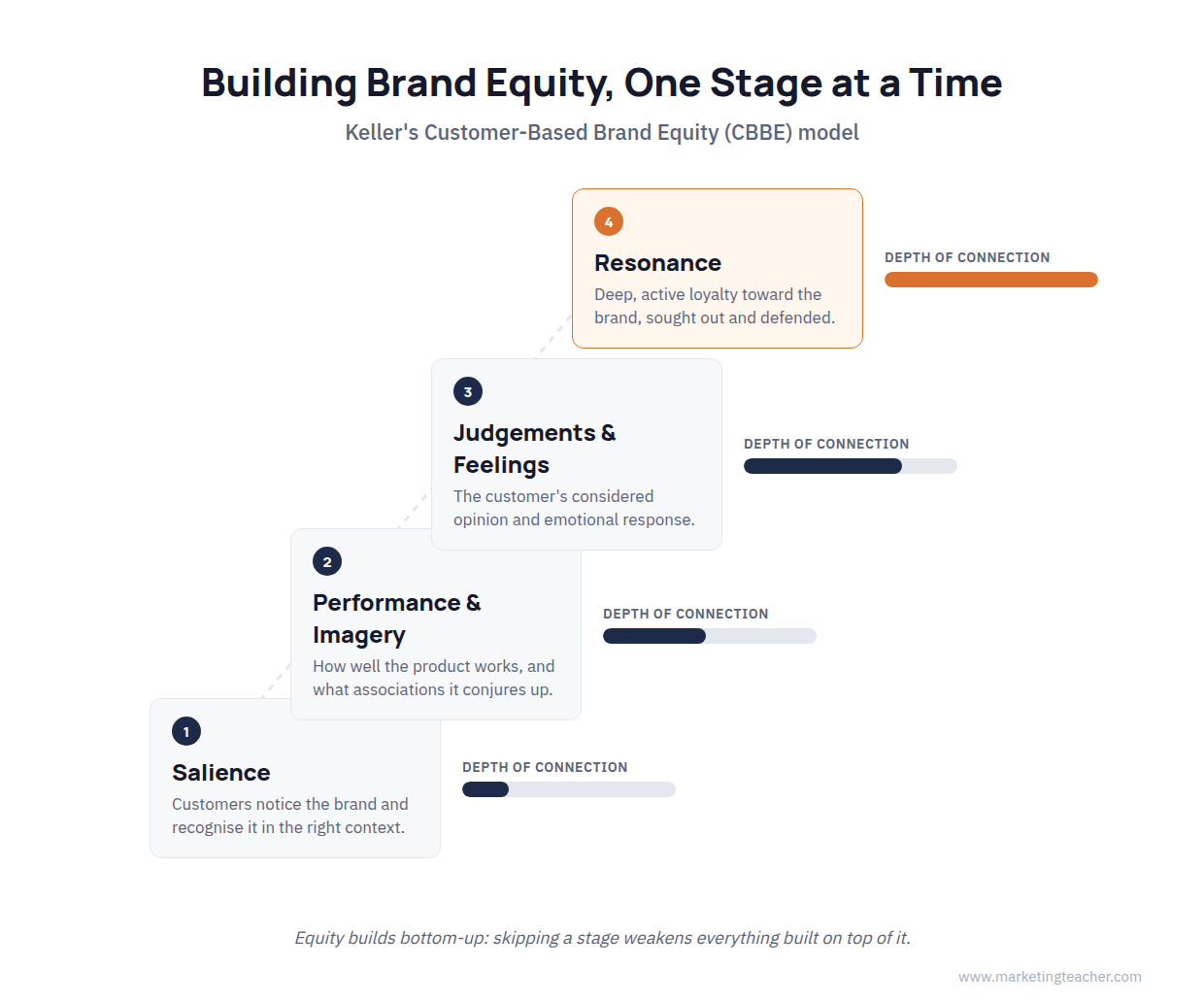
One of the most widely used models for how brand equity gets built is Keller’s Customer-Based Brand Equity (CBBE) model, often shown as a pyramid (Keller, 2001). It argues equity has to be built in a specific order, from the ground up, and that skipping a stage weakens everything built on top of it. The foundation is brand salience: simply making sure customers are aware of the brand and recognise it in the right context. Above that comes brand performance and brand imagery, how well the product actually works and what associations and feelings it conjures up. Above that comes brand judgements and brand feelings, the customer’s considered opinion of the brand and their emotional response to it. At the very top sits brand resonance, a deep, active loyalty where the customer feels a genuine personal connection to the brand and behaves accordingly, seeking it out, defending it, and returning to it without much further persuasion.
The Many Ways “Brand” Gets Defined
Part of what makes branding confusing as a topic is that academics and practitioners define “brand” in genuinely different ways, and de Chernatony and Dall’Olmo Riley (1998) catalogued a dozen distinct interpretations found across the literature. A brand can be treated simply as a logo, a recognisable mark like a company’s symbol. It can be treated as a legal instrument, protected in much the same way as a patent or copyright. It can be treated as the company itself, where the brand and the organisation are effectively the same thing in the customer’s mind. It can be treated as shorthand, a mental shortcut that lets a customer skip a lengthy information search in an unfamiliar category. It can be treated as a risk reducer, reassuring a customer in unfamiliar territory. It can be treated as a personality, a cluster of values, or simply as added value, the extra worth a customer perceives over an equivalent unbranded or generically branded alternative. None of these interpretations is wrong; they simply reflect the different angles from which branding can usefully be studied.
Summary
The slides, worksheet, lesson plan and poster for this lesson are free to download and free to use in your course — no sign-up, no permission needed. See the teacher resources →
Assign this lesson to your class:
Using Canvas, Blackboard or Moodle? Copy the link and paste it into your course page or assignment. More ways to add lessons to your LMS.

