
Why Does Marketing Need Relationships Inside the Business?
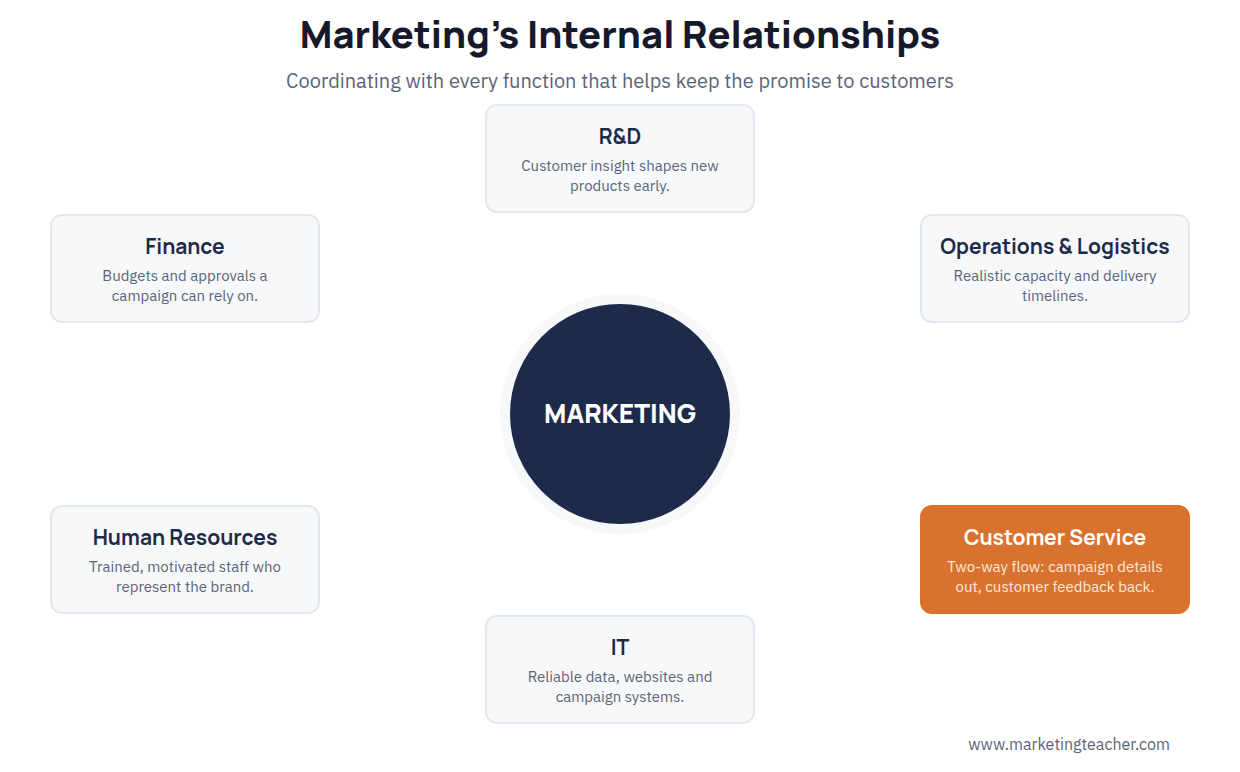
Marketing is often pictured as the department that faces outward, toward customers, competitors and the wider market, but a marketing plan only succeeds if the rest of the business can actually deliver on it. Christopher, Payne and Ballantyne’s (1991) relationship marketing model widens the usual focus on external customers to include internal marketing too, treating internal customers with the same care as external ones: the colleagues in other departments whose cooperation marketing depends on every single day. A promise made to an external customer, faster delivery, a new product feature, a lower price, is really a promise made on behalf of the whole organisation, and it can only be kept if the people responsible for delivery, production and support are aligned with it from the start.
Internal and External Customers
An external customer is the traditional kind: the person or business that buys what the company sells. An internal customer is a colleague or department further along the chain who depends on another department’s work to do their own job well. A salesperson who needs accurate stock information from operations, or a customer service team that needs to know about a promotion before customers start calling about it, is an internal customer of another function. Treating these internal relationships with the same care as external ones, clear communication, realistic promises, genuine responsiveness, tends to produce far smoother delivery to the external customer at the end of the chain.
Marketing’s Key Internal Relationships
Marketing rarely works alone, and coordinating well with several other functions is central to making a plan actually happen. With research and development, marketing brings customer insight to the table early, so that new products are shaped around a genuine gap in the market rather than a solution in search of a problem. With production, operations and logistics, marketing needs realistic answers about capacity and lead times before promising delivery dates or launch volumes it cannot support. With human resources, marketing depends on staff who are properly trained and genuinely motivated to represent the brand consistently, since a mismatch between what marketing promises and how staff actually behave quickly damages trust. With IT, marketing increasingly relies on data systems, websites and campaign tools that need to be reliable and well maintained. With customer service, marketing needs a two-way flow of information: service teams should know what campaigns are running, and marketing should hear what customers are actually saying once a campaign is live.
Setting Objectives That Coordination Can Actually Deliver
Good intentions about working together are not enough on their own; cross-functional relationships work best when they are anchored to clear, shared objectives that everyone involved can actually measure themselves against. The now-standard SMART framework, tracing back to Doran’s (1981) call for specific, measurable, time-bound goals in management writing, gives departments a shared language for this: an objective should be specific enough that everyone understands exactly what is meant, measurable so progress can be tracked, achievable given the resources actually available, realistic in the context of the wider business, and time-bound with a clear deadline. A goal such as “reduce order-to-delivery time” is far weaker than “reduce order-to-delivery time from six days to four days by the end of the quarter,” because only the second version gives operations and marketing a shared, checkable target rather than a vague aspiration.
What Good Coordination Delivers
When internal relationships and shared objectives are both handled well, the benefits show up in fairly concrete ways. Conflict between departments falls, since fewer decisions get made in isolation and then discovered too late by the people who have to implement them. Genuine cooperation rises, because departments that trust each other’s intentions share information more freely rather than guarding it. Costly mistakes, promising a delivery date operations cannot meet, launching a campaign customer service knows nothing about, become rarer. Relationships with external suppliers also tend to improve indirectly, since a business that coordinates well internally is generally easier and more predictable for outside partners to work with too. None of these benefits appear automatically; they are the result of deliberately managing internal relationships with the same seriousness normally reserved for external customers.
When Coordination Breaks Down
The cost of poor internal coordination is usually invisible until something goes wrong publicly. A marketing campaign that launches before the website can handle the extra traffic, or a promotion that promises a discount the finance team has not actually approved, are the kind of failures that trace directly back to a relationship inside the business that was never properly managed. These situations are rarely caused by any one department acting carelessly; they are usually the predictable result of two departments each working toward their own version of success without a shared, specific objective connecting the two. Building the habit of checking assumptions with other departments before committing to external customers is a cheap form of insurance against exactly this kind of failure.
Summary
Christopher, Payne and Ballantyne’s (1991) relationship marketing model reframes colleagues in other departments as internal customers whose cooperation marketing genuinely depends on. Strong relationships with research and development, production, HR, IT and customer service, anchored to clear SMART objectives tracing to Doran (1981), reduce conflict and costly mistakes while making a business easier to work with for outside partners too. A business that manages these internal relationships as carefully as its external ones is far better placed to actually deliver on the promises its marketing makes.
The slides, worksheet, lesson plan and poster for this lesson are free to download and free to use in your course — no sign-up, no permission needed. See the teacher resources →
Assign this lesson to your class:
Using Canvas, Blackboard or Moodle? Copy the link and paste it into your course page or assignment. More ways to add lessons to your LMS.

