
What Is the Long Tail?
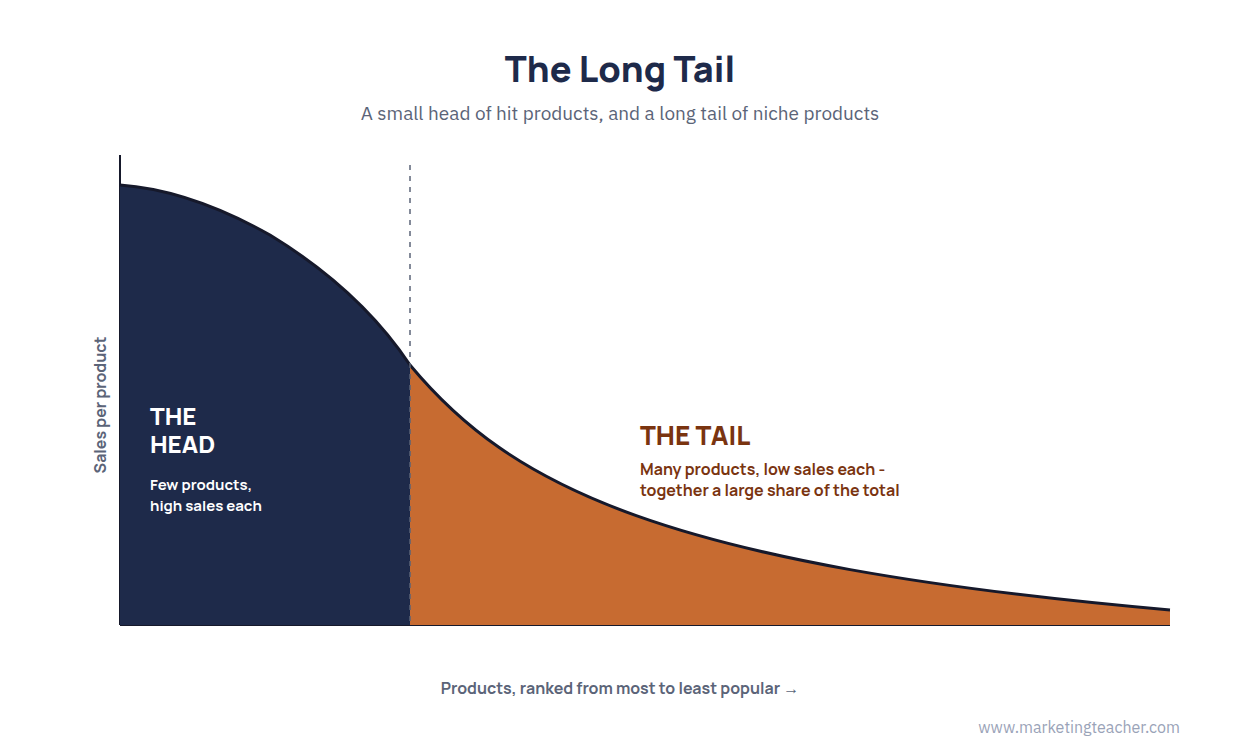
The Long Tail describes a pattern in sales distribution: a small number of very popular “hit” products account for a large share of sales (the short, tall “head” of the curve), while a very large number of niche products each sell in small quantities, but together add up to a substantial share of the total (the long, low “tail”). The term was coined by Chris Anderson in a 2004 Wired magazine article, which argued that businesses built around digital distribution could profitably serve that long tail of niche demand in a way traditional, physically-limited retailers never could (Anderson, 2004). Where a traditional shop has to fill its limited shelf space with whatever sells fastest, an online catalogue faces no such constraint, so it can carry thousands of niche titles that each sell only a handful of copies a year.
Why the Long Tail Became Possible
Three changes made the long tail commercially viable rather than just a curiosity. Digital or centralised distribution removed the shelf-space constraint that forced physical retailers to stock only fast-sellers. Search and recommendation tools made it possible for customers to actually find niche products they would never have stumbled across in a physical shop. And low-cost production and hosting meant a niche product could be made available at very little ongoing cost even if it sold only occasionally. Brynjolfsson, Hu and Smith (2006) studied online retail sales data directly and found that niche, lower-selling titles collectively accounted for a genuinely significant share of total sales – not just a rounding error next to the hits – confirming that the long tail was a measurable commercial effect and not only a plausible theory.
The Long Tail Is Not a Universal Strategy
The long tail works best where the constraint it removes – physical shelf space or another hard capacity limit – was the main thing stopping niche products from being sold profitably before. It matters less for a business whose limits are elsewhere, such as one already selling on-demand or one where customers strongly prefer mainstream choices regardless of what else is available. A long tail strategy also depends on customers actually being able to find niche products, so search and recommendation quality is not a nice-to-have but a precondition for the model working at all – a huge catalogue nobody can search through is not a long tail strategy, just clutter. It is also worth remembering that the long tail is additive rather than a replacement for the head: even businesses built around the concept, such as large streaming or online retail platforms, still rely heavily on a small number of major hits to draw in new customers, with the tail adding incremental revenue on top rather than substituting for it entirely.
Long Tail as a Growth Strategy
The long tail is a useful lens when a business is considering how to grow. In terms of Ansoff’s Matrix, building out a long tail of niche products for an existing customer base is usually a Product Development move – the market is already understood, but the product range widens considerably – and is generally lower-risk than chasing an entirely new market. Because a long tail strategy depends on serving many small, well-defined groups of customers rather than one large uniform market, it works closely alongside Segmentation: a business cannot serve niche demand well without first being clear about what those niches actually are.
Summary
The Long Tail describes how a small number of hit products (the head) and a very large number of niche products (the tail) can each account for a substantial share of total sales, once digital distribution, search, and low-cost hosting remove the shelf-space limits that used to make niche products commercially pointless. It is not a universal strategy – it depends on customers being able to find the niche products on offer – but where it applies, it offers a lower-risk Product Development route to growth, closely tied to how well a business understands its own customer segments.
The slides, worksheet, lesson plan and poster for this lesson are free to download and free to use in your course — no sign-up, no permission needed.

