
What Is Market Segmentation?
Segmentation is the first of the three stages in the segmentation-targeting–positioning (STP) process: identifying subsets of buyers within a market who share similar needs and demonstrate similar buying behaviour, before a business chooses which of those subsets to target and how to position itself within them. Smith (1956) is widely credited with first setting out segmentation as a distinct alternative to treating a market as one undifferentiated whole, arguing that a market is more accurately viewed as a collection of smaller, more homogeneous groups. Kotler and Armstrong (2018) build on this by framing segmentation as the practical starting point for any targeted marketing effort, since a single message or product can rarely serve every buyer equally well. No two markets segment in exactly the same way; segmentation is a form of judgement about where genuine differences in need and behaviour lie, not a fixed procedure with one correct answer. It is also not a one-off exercise: the way a market divides shifts as an offering moves through the product life cycle. Segmentation also matters because marketing resources are always limited: a business that tries to be everything to everyone typically ends up with a message so generic that it persuades no one particularly well, while a business that identifies where real differences in need actually sit can direct its budget, product development and messaging toward the buyers most likely to respond.
The Four Bases of Segmentation
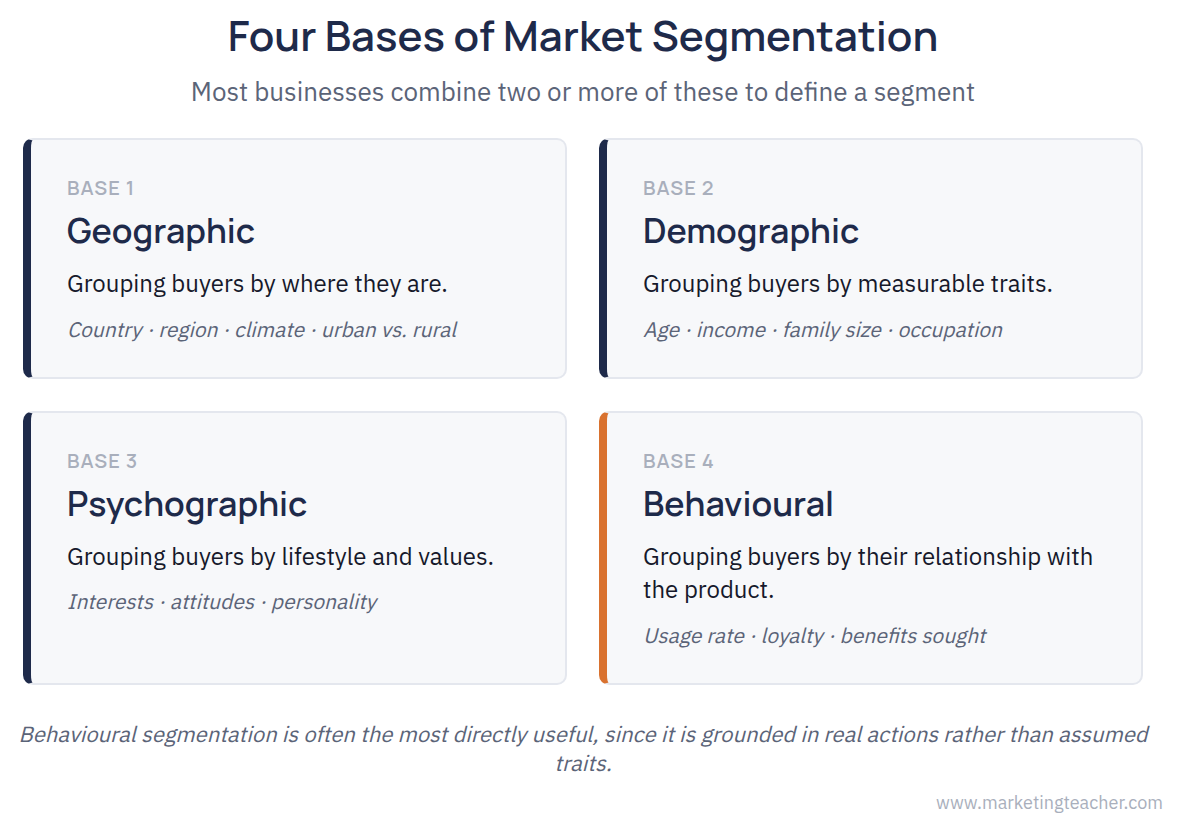
Markets are commonly segmented along four bases. Geographic segmentation groups buyers by location, country, region, climate or urban versus rural, useful wherever needs genuinely differ by place. Demographic segmentation groups buyers by measurable traits such as age, income, family size or occupation, and remains the most widely used base because the data is usually the easiest to obtain and act on. Psychographic segmentation groups buyers by lifestyle, values or personality, capturing differences that demographics alone can miss, two buyers of the same age and income can still want very different things from the same product category. Behavioural segmentation groups buyers by their actual relationship with the product, usage rate, brand loyalty, purchase occasion or the benefits they are seeking, and is often considered the most directly useful base because it is grounded in real behaviour rather than assumed characteristics. Most businesses combine two or more of these bases rather than relying on a single one, since geographic and demographic data alone rarely explain why buyers actually choose one product over another. A useful check when choosing which bases to combine is to ask which variables actually correlate with different buying behaviour for the specific product in question, rather than defaulting to whichever data happens to be easiest to collect.
Testing a Segment: Three Criteria
Not every identifiable group is worth treating as a target segment. Three criteria are commonly used to test a segment before committing resources to it. A segment must be viable, capable of generating a genuine profit once the cost of reaching and serving it is accounted for. It must be accessible, meaning the business can actually reach that group through its existing or realistic marketing and distribution channels. It must also be measurable, meaning the business can obtain reasonably reliable data on its size and potential rather than relying on guesswork. A segment that fails any one of these three tests, however appealing it looks on paper, is usually not worth pursuing as a dedicated target: a group might be large and easy to describe, but if the business cannot reach it affordably or cannot obtain reliable data on it, treating it as a formal segment risks wasting resources that would be better spent elsewhere. Deciding where those resources should go instead is the work of the marketing plan.
Summary
Market segmentation identifies subsets of buyers who share similar needs and behaviour, using geographic, demographic, psychographic and behavioural bases, usually combined rather than used alone. A workable segment must pass three tests, viability, accessibility and measurability, before a business commits resources to it. Segmentation is the first stage of the STP process, setting up the decisions a business makes next about which segments to target and how to position itself within them.

Segmentation, targeting and positioning are three stages of one process — see segmentation, targeting and positioning for how they fit together.
The slides, worksheet, lesson plan and poster for this lesson are free to download and free to use in your course — no sign-up, no permission needed. See the teacher resources →
Assign this lesson to your class:
Using Canvas, Blackboard or Moodle? Copy the link and paste it into your course page or assignment. More ways to add lessons to your LMS.

