
Two Ways to Think About a Sale
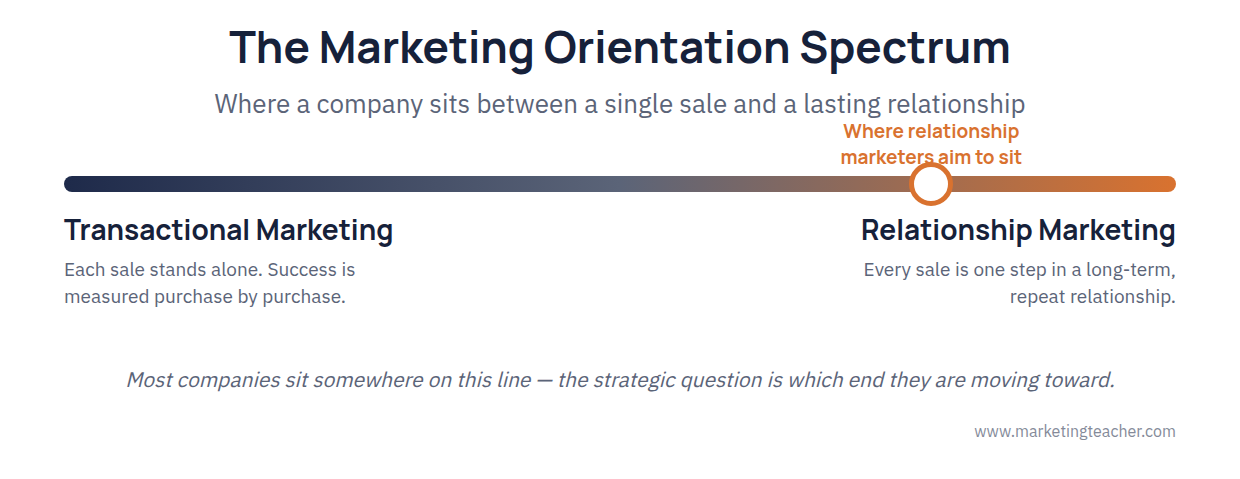
Every business has to decide, whether it states this explicitly or not, what a successful sale actually looks like. One answer treats each sale as a complete, self-contained event: a customer pays, receives a product, and the transaction is finished. This is a transactional marketing orientation. The other answer treats each sale as one step in something longer: the aim is not just today’s payment but a customer who buys again, recommends the business, and stays loyal for years. This is a relationship marketing orientation, and it sits at one end of a spectrum most businesses can be placed somewhere along.
Where This Comes From: Production, Product, Selling and Marketing
Kotler and Armstrong (2018) describe several historical orientations businesses have adopted, and transactional thinking has deep roots in some of the oldest of these. The production concept holds that consumers simply favour products that are widely available and affordable, so management should focus on efficient production and distribution rather than on the customer relationship itself. This approach can still work in some markets, but Kotler and Armstrong warn it risks marketing myopia — a narrow focus on the company’s own operations that loses sight of the real objective, which they describe as satisfying customer needs and building customer relationships. Relationship marketing is, in effect, the deliberate correction to that risk.
The Selling Concept: A Related but Different Trap
A closely related orientation, also described by Kotler and Armstrong (2018), is the selling concept — the belief that customers will not buy enough of a company’s products unless the company undertakes a large-scale selling and promotion effort. Like the production concept, the selling concept is fundamentally transactional: its goal is to close the sale in front of the salesperson, not to build a relationship that survives beyond it. A business practising the selling concept can hit short-term sales targets while quietly damaging its long-term customer relationships, because customers who feel sold to rather than served are unlikely to come back voluntarily.
Why Relationship Marketing Matters More in Some Industries
Relationship marketing is not equally important everywhere, but it tends to matter most where customers have an ongoing, repeated need for a service rather than a single, one-off purchase. Airlines are a classic example: a passenger who is well looked after at check-in, during the flight and afterwards is far more likely to fly the same airline again, especially once loyalty schemes like air miles and status upgrades start rewarding repeat business. The same logic applies to hotels, insurers, subscription services and many business-to-business suppliers, where a single lost sale is rarely the real cost of a poor customer experience — the real cost is every future sale the business never gets the chance to make.
Branding as a Substitute for Face-to-Face Relationships
Not every relationship marketing strategy depends on direct, personal contact. A large consumer brand cannot have a personal relationship with every individual customer, but strong branding, consistent product quality and thoughtful design can produce some of the same loyalty effects that a personal relationship would. A customer who trusts a brand to deliver a consistent experience every time is, in a real sense, in an ongoing relationship with that brand — even without ever speaking to an employee directly. This is why branding, innovation and design are often discussed alongside relationship marketing rather than as a completely separate topic.
The Marketing Orientation Spectrum
The diagram above places transactional and relationship marketing at opposite ends of a single spectrum, rather than treating them as two unrelated categories. Very few real businesses sit at either extreme. The useful strategic question is not “are we transactional or relational?” but “which direction are we actually moving in, and does that match what our customers and our market actually need from us?”
Summary
Marketing and customer relationships are connected through a simple strategic choice: whether a business treats each sale as a complete, standalone event, or as one step toward a longer relationship. Transactional thinking has historical roots in the production and product concepts, but modern marketing generally favours a relationship orientation, particularly in service industries and B2B markets where repeat business is central to profitability. Even the production and selling concepts, both fundamentally transactional in their focus, still shape how some businesses operate today. And brands that cannot build face-to-face relationships with every individual customer can achieve many of the same loyalty effects through consistent branding, product quality and thoughtful design.
The slides, worksheet, lesson plan and poster for this lesson are free to download and free to use in your course — no sign-up, no permission needed. See the teacher resources →
Assign this lesson to your class:
Using Canvas, Blackboard or Moodle? Copy the link and paste it into your course page or assignment. More ways to add lessons to your LMS.

