
Why Marketers Need to Understand Financial Statements
Marketing professionals are sometimes stereotyped as creative people who spend a company’s money without worrying too much about how effectively it is being spent. Whether or not that stereotype is fair, a marketing manager who cannot read a company’s core financial statements is working with one hand tied behind their back, since those statements are exactly where a business’s real spending capacity, past performance and cash position are recorded. Kotler and Armstrong (2018) note that marketing plans are only as credible as the financial reasoning behind them; a campaign that looks compelling on paper but ignores the company’s actual financial position is not a serious plan.
The Balance Sheet
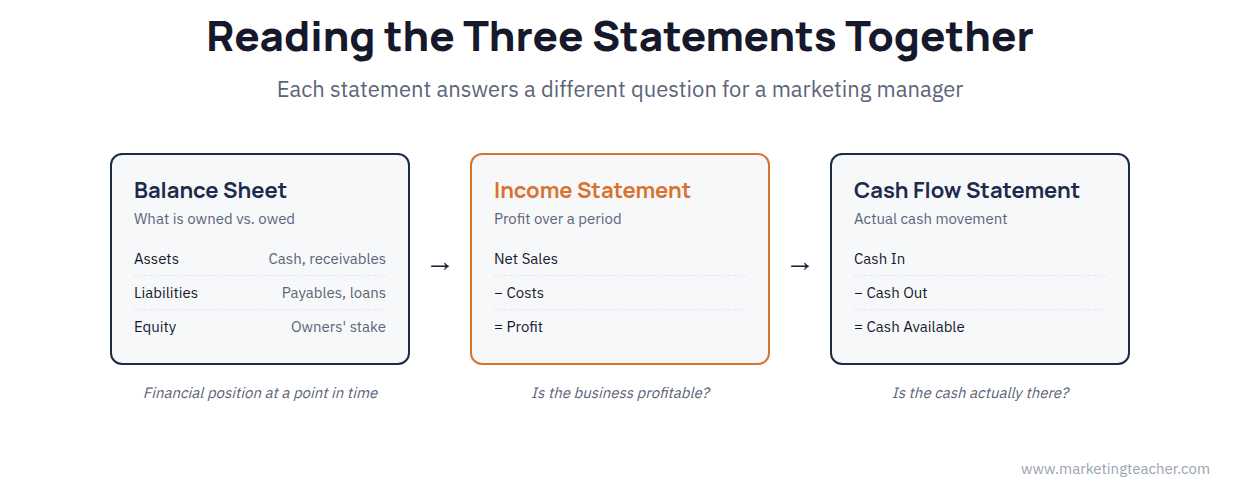
The Balance Sheet lists what a company owns (its assets, cash on hand, accounts receivable, equipment and vehicles among them) against what it owes (its liabilities, accounts payable, loans due within the year, and owners’ equity). In a young or growing company, owners’ equity is often propping up a gap left by slow-paying customers, which is worth knowing before proposing a marketing campaign that assumes plentiful free cash is sitting in the business.
The Profit and Loss (Income) Statement
The Profit and Loss Statement, also called an Income Statement, shows net sales, the cost of goods sold, operating expenses such as rent and payroll, and the resulting profit or loss over a period. Berman and Knight (2013) describe the income statement as the most intuitive of the three core statements for a non-financial manager to start with, because it tells a simple, familiar story: how much came in, how much went out, and what was left over.
The Cash Flow Statement
The Cash Flow Statement tracks the actual movement of cash in and out of a business over a period, which is not the same thing as profit. A company can show a healthy profit on its income statement while still running short of cash if customers are slow to pay or inventory is tying up funds; the cash flow statement is what actually tells a marketing manager whether the money to fund a campaign will be available when the invoices for it come due.
Reading the Statements Together
No single statement tells the full story on its own. The income statement shows whether the business is profitable; the balance sheet shows what it owns and owes at a single point in time; and the cash flow statement shows whether the cash to act on that profitability is actually available. A marketing manager who reads all three together is far less likely to propose a campaign the business cannot actually afford, or to miss an opportunity the numbers would otherwise support.
What the Statements Tell You About Your Marketing Plan
Financial statements can explain marketing outcomes that otherwise look puzzling. A previous advertising campaign that was suddenly scaled back may show up as an inventory shortfall on the balance sheet rather than a change of marketing strategy. A marketing budget that seemed generous on paper may be constrained in practice because owners’ equity is committed elsewhere. Once a business has read its statements, calculating financial ratios, profitability, liquidity and efficiency ratios among them, turns the raw numbers into standardised measures that can be tracked over time or compared against competitors.
Building a Marketing Budget From the Statements
Once a marketing manager understands what the three statements say about the business’s current position, the natural next step is turning that understanding into a marketing budget grounded in real numbers rather than an arbitrary percentage of last year’s spend. A budget built this way starts from the income statement’s net sales and gross margin to see what level of marketing spend the business can realistically support, checks the cash flow statement to confirm the money will be available when campaign invoices actually fall due, and uses the balance sheet to judge whether financing a larger campaign would require drawing down cash reserves the business needs for other purposes. Skipping this step is a common and avoidable mistake: a budget set purely by matching a competitor’s spend, or by simply repeating last year’s figure with a small increase, ignores whatever the statements are actually saying about the business’s current financial position.
Summary
Marketing decisions are ultimately financial decisions, which is why marketing managers need a working understanding of the balance sheet, the profit and loss (income) statement, and the cash flow statement (Kotler and Armstrong, 2018; Berman and Knight, 2013). Reading all three together, rather than relying on sales figures or a single strong quarter, is what lets a marketing manager judge whether a campaign is not just appealing but genuinely affordable.
The slides, worksheet, lesson plan and poster for this lesson are free to download and free to use in your course — no sign-up, no permission needed. See the teacher resources →
Assign this lesson to your class:
Using Canvas, Blackboard or Moodle? Copy the link and paste it into your course page or assignment. More ways to add lessons to your LMS.

