
What Is the Loyalty Ladder?
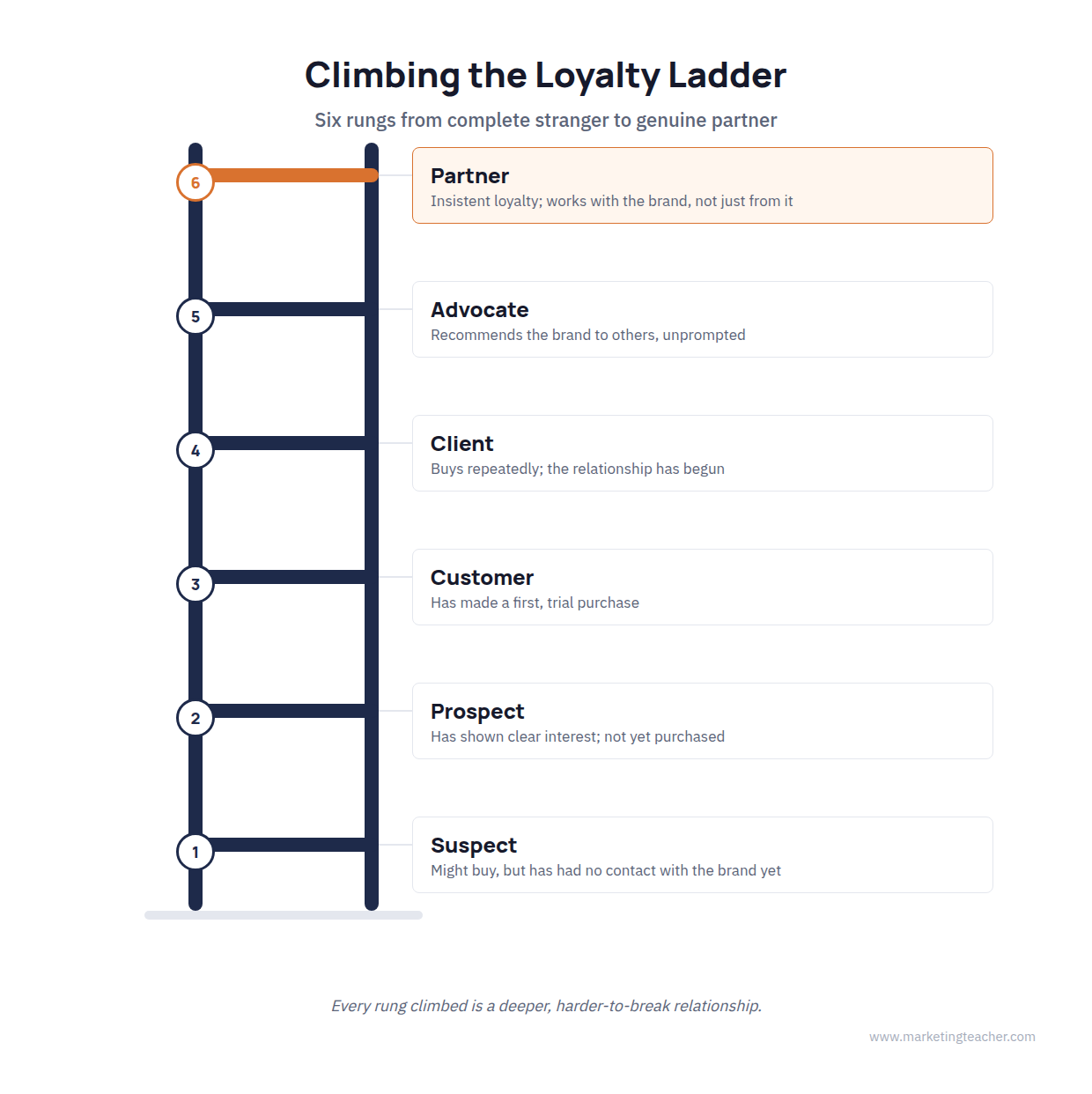
The loyalty ladder is a tool for thinking about customers not as a single group, but as a set of relationships at different stages of depth. The idea, developed by Christopher, Payne and Ballantyne (1991) as part of the wider relationship marketing framework, is that a person can be moved up a continuum from complete stranger to committed partner using deliberately targeted marketing communications at each stage. Every rung represents a real shift in the relationship, not just a bigger discount or a louder advert, and each shift requires a different kind of message.
The Six Rungs, From Stranger to Partner
At the bottom of the ladder is the suspect: someone who fits the target market but has had no contact with the brand at all. Once that person shows real interest, perhaps by visiting a website or requesting information, they become a prospect. The first purchase turns a prospect into a customer, though at this point the relationship is still fragile and easily lost to a competitor. Repeat purchases turn a customer into a client, someone the business can reasonably expect to hear from again. Further up sits the advocate, a client who now recommends the brand to other people without being asked or incentivised to do so. At the very top is the partner, a customer so invested in the relationship that they work with the brand, offering feedback, forgiving occasional mistakes and actively shaping how it improves, rather than simply buying from it.
Why the Climb Is Worth the Investment
Reichheld (1996) showed that the economics of retention are compelling: a customer who stays with a business for longer tends to become more profitable over time, through repeat purchases, reduced price sensitivity, and a lower cost to serve as the relationship matures. This is closely related to the idea of customer lifetime value, since every rung climbed on the loyalty ladder generally increases how much a customer is worth over the full length of the relationship, not just on their next visit. This is also why acquiring a new customer is consistently more expensive than retaining an existing one: a suspect has to be found, persuaded and converted from nothing, while a client already trusts the brand enough to be moved another rung with far less marketing spend.
Moving Someone Up a Rung
Each stage calls for a different communications job rather than one generic campaign repeated at higher volume. Moving a suspect to a prospect is an awareness and targeting problem, best solved with broad-reach advertising or content that answers an early question. Moving a prospect to a customer is a persuasion problem, often solved with a trial, a guarantee, or a low-risk first offer that removes the fear of a bad decision. Moving a customer to a client is a satisfaction and consistency problem: the product or service simply has to deliver on its first promise, repeatedly. Moving a client to an advocate is a delight problem, since people do not recommend brands that merely meet expectations; something has to be memorable enough to talk about. Moving an advocate to a partner is a trust and access problem, usually solved by genuinely inviting the customer into decisions, not by dressing up a loyalty-card tier as a partnership.
Tracking Where Customers Sit on the Ladder
None of this works if a business cannot tell which rung a given customer is actually on, which is why the loyalty ladder is usually paired with some form of customer relationship management (CRM) system rather than used as a purely abstract model. Purchase frequency and recency separate suspects and prospects from genuine customers; repeat-purchase patterns identify clients; referral codes, reviews and social mentions flag advocates who are already promoting the brand unprompted; and sustained, two-way engagement, such as responding to feedback requests or joining a panel, marks out the small group of true partners. Without this kind of tracking, a business risks treating every customer identically, which wastes budget on suspects who are not yet ready to buy and, just as wastefully, under-invests in the clients who are closest to becoming advocates.
Summary
The slides, worksheet, lesson plan and poster for this lesson are free to download and free to use in your course — no sign-up, no permission needed. See the teacher resources →
Assign this lesson to your class:
Using Canvas, Blackboard or Moodle? Copy the link and paste it into your course page or assignment. More ways to add lessons to your LMS.

