
What Is a Marketing Budget?
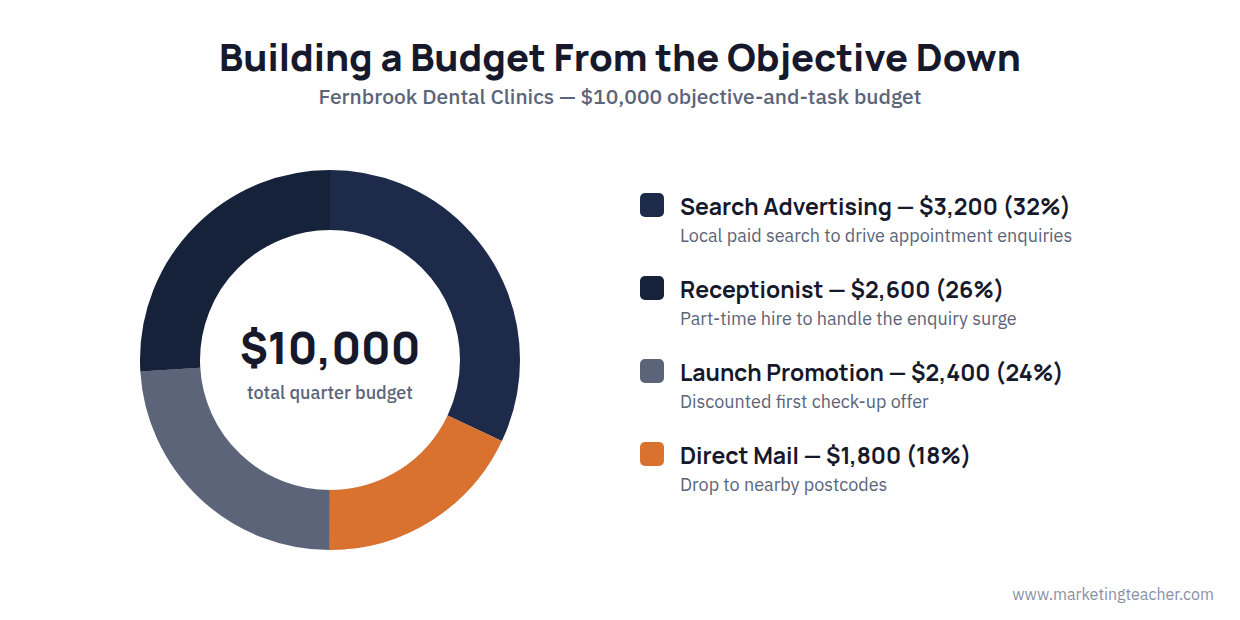
A marketing budget is a marketing plan translated into costs. Kotler and Armstrong (2018) place it inside the wider promotion budget decision every business has to make: having decided what a campaign should achieve, a business still has to decide how much to actually spend achieving it, and a marketing budget is where that decision gets written down and allocated across specific activities. Underfunding a marketing plan is one of the most common reasons an otherwise well-designed campaign fails to deliver, since even the right strategy cannot reach its audience without an honestly costed budget behind it.
Four Ways to Set a Marketing Budget
Kotler and Armstrong (2018) describe four common methods businesses use to arrive at a figure. The affordable method sets the budget at whatever a business believes it can spare once other costs are covered, which is simple but takes no account of what marketing is actually meant to achieve. The percentage-of-sales method sets the budget as a fixed percentage of current or forecast sales, which is easy to apply but treats marketing spend as a result of sales rather than a cause of them. The competitive-parity method sets spending in line with what competitors are believed to spend, which keeps a business from falling conspicuously behind but assumes competitors have already got their own budgeting right. The objective-and-task method works in the opposite direction to the other three: it starts from the specific objectives a campaign needs to achieve, defines the tasks required to achieve them, and estimates the cost of each task, building the budget up from the plan rather than down from an arbitrary figure or last year’s spending.
What Belongs in a Marketing Budget
A marketing budget typically covers two broad categories. General marketing expenses include salaries for marketing managers and support staff, office space and equipment dedicated to the marketing function, and agency commissions. Marketing communications costs cover the more visible, campaign-facing spend: advertising across television, radio, print or digital channels, public relations, website development and hosting, direct marketing, sales promotions, and the printing and design work behind all of it. Most of a marketing budget in practice sits in this second category, since it is where a plan’s strategy actually becomes something a customer can see or hear. A common mistake is treating the general marketing expenses as fixed overhead and only scrutinising the communications spend, when in fact both categories should be reviewed together each budgeting cycle: a business that trims its communications budget every year while its administrative marketing costs quietly grow untouched is not actually becoming more efficient, just less visible to the customers it is trying to reach.
Why Pre-Budget Research Matters
A budget is only as realistic as the research behind it. Industry and market research shows what level of spending is typical for achieving a given result in a particular sector, while competitor analysis shows roughly what rivals are investing and where. A business’s own internal marketing records, the actual return generated by past campaigns, are often the most valuable input of all, since they show what has and has not worked for this specific business rather than the market in general. A marketing audit is a useful place to gather this internal evidence systematically before a budget is set, rather than relying on memory or guesswork about which past campaigns actually paid off. This kind of research also helps a business avoid the two opposite failure modes of budgeting: setting a figure so low that the plan cannot realistically achieve its objectives, or setting one so high that money is spent on activity a smaller, better-targeted budget could have achieved just as well.
Summary
A marketing budget turns a marketing plan into costed reality, and how it is set matters as much as how much it totals (Kotler & Armstrong, 2018). The affordable, percentage-of-sales and competitive-parity methods are all quicker to apply, but the objective-and-task method, building the figure up from what specific objectives actually require, tends to produce a budget that is both more realistic and easier to justify. Pairing that method with genuine pre-budget research, drawn from the market, competitors and a business’s own past performance, is what separates a marketing budget from a guess, and it feeds directly into the wider marketing plan the spending is meant to deliver.
The slides, worksheet, lesson plan and poster for this lesson are free to download and free to use in your course — no sign-up, no permission needed. See the teacher resources →
Assign this lesson to your class:
Using Canvas, Blackboard or Moodle? Copy the link and paste it into your course page or assignment. More ways to add lessons to your LMS.

