
What Is the Marketing Concept?
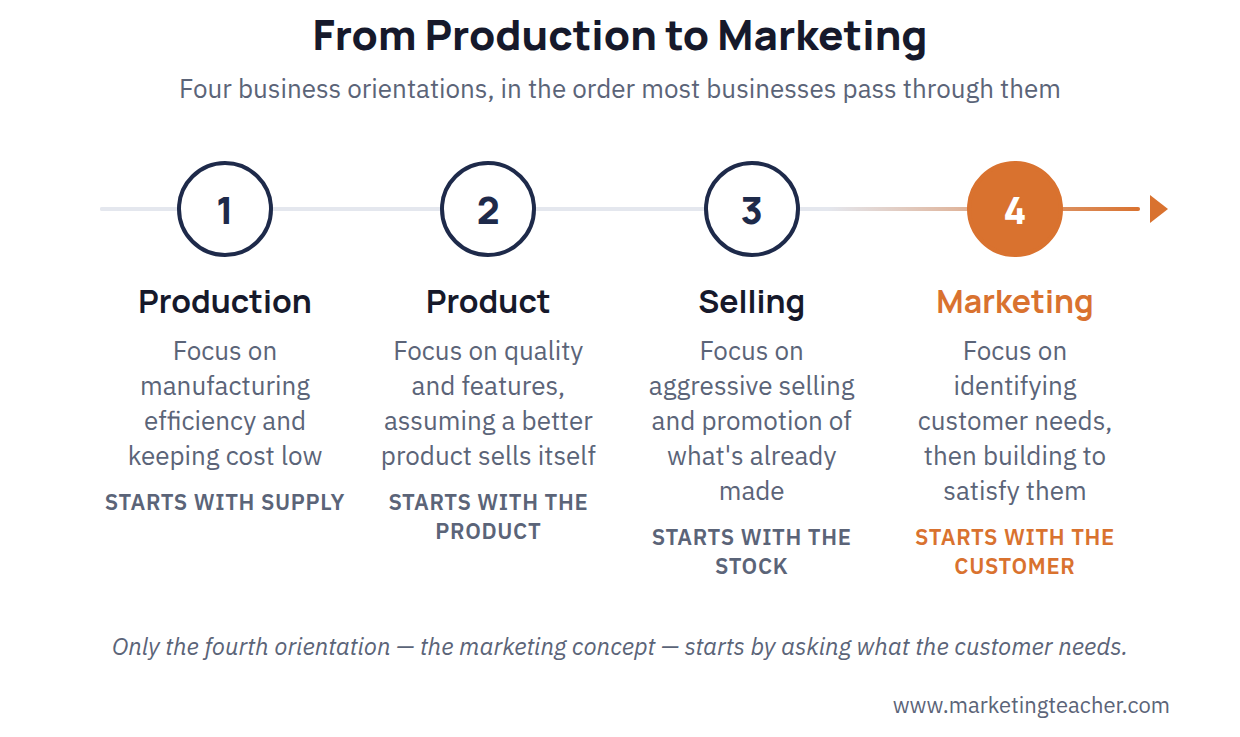
The marketing concept holds that achieving an organisation’s goals depends on knowing the needs and wants of a target market and delivering the desired satisfaction more effectively than competitors do (Kotler and Armstrong, 2018). It is a business philosophy, not a department: rather than starting with what a company already knows how to make and then looking for buyers, a marketing-orientated business starts with the customer’s needs and works backwards to a product, price and service that satisfy them. Peter Drucker made a similar point long before “marketing orientation” became standard vocabulary, arguing that marketing is not a specialised activity at all, but the whole business seen from the point of view of the final result — that is, from the customer’s point of view (Drucker, 1954/2007). Under this view, responsibility for marketing runs through every department of a business, not just the marketing team.
From Production to Marketing: Four Business Orientations
Kotler and Armstrong (2018) describe the marketing concept as the last of four orientations a business typically passes through as markets mature. Under a production orientation, a business assumes customers will favour whatever products are affordable and widely available, so management concentrates on manufacturing efficiency and low cost — a sensible approach when demand outstrips supply, but a risky one once competitors appear. Under a product orientation, the assumption shifts to quality: a business believes customers will choose the product with the best features and performance, so it keeps refining the product without checking whether the market actually wants those improvements. A selling orientation goes a step further and assumes customers will not buy enough unless the business actively sells and promotes what it has already produced, so the priority becomes moving stock that has already been made rather than the customer’s underlying needs. Only the fourth orientation, the marketing concept itself, starts the process the other way round: research what the target market needs first, then design, price and deliver a product to satisfy it better than competitors do.
The Societal Marketing Concept
Kotler and Armstrong (2018) also describe an extension of the marketing concept called the societal marketing concept, which asks a business to balance three things at once rather than just two: consumer wants, the company’s own profit requirement, and society’s long-run interests. A straightforward marketing concept could, in isolation, lead a business to satisfy short-term consumer wants in ways that carry a wider cost. Cheap, heavily packaged snack food is a commonly used example, since it satisfies immediate taste and price preferences while raising longer-run health and environmental concerns. A societally-orientated business still starts from customer needs, but designs products, packaging and messaging with those wider consequences in view from the outset, rather than treating them as a problem to manage later.
Why the Marketing Concept Still Matters
None of this makes the earlier orientations obsolete in every situation. A business facing a genuine supply shortage still has good reason to focus on production efficiency, and a strong product genuinely can sell itself for a while. What the marketing concept changes is the default starting point for decisions across the whole business, from product development through pricing to customer service. Instead of asking how to sell more of what it already makes, a marketing-orientated business asks what the market needs and how to build that. That shift in starting question, more than any single technique, is what separates a business that merely does some marketing from one that is genuinely marketing-orientated.
A useful test is to look at where new-product ideas actually come from inside a business. In a production- or product-orientated company, ideas mostly originate in the factory or the design department, and marketing’s job is to find buyers afterwards. In a marketing-orientated company, ideas are expected to originate in customer research, complaints, reviews and unmet needs, and the factory’s job is to turn those findings into something buildable. Neither department disappears under the marketing concept; what changes is which one goes first.
Summary
The marketing concept holds that a business achieves its goals by identifying what a target market needs and satisfying it better than competitors do, rather than by pushing whatever it already produces. It is the last of four orientations — production, product, selling and marketing — and its societal extension adds a wider duty to balance consumer wants against society’s longer-run interests. Understanding it is the starting point for topics covered elsewhere on this site, including the marketing environment a business operates in and the marketing mix it designs once it knows what a market actually wants.

The slides, worksheet, lesson plan and poster for this lesson are free to download and free to use in your course — no sign-up, no permission needed. See the teacher resources →
Assign this lesson to your class:
Using Canvas, Blackboard or Moodle? Copy the link and paste it into your course page or assignment. More ways to add lessons to your LMS.

