
Learning outcome
Who Does Marketing?
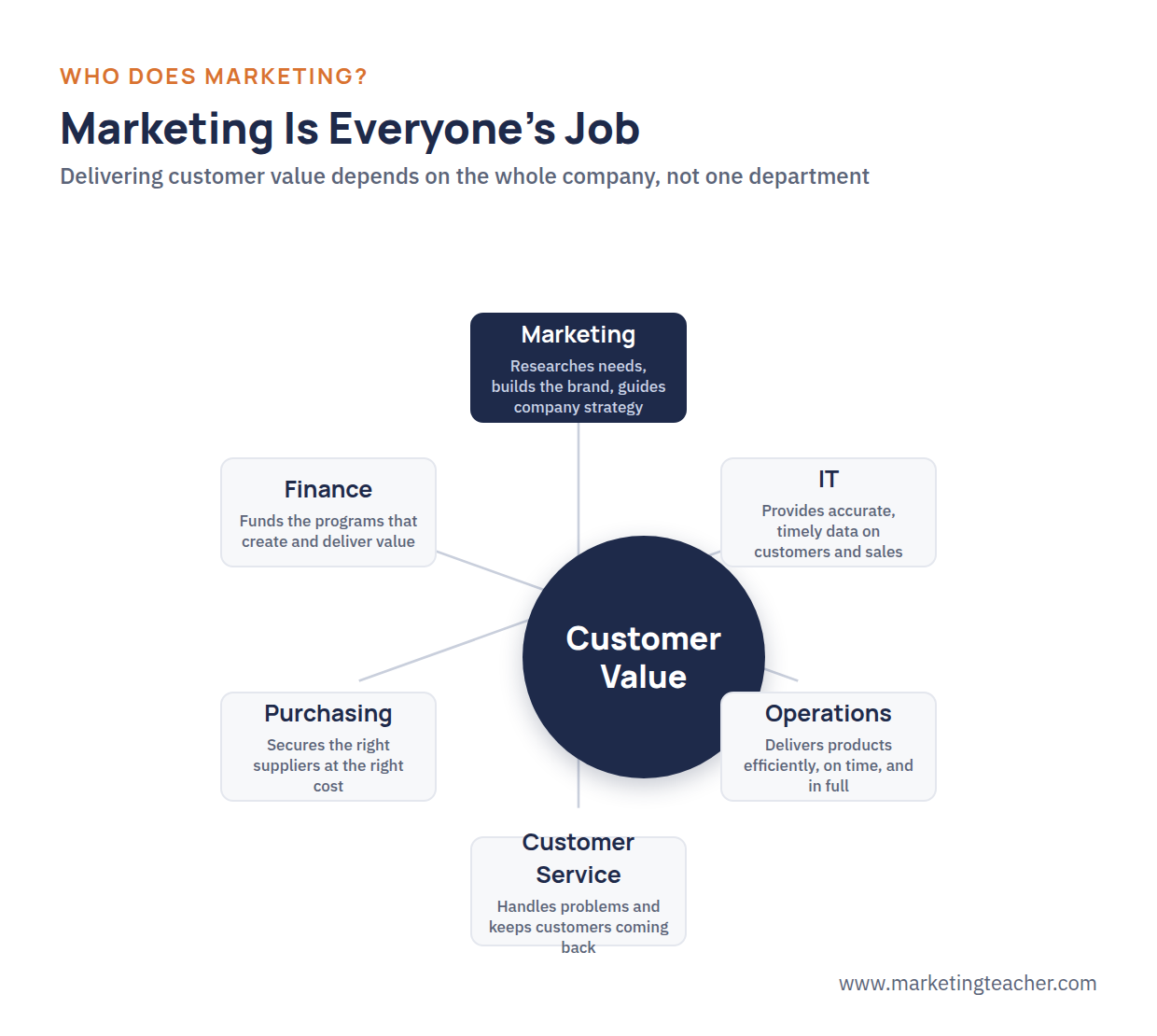
Ask most people who “does marketing” at a company, and they’ll point straight to the marketing department: the people who write the ads, run the social media accounts, and design the packaging. That’s not wrong, but it’s incomplete. A company’s marketing department can plan a brilliant campaign, but if purchasing buys the wrong materials, if operations ships orders late, or if customer service handles complaints poorly, the customer’s actual experience of the brand falls apart (Kotler & Armstrong, 2018). Delivering real customer value takes the whole organization working together, which means, in a very real sense, marketing is everybody’s job.
More Than a Marketing Department
Every department in a company can be thought of as a link in an internal value chain: a series of departments that each carry out the work of designing, producing, marketing, delivering, and supporting the company’s products (Kotler & Armstrong, 2018). A company’s success depends not only on how well each department performs its own job, but on how well those departments coordinate with each other. Marketing plays a leading role in this chain by championing the customer’s point of view, but marketing alone cannot create customer value. It needs purchasing to secure the right suppliers at the right cost, it needs information technology to provide accurate, timely data, and it needs operations to deliver products efficiently and reliably. When departments work in harmony, the customer experiences a smooth, satisfying relationship with the brand. When they don’t, customers notice.
In practice, this coordination is rarely as tidy as it sounds. Interdepartmental relations are often full of friction, because each department tends to see the business through its own lens. Marketing takes the consumer’s point of view, and when it pushes for changes that improve customer satisfaction, it can end up making life harder for other departments in the short term. A marketing push for more product variety, for example, can raise purchasing costs, complicate production schedules, and inflate inventory, which is exactly why other departments sometimes resist marketing’s requests. Getting every department to genuinely “think consumer” rather than just tolerate marketing’s demands is an ongoing challenge, not a one-time fix.
True Value Hardware built an entire advertising campaign, “Behind Every Project Is a True Value,” around this exact idea. Rather than only featuring professional marketers, the campaign’s print ads put the spotlight on a marketing research analyst and an operations manager side by side, both credited with helping deliver “the value of getting the products to the people.” The message was direct: from the people who study what customers need to the people who make sure products actually reach nearly 3,500 independently owned True Value stores, everyone in the organization contributes to the value customers feel. As one marketing expert summed it up, “Engaging customers today requires commitment from the entire company. We’re all marketers now.”
Marketing as a Career
Within that company-wide effort, plenty of people do hold marketing as their actual job title and career path, and the field offers more ways to specialize and credential yourself than most people expect. The American Marketing Association (AMA), one of the profession’s leading organizations, operates more than 65 local chapters across the country, giving students and working marketers a way to network, find mentors, and compete in real-world marketing case competitions (OpenStax, 2023). The AMA has also partnered with the Digital Marketing Institute to offer specialized certifications for marketers who want to stand out in a crowded job market. Beyond the AMA, aspiring marketers can build credentials through free courses and certificates from platforms like Google Analytics, HubSpot Academy, and LinkedIn Learning, covering everything from digital advertising to customer relationship management. A career in marketing, in other words, isn’t limited to a single job description; it spans research, strategy, digital advertising, branding, and analytics, each with its own professional path.
Marketing Partners With the Wider System
Marketing’s job doesn’t stop at the edge of the company, either. To create real value, a business also has to look beyond its own walls and into the value chains of its suppliers, distributors, and business partners. Consider McDonald’s: customers don’t swarm to McDonald’s locations purely because they love a particular burger. They come back because McDonald’s entire system, franchisees, suppliers, and corporate marketers together, reliably delivers on a consistent standard of quality, service, cleanliness, and value. That system only works because McDonald’s successfully partners with thousands of independent franchise owners and suppliers to jointly create the experience customers expect, no matter which location they visit.
Summary
Marketing is often pictured as the exclusive work of a marketing department, but real customer value depends on far more people than that. Every department inside a company, from purchasing to IT to operations, plays a role in the internal value chain that shapes what customers actually experience. At the same time, a growing profession of dedicated marketers builds specialized careers through organizations like the AMA and a wide range of certifications. And beyond the company’s own walls, marketers partner with suppliers, distributors, and franchisees to compete as part of a larger value delivery network. Who does marketing? In a meaningful sense, everyone connected to delivering value to the customer does.
Quiz

The slides, worksheet, lesson plan and poster for this lesson are free to download and free to use in your course — no sign-up, no permission needed.

