
What Does It Mean to Make Sustainability a Core Brand Value?
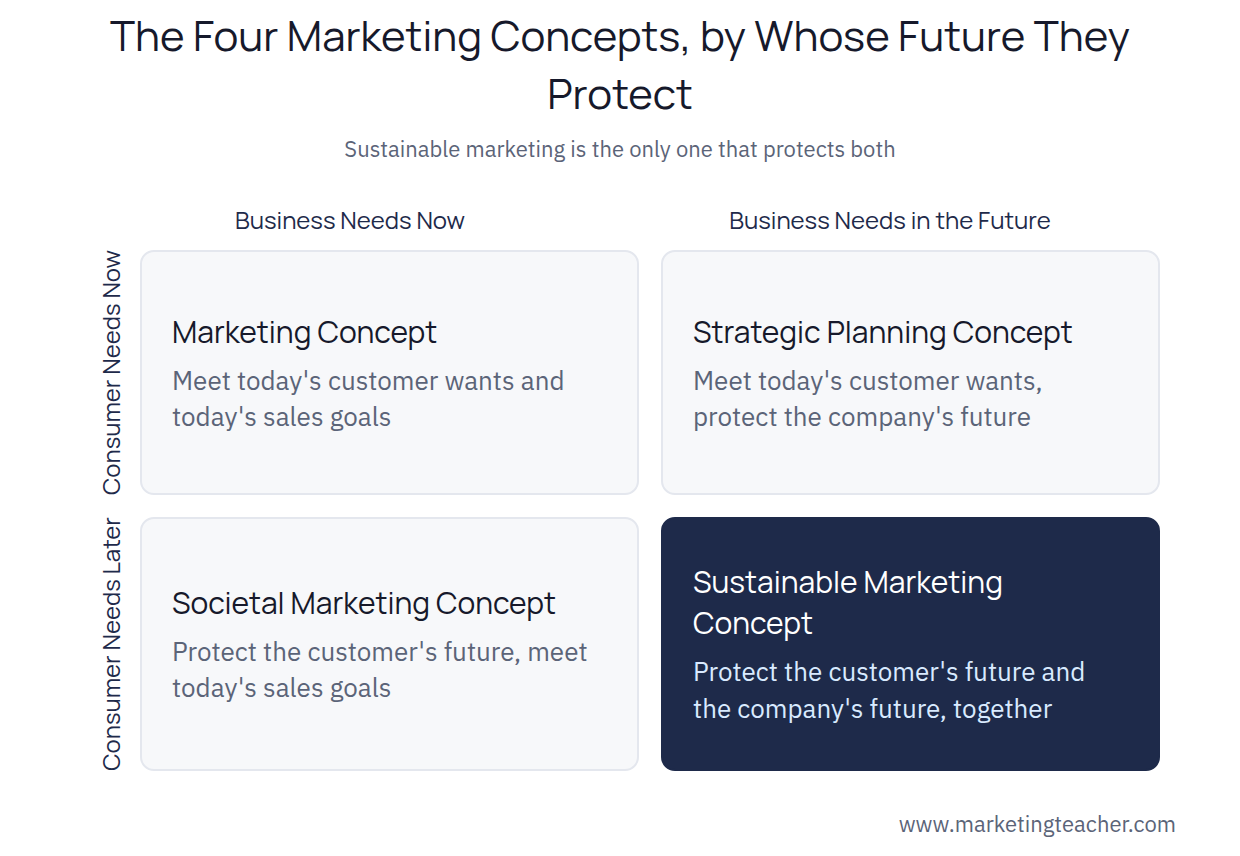
A brand that treats sustainability as a core value doesn’t just run occasional environmental campaigns — it builds social and environmental responsibility into how it makes ordinary business decisions, alongside price, quality and service. Kotler and Armstrong (2018) define this broader idea as sustainable marketing: marketing that meets the present needs of consumers and businesses while also preserving or enhancing the ability of future generations to meet their own needs. The core value only becomes real once it shapes the decisions a brand actually makes, not just the language it uses to describe itself.
Four Ways to Think About Whose Needs Marketing Serves
Kotler and Armstrong (2018) contrast sustainable marketing with three narrower ideas a brand could instead adopt. The plain marketing concept focuses on satisfying customers’ current wants and the company’s current sales goals — a valid starting point, but one that can quietly trade away the future of either side. The societal marketing concept adds a concern for consumers’ long-term welfare, while the strategic planning concept adds a concern for the company’s own long-term health. Sustainable marketing is the combination of both: a brand pursuing it protects the future interests of its customers and its own future at the same time, rather than treating one as the price of the other.
Why “Meeting Today’s Wants” Isn’t Automatically Sustainable
Kotler and Armstrong (2018) use the case of early fast-food strategy to make the distinction concrete: tasty, fat- and salt-laden menus satisfied customers’ immediate desires and delivered strong sales, but critics linked the pattern to long-term public health costs, and the resulting shift in consumer preference eventually hurt the same companies’ sales. A strategy can succeed by every short-term measure a business tracks and still fail the sustainability test, because it quietly borrows against a future that arrives later, for the customer or for the company itself.
What Businesses Actually Do to Make It Real
Kotler and Armstrong (2018) describe sustainable marketing as depending on a functioning system in which consumers, companies and policymakers all play a part, but the business side of that system has specific, checkable actions: redesigning products and packaging to reduce environmental impact, being transparent about sourcing and supply chains, and setting public, measurable commitments rather than vague pledges. A brand’s sustainability claim is only as credible as the specific action behind it — a stated commitment to “using less packaging” invites a follow-up question (how much less, verified how, by when) in a way a general claim of “caring about the planet” does not.
The Risk of Sustainability as Marketing Language Only
The gap between stated values and actual practice is where sustainability claims most often lose customer trust. A brand that markets itself as sustainable while making no real changes to sourcing, packaging or supply chain practices is exposed the moment a customer, journalist or competitor checks the claim against the evidence — and unlike a straightforward product complaint, a credibility failure on values tends to attach to the whole brand rather than one transaction. Treating sustainability as a genuine constraint on decisions, not a tagline layered on top of them, is what keeps the core value from becoming a liability.
Sustainability Reaches Every Part of the Marketing Mix
Treating sustainability as a core value tends to touch far more of a business than its advertising. Product decisions shift toward durability, recyclability or lower-impact ingredients, sometimes at higher unit cost. Pricing has to account for that cost honestly rather than absorbing it invisibly or passing it on without explanation. Place and distribution choices affect the size of a supply chain’s own environmental footprint, from shipping distances to packaging waste. Promotion is the part most visible to customers, but it is also the easiest to get wrong: a promotional claim that outruns what the rest of the mix can actually support is exactly the gap that damages trust once it’s noticed. A brand serious about the value works through all four areas together, not just the one customers see first.
Summary
Making sustainability a core brand value means going beyond satisfying today’s customer wants and today’s sales targets, to also protect the future interests of customers and the company itself — what Kotler and Armstrong (2018) call sustainable marketing. It sits apart from the narrower marketing concept, societal marketing concept and strategic planning concept by addressing both sides of that future at once. The test of whether a brand has actually done this lies in specific, checkable business decisions — sourcing, packaging, transparency — rather than in the language used to describe them, since a sustainability claim unsupported by real practice tends to damage trust in the whole brand once it’s checked against the evidence.
The slides, worksheet, lesson plan and poster for this lesson are free to download and free to use in your course — no sign-up, no permission needed. See the teacher resources →
Assign this lesson to your class:
Using Canvas, Blackboard or Moodle? Copy the link and paste it into your course page or assignment. More ways to add lessons to your LMS.

