
What Do Data Privacy Regulations Actually Require?
Data privacy regulation sets rules for how a business collects, uses, and stores personal information about the people it markets to, separate from data security, which is about keeping that same data safe from unauthorised access or breaches. The EU’s General Data Protection Regulation, GDPR (Regulation (EU) 2016/679, 2016), is the most influential example, and its core principles recur, in some form, across most regulations that followed it: a business needs a genuine, informed basis for collecting personal data in the first place, should collect only what a specific purpose actually requires rather than gathering data speculatively for later use, and must keep what it does hold accurate and reasonably secure. Cavoukian (2009) frames this as a design question rather than a compliance afterthought: her “Privacy by Design” principles argue that privacy protections should be built into a product or campaign from the outset, not bolted on once a regulator raises a concern, since retrofitting privacy into an existing system is consistently more difficult and more error-prone than designing for it from the start.
The Regulations a Global Marketer Should Know
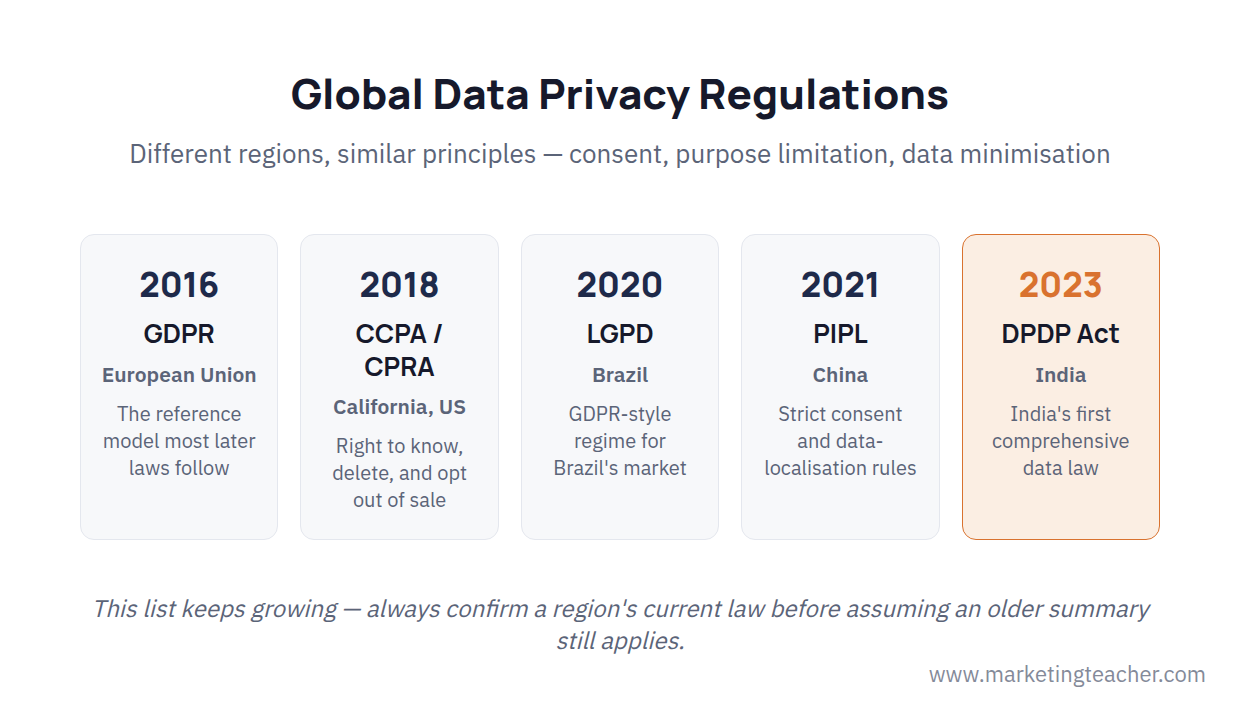
The GDPR applies not only to businesses based in the EU but to any organisation, anywhere, that processes the personal data of EU residents, which is why it shaped global practice well beyond Europe’s own borders. In the United States, California’s Consumer Privacy Act, since substantially expanded by the California Privacy Rights Act (California Civil Code, 2018, as amended), gives California residents specific rights, including the right to know what data a business holds on them and the right to opt out of its sale, and several other US states have since passed similar laws of their own. India’s Digital Personal Data Protection Act, passed in 2023, brings a large, fast-growing digital market under its own comprehensive data protection regime for the first time, following broadly similar consent-and-purpose principles to the GDPR. Brazil’s Lei Geral de Proteção de Dados and China’s Personal Information Protection Law follow the same general pattern in their own regions. A business marketing to customers in more than one of these regions needs to treat this as a genuinely layered compliance picture, since meeting the requirements of one regulation does not automatically satisfy another.
What Non-Compliance Actually Costs
Regulators under these laws can issue fines calculated as a percentage of a company’s global revenue rather than a small fixed penalty, which is what makes non-compliance a board-level financial risk rather than a narrow legal technicality. Beyond the direct fine, a publicised data privacy failure tends to damage customer trust in a way that outlasts the financial penalty itself, since a data breach or a heavy-handed regulatory finding becomes a lasting part of how a brand is perceived. Many regulations, GDPR among them, also require a business above a certain size, or handling certain categories of data, to appoint a named Data Protection Officer responsible for compliance, giving accountability a specific owner inside the organisation rather than leaving it diffused across departments.
Building Compliance Into Everyday Practice
A practical starting point is a data inventory: a clear record of what personal data a business actually collects, where it is stored, and how it flows between systems and teams, since a business cannot properly protect or govern data it cannot first account for. From there, applying Cavoukian’s design principle in practice usually means reviewing new marketing tools, forms, and campaigns for privacy implications before launch, rather than treating a privacy review as a final check once a campaign is already built. Ongoing staff training matters too, since a policy sitting in a compliance document has little effect if the people running day-to-day marketing activity are not aware of what it actually requires of them in practice. Because regulations in this area continue to be updated and new ones continue to be introduced, revisiting this compliance picture on a regular schedule, not only when a new market launch forces the question, is what keeps a business ahead of the requirement rather than reacting to it after the fact.
Summary
Data privacy regulations govern how a business collects, uses, and stores personal information, and the GDPR’s principles of consent, purpose limitation, and data minimisation have shaped most of the regional laws that followed it, from California’s CCPA/CPRA to India’s DPDP Act. Non-compliance carries real financial and reputational cost, calculated in some regulations as a share of global revenue rather than a fixed penalty. Cavoukian’s Privacy by Design approach offers a practical response: build privacy into marketing systems and campaigns from the outset, supported by a clear data inventory and regular staff training, rather than treating compliance as a one-off reaction to a specific market launch or regulatory scare.
The slides, worksheet, lesson plan and poster for this lesson are free to download and free to use in your course — no sign-up, no permission needed. See the teacher resources →
Assign this lesson to your class:
Using Canvas, Blackboard or Moodle? Copy the link and paste it into your course page or assignment. More ways to add lessons to your LMS.

