
What Do We Mean by “Marketing”?
Marketing is often reduced to advertising or selling, but that undersells what it actually is. Kotler and Armstrong define marketing as the process by which companies create value for customers and build strong customer relationships in order to capture value from customers in return (Kotler & Armstrong, 2018). Selling and advertising are just two of the tools marketing uses — the real work starts much earlier, with understanding what customers actually need. This lesson looks at the concepts that sit underneath every marketing decision: the difference between a need, a want, and a demand, what makes an exchange happen at all, and why the goal is rarely a single sale.
Needs, Wants, and Demands
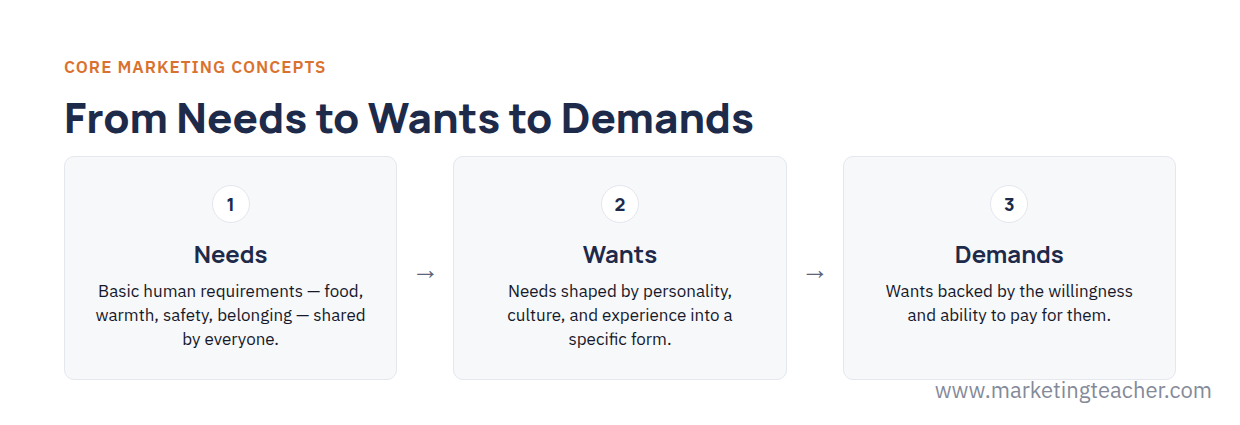
Marketing begins with human needs: the basic requirements for food, clothing, warmth, safety, belonging, and self-expression that every person has, marketer or not (Kotler & Armstrong, 2018). Needs become wants when they are shaped by a person’s individual personality, culture, and experience — everyone needs food, but a customer in Naples might want a wood-fired pizza while a customer in Bangkok wants a bowl of noodles. Wants become demands when a customer has the willingness and ability to pay for what they want. A business cannot invent a genuine need out of nothing, but it can shape how a want is expressed, and it can turn a want into a demand by making its product affordable and easy to buy.
Value, Satisfaction, and Exchange
Customers form expectations about the value and satisfaction a product will deliver, and they buy accordingly. Value is the customer’s estimate of a product’s overall capacity to satisfy their needs, weighed against what they give up to get it — money, time, and effort (Kotler & Armstrong, 2018). A product that delivers less value than expected leaves a customer dissatisfied and unlikely to return; a product that delivers more than expected builds the kind of satisfaction that turns a one-off buyer into a repeat customer.
This exchange — giving up something of value to receive something of value in return — is the concept that underlies every marketing transaction. For an exchange to happen, at least two parties must each have something the other values, be able to communicate and deliver it, and be free to accept or reject the offer. Marketing exists to make that exchange more likely: by understanding what a target market values, and shaping a product, price, and message around it.
Marketing as Relationship-Building, Not a One-Off Sale
Modern marketing rarely stops once a single exchange is complete. Businesses that treat every purchase as a one-off transaction miss the far larger opportunity of a long-term customer relationship, built through consistently delivering value over time (Kotler & Armstrong, 2018). A customer who has a good experience once is a sale; a customer who has a good experience repeatedly is a source of steady, predictable revenue, word-of-mouth recommendations, and useful feedback — which is why so much of modern marketing practice, from loyalty programs to customer service, is built around keeping a relationship going rather than closing a single deal.
Why the Distinction Matters in Practice
Confusing a want with a need is a common way marketing goes wrong. A business that assumes its own product is what customers “need” — rather than one way of meeting a broader underlying need — tends to miss the competitors solving the same need differently. A rail operator that defines its need as “train travel” can be blindsided by a coach company or a low-cost airline solving the same underlying need — getting from one city to another — in a completely different way. Defining the need broadly (getting from A to B) rather than narrowly (riding this specific train) is what keeps a business looking at the right competitors and the right opportunities, instead of only at other train operators.
Summary
Marketing starts with a genuine human need, which is shaped by culture and personality into a want, and becomes a demand once a customer can and will pay for it. Every exchange depends on both sides valuing what the other offers, and the value a customer perceives — weighed against the cost, time, and effort of buying — determines whether they are satisfied enough to return. Because a repeat customer is worth far more than a single sale, modern marketing is built around sustaining that relationship, not just winning the first transaction.

The slides, worksheet, lesson plan and poster for this lesson are free to download and free to use in your course — no sign-up, no permission needed. See the teacher resources →
Assign this lesson to your class:
Using Canvas, Blackboard or Moodle? Copy the link and paste it into your course page or assignment. More ways to add lessons to your LMS.

