
What is segmentation, targeting and positioning?
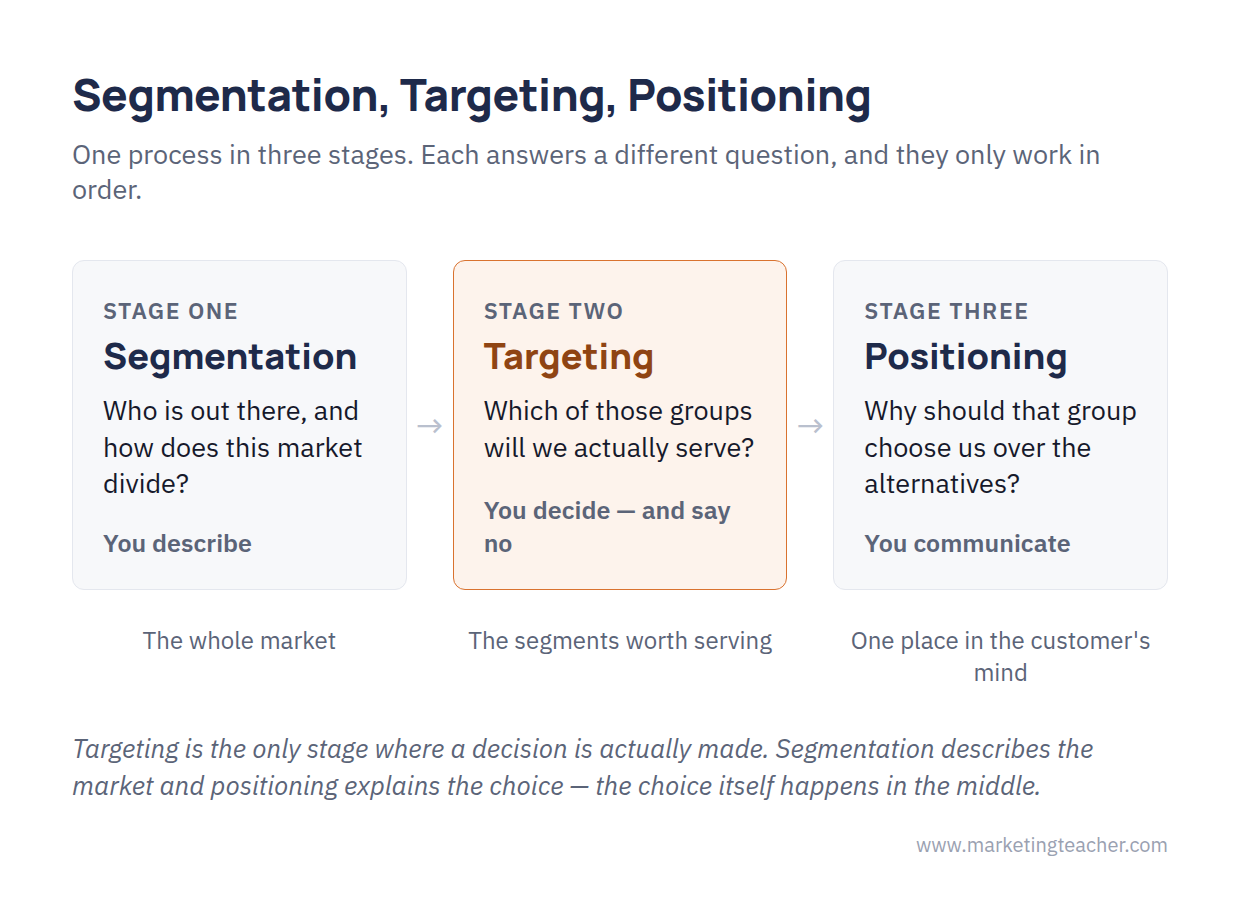
Segmentation, targeting and positioning — usually shortened to STP — is the process by which a company decides who it is for. It runs in three stages. First the market is divided into groups of buyers who want different things. Then the company chooses which of those groups it will serve. Finally it decides what it wants to mean to those buyers, relative to everyone else competing for them.
The three stages are often taught separately, and that is where students lose the thread. They are one argument. Segmentation without targeting is a description nobody acts on. Targeting without segmentation is a guess. Positioning without either is advertising aimed at everybody, which reaches nobody in particular.
Stage one: segmentation
Segmentation divides a market into groups whose members want broadly similar things and respond to marketing in broadly similar ways. Wendell Smith (1956) set out the idea in its modern form, distinguishing it from product differentiation: differentiation changes how a product is presented to the whole market, while segmentation accepts that the market is not one thing and never was.
Markets are usually divided on four bases — geographic, demographic, psychographic and behavioural — and the useful ones are rarely the obvious ones. Age and income are easy to measure and often explain very little; what a buyer is trying to achieve usually explains more. A segment is only worth having if it is measurable, accessible, substantial and actionable: you must be able to find it, reach it, make money from it, and do something different for it.
The full lesson, with the four bases and the tests, is at market segmentation.
Stage two: targeting
Targeting is the choice. Having described the market, the company decides which segments it will serve and, by implication, which it will not. This is the only stage where anything is actually decided, and it is the stage companies most often fudge — naming a target segment while continuing to sell to everyone who will buy.
There are four broad approaches. Undifferentiated marketing ignores the segments and offers one thing to the whole market. Differentiated marketing serves several segments with a distinct offer for each. Concentrated marketing commits to one segment and tries to own it. Micromarketing tailors down to the local area or the individual customer.
The choice depends on the company’s resources, how varied the market really is, and what competitors are already doing. A small company that picks differentiated marketing usually ends up doing several things badly. The full lesson is at market targeting.
Stage three: positioning
Positioning is what the company wants to occupy in the customer’s mind, relative to the alternatives. Ries and Trout (1981) made the point that positioning is not something you do to a product but something you do to the mind of the prospect — and that the mind has limited room, so a position is taken at somebody else’s expense.
A position is normally expressed as a claim the company can defend: a benefit, a price and quality combination, a use occasion, or a comparison with a named competitor. It is tested with a positioning map, plotting the alternatives on the two dimensions customers actually use to choose, and looking for a defensible space that somebody wants to occupy. The full lesson is at positioning.
Why the order matters
Each stage narrows the one before it, and skipping a stage shows up later as a decision nobody can justify. A company that positions before targeting ends up with a claim that appeals to a segment it has not decided to serve. A company that targets before segmenting picks its customers from habit rather than evidence — usually the customers it already has, which is how a business ends up defending a shrinking market it never chose.
The output of STP is also the input to everything downstream. The marketing mix is where the position gets built: the product specified, the price set, the channels chosen and the message written. A mix assembled without a position is a series of unrelated decisions, and it usually looks like one.
Where STP goes wrong
Three failures account for most of it. The first is segmenting on what is easy to measure rather than what explains buying behaviour, which produces neat groups that behave identically. The second is refusing to say no — naming a target while serving anyone who arrives, so the position never becomes true. The third is treating STP as a one-off exercise. Markets re-divide as offerings move through the product life cycle, and a segmentation that described the market three years ago may now describe nothing.
It is also worth saying that STP is a planning framework, not a discovery method. It tells you how to organise a decision. It does not tell you what customers want, and no amount of process substitutes for asking them (Kotler and Armstrong, 2018).
Summary
Segmentation, targeting and positioning is one process in three ordered stages. Segmentation divides the market into groups that want different things; targeting chooses which of those groups to serve and which to decline; positioning decides what the company will mean to the chosen group, relative to the alternatives. The order matters because each stage narrows the last, and the output feeds directly into the marketing mix. The hard stage is the middle one, because it is the only one that requires the company to give something up.
The slides, worksheet, lesson plan and poster for this lesson are free to download and free to use in your course — no sign-up, no permission needed.

