
What Is Consumer Behavior?
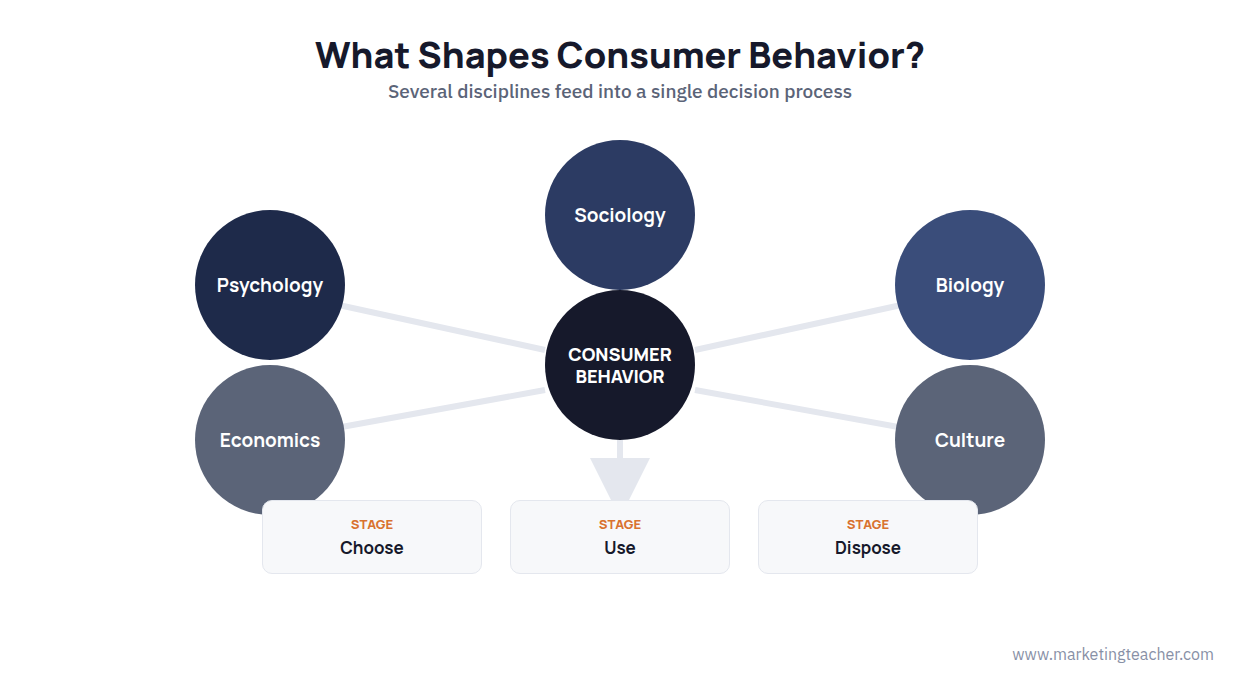
People make product decisions constantly, often without noticing they are doing it. What to wear, what to eat, which app to open first, are all small decisions that add up to a large share of how an economy actually moves. Consumer behavior is the study of consumers and the processes they use to choose, use, and dispose of products and services, along with how that process affects the wider world around them. It is not a single, narrow discipline: it draws on ideas from psychology, sociology, biology, and economics to explain why people buy what they buy, when they buy it, and what they do with it afterwards.
Why Marketers Study Consumer Behavior
Hawkins, Mothersbaugh and Best (2007) argue that all marketing decisions rest on assumptions and knowledge about consumer behavior, whether or not a business has ever formally researched it. A business that misunderstands why its customers buy is likely to misjudge its pricing, its messaging, and its product design, even if every other part of its marketing looks professional. Studying consumer behavior properly, rather than relying on assumption, lets a business target customers more effectively, refine its products and services around what people actually value, and build a genuine competitive advantage rather than guessing at one. It also helps a business understand how its own offering is perceived relative to competitors, which is often quite different from how the business perceives itself.
What Consumer Behavior Actually Covers
Consumer behavior is broader than the single moment of purchase. It covers how a person first recognises a need or want, how they search for and evaluate options, the decision itself, and what happens after the purchase, whether the product is used as intended, shared, stored, or simply discarded. Each of these stages can be studied and influenced separately: a business that only pays attention to the final purchase decision misses the earlier stages where a competitor’s messaging might already have shaped what the customer is looking for, and misses the later stages where a disappointing post-purchase experience can undo an otherwise successful sale.
Internal and External Influences on Choice
Two broad sets of factors shape any given consumer decision. Internal influences sit inside the individual: personal motivation, perception of a brand, attitudes formed by past experience, and a person’s own self-image all affect what looks appealing before a single advertisement is ever seen. External influences come from outside the individual: family, friends, reference groups, culture, and social class all shape what a person considers a normal or desirable purchase in the first place. The two sets of influences interact constantly. A person’s internal attitude toward a product category is itself often shaped by the external groups they belong to, which is why the same advertisement can succeed with one audience and fail completely with another that has different reference points. Marketers who study only one side of this, focusing entirely on internal psychology while ignoring the social context a customer buys within, tend to build campaigns that work in testing but underperform once launched into a real, socially embedded audience.
Consumer Behavior and Society
Because consumer decisions add up across millions of people, consumer behavior research also has uses beyond selling more of any one product. The same understanding of how people choose and act can be applied to encourage healthier habits, support charitable giving, or reduce behaviors like excessive drinking or drug use, an application usually called social marketing. The underlying psychology of choice does not change simply because the objective is public health rather than profit, which is why marketers, public health bodies, and policymakers frequently draw on the same body of consumer behavior research, from the same understanding of internal motivation and external social pressure described above, to design very different kinds of campaigns.
Summary
Consumer behavior is the study of how people choose, use, and dispose of products and services, and why (Hawkins, Mothersbaugh & Best, 2007). It draws on psychology, sociology, biology, and economics, and it covers the whole process from need recognition through to disposal, not just the moment of purchase. Understanding it properly, rather than relying on untested assumptions, is what allows a business to target customers effectively, build products people genuinely value, and develop a real competitive advantage.
The slides, worksheet, lesson plan and poster for this lesson are free to download and free to use in your course — no sign-up, no permission needed. See the teacher resources →
Assign this lesson to your class:
Using Canvas, Blackboard or Moodle? Copy the link and paste it into your course page or assignment. More ways to add lessons to your LMS.

