
Why the Direct/Indirect Distinction Matters
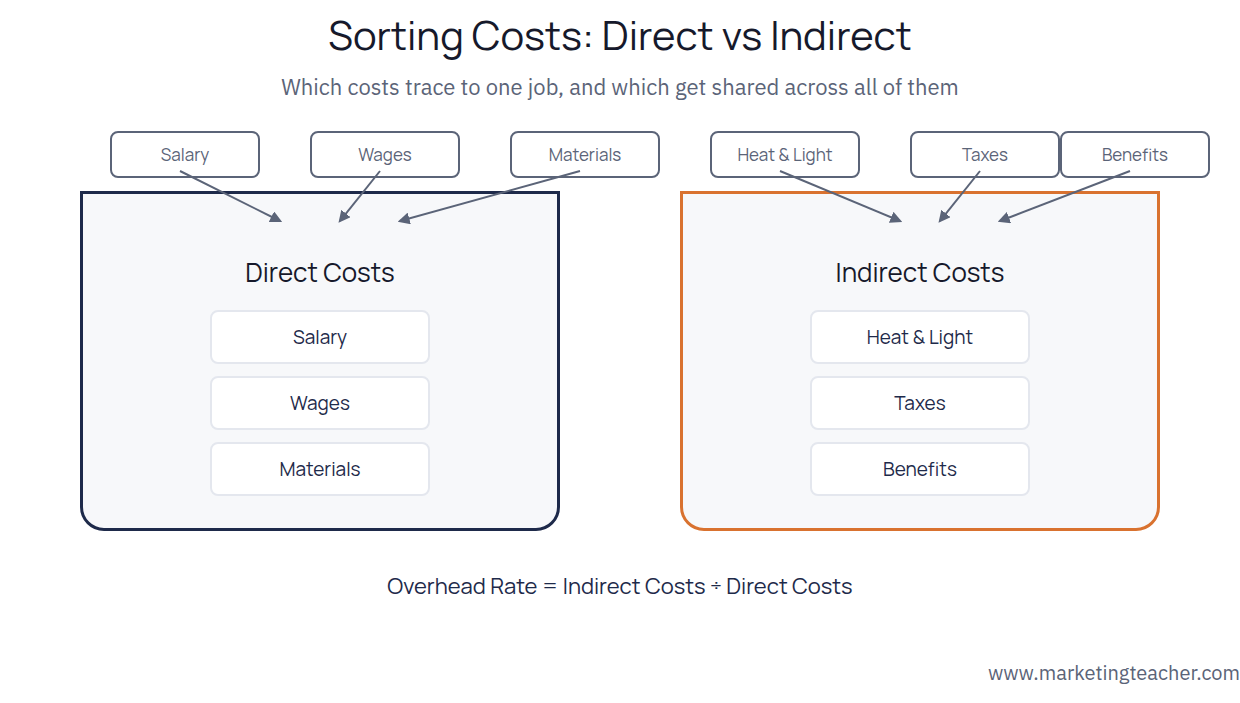
Sorting a business’s costs into direct and indirect categories is one of the more mundane parts of accounting, but it has a direct effect on how accurately a product or project’s true cost — and therefore its true profitability — gets calculated. Get the split wrong and a product can look more profitable than it actually is, because some of the overhead it genuinely consumes has been quietly absorbed elsewhere. The distinction matters enough that some prime contractors and government bodies impose a specific accounting methodology on the businesses they work with, precisely to stop this kind of cost-shifting (Garrison, Noreen and Brewer, 2020).
Direct Costs
Direct costs are costs that can be traced clearly and specifically to the production of a particular product or the delivery of a particular service. The clearest examples are the wages of staff working directly on that product, the salaries of people dedicated to that project, and the raw materials that physically become part of what’s being made. A useful test is whether the cost would disappear if that one product or project were cancelled — if yes, it’s a strong candidate for a direct cost. Direct costs, by definition, are not allocated to overhead; they belong entirely to the thing that caused them.
Indirect Costs
Indirect costs, sometimes called overhead, are costs that keep the business running generally but can’t be traced to one specific product or project without some kind of allocation method. Typical examples include heating and lighting a shared facility, property taxes, and employee benefits that apply across the whole workforce rather than one team. These costs don’t vanish if a single product line is discontinued — the building still needs heating and the remaining staff still need benefits — which is exactly why they can’t be assigned directly and have to be shared out using a formula instead.
Calculating the Overhead Rate
Once costs are correctly sorted, the overhead rate is a straightforward ratio:
Overhead Rate = Indirect Costs ÷ Direct Costs
This expresses indirect costs as a percentage of direct costs, giving a business a consistent way to load a fair share of overhead onto each job’s price rather than guessing. The method used to calculate it can vary by circumstance and industry, and in some cases the calculation method itself is dictated by a customer or regulator rather than chosen freely by the business — which is precisely the situation with publicly funded contracts.
A Grey Area: Costs That Could Go Either Way
Not every cost sorts itself neatly. A quality-control inspector who checks every batch across all three of Sedgefield’s print lines is arguably direct to production in general but indirect to any one specific job, since their time isn’t tied to a single print run. Software licences, equipment depreciation, and supervisory salaries often sit in this same grey area — technically traceable with enough effort, but not cheaply or reliably enough to justify treating them as direct. Most businesses resolve this pragmatically: if tracing a cost to one job would cost more in administrative effort than the accuracy gained is worth, it gets classified as indirect and allocated with everything else, even though a case could technically be made either way.
Why This Matters Especially for Publicly Funded Work
Where a project is funded in whole or in part by taxpayer money, the direct/indirect distinction stops being just good internal practice and becomes a compliance requirement. In the United States, for example, federal cost principles set out in the government’s Uniform Guidance specify in detail how a contractor must classify and allocate direct versus indirect costs on a federally funded award, precisely so that public money isn’t used to quietly cross-subsidise unrelated overhead. Manufacturers, service firms, not-for-profits, joint venture projects, and education providers are all industries where getting this classification right is treated as particularly important, whether or not public funding is directly involved.
Summary
Direct costs — labour, wages, and materials tied to a specific product or project — can be traced and allocated with confidence; indirect costs — heat, light, taxes, shared benefits — have to be spread across output using a formula like the overhead rate, indirect costs divided by direct costs (Garrison, Noreen and Brewer, 2020). The distinction is more than bookkeeping tidiness: it underpins accurate pricing and profitability analysis in any business, and it’s a hard compliance requirement on publicly funded contracts specifically.
The slides, worksheet, lesson plan and poster for this lesson are free to download and free to use in your course — no sign-up, no permission needed. See the teacher resources →
Assign this lesson to your class:
Using Canvas, Blackboard or Moodle? Copy the link and paste it into your course page or assignment. More ways to add lessons to your LMS.

