
By the end of this lesson you will be able to explain the content marketing matrix, describe its two axes and four quadrants, and choose content types that actually match a specific marketing goal rather than creating content for its own sake.
What Is the Content Marketing Matrix?
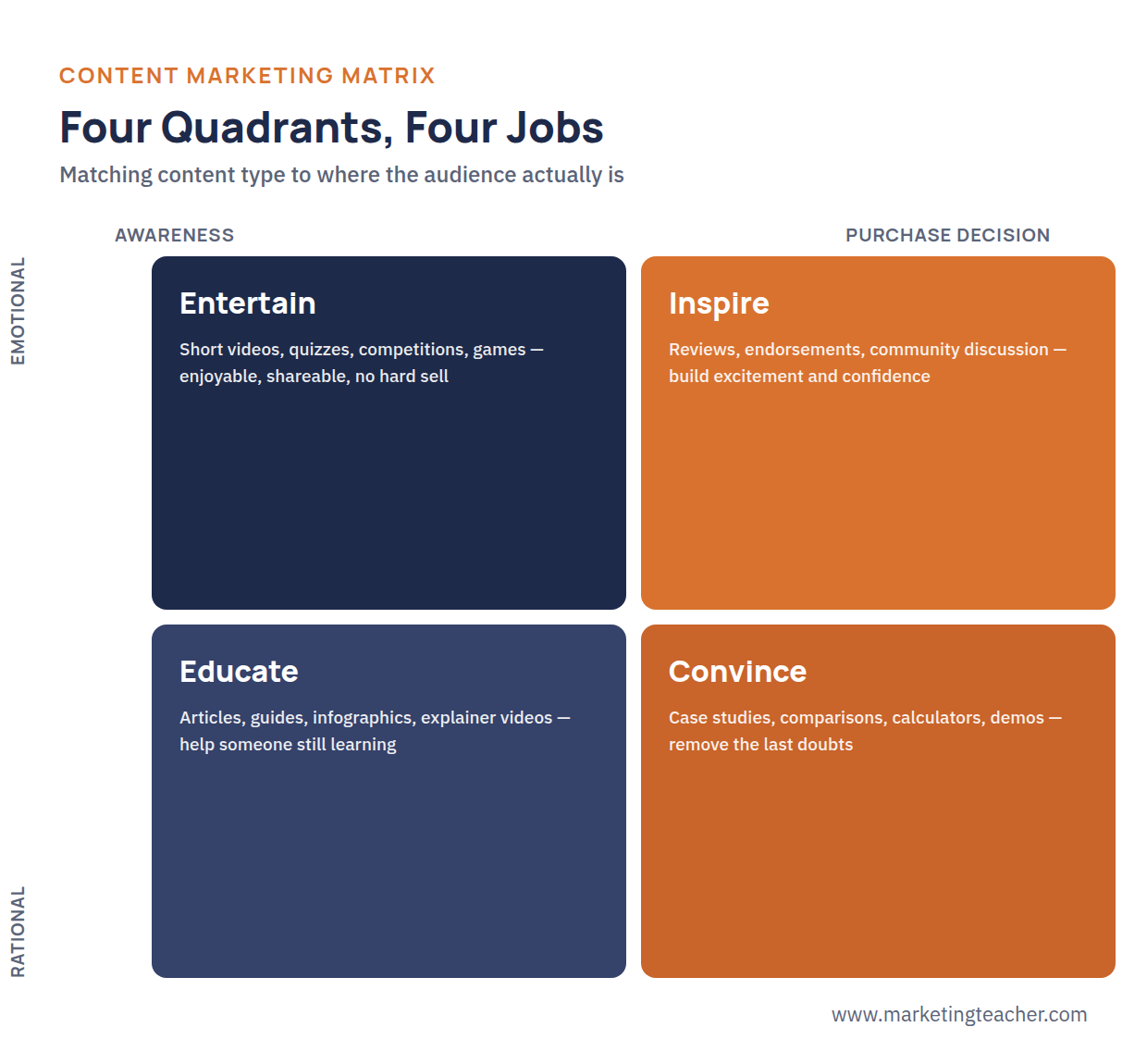
Marketers produce a huge range of content: short videos, quizzes, blog guides, case studies, calculators, and more. Not all of it does the same job, even when it is all technically well made. The content marketing matrix is a simple planning tool that helps a business match the type of content it creates to what it is actually trying to achieve with a particular audience at a particular moment, rather than producing content because it seems popular or easy to make (Chaffey, 2021).
Two Axes, Four Quadrants
The matrix is built from two simple questions. The first is about the audience’s stage in the buying journey: are they just becoming aware that a type of product or service exists, or are they much closer to an actual purchase decision? The second is about the type of appeal the content makes: is it primarily emotional, aiming to entertain or inspire a feeling, or is it primarily rational, aiming to inform or persuade with facts and evidence? Plotting those two questions against each other creates four quadrants (Chaffey, 2021).
Content that is emotional and aimed at people early in their awareness produces the "entertain" quadrant: short videos, quizzes, competitions, and games designed to be enjoyable and easy to share, with little or no direct selling involved. Content that is emotional but aimed at people closer to a decision produces the "inspire" quadrant: customer reviews, endorsements, and community discussion that build excitement or confidence about a choice someone is already leaning toward. Content that is rational and aimed at people early in their awareness produces the "educate" quadrant: articles, guides, infographics, and explainer videos that help someone who is still learning understand a topic. Content that is rational and aimed at people close to a decision produces the "convince" quadrant: case studies, comparison sheets, pricing calculators, and product demonstrations built to remove the last doubts before someone buys.
Matching Content to the Right Goal
A common mistake is producing strong content without thinking about which quadrant it actually belongs in. A detailed technical comparison sheet, which is textbook "convince" content, will usually fall flat in front of an audience that has never heard of the brand before, because that audience is not ready for it yet, they need to be entertained or educated first. In the same way, a funny, shareable video can build a huge amount of goodwill and reach, but it rarely closes a sale on its own for someone who is already comparing prices between two or three serious options and needs solid proof before they commit. Content that works brilliantly in one quadrant can fail completely in another, not because it is poorly made, but because it is answering the wrong question at the wrong moment in someone’s decision.
A small project-management software company is planning content for a new product launch and decides to map its ideas across all four quadrants rather than picking one type of content and running with it everywhere. For "entertain," it makes a short, lighthearted video about a chaotic, disorganised team, without mentioning the product at all, designed purely to be shareable. For "inspire," it films a short customer testimonial about the relief of finally feeling in control of a big project. For "educate," it writes a practical blog guide on keeping a small team organised, with the software mentioned only briefly near the end. For "convince," it builds a downloadable comparison chart against two competitor tools, alongside a simple pricing calculator. Individually, none of these four pieces does the whole job. Together, they walk a visitor from first noticing the brand through to being ready to buy, with each piece doing the specific job its quadrant is meant to do.
Why the Matrix Is Useful Beyond Planning
The matrix is also a useful audit tool for content a business has already produced (Chaffey, 2021). Many organisations, when they map their existing content onto the four quadrants, discover they have plenty of "educate" material and almost nothing in "inspire" or "entertain," or the reverse: lots of flashy, entertaining content and almost nothing that helps a near-ready buyer take the final step. Neither imbalance is automatically wrong, since the right mix depends on the product and the audience, but it is far better to notice a gap on purpose than to discover it by accident when a campaign underperforms and nobody can say why.
Summary
The content marketing matrix organises content along two axes: how close the audience is to making a purchase decision, and whether the content’s appeal is mainly emotional or mainly rational. Together these produce four quadrants, entertain, inspire, educate, and convince, each suited to a different job in moving someone from first awareness toward a confident decision. Rather than producing content at random, a business can use the matrix to plan a fuller mix of content on purpose, and to spot where its existing content leans too heavily on one quadrant at the expense of the others.
Quiz

The slides, worksheet, lesson plan and poster for this lesson are free to download and free to use in your course — no sign-up, no permission needed.

