
What Is the RACE Framework?
Digital marketing generates a lot of activity – social posts, paid search, email campaigns, landing pages – but activity is not the same as progress. The RACE framework gives that activity a structure. Developed by digital marketing consultant Dave Chaffey, RACE stands for Reach, Act, Convert and Engage: four stages that map onto the journey a customer actually takes, from first hearing about a brand through to becoming a repeat buyer and advocate (Chaffey & Ellis-Chadwick, 2022). Rather than treating digital marketing as a single undifferentiated task, RACE asks marketers to set a goal, choose activities and pick a measure of success separately for each stage – which is what makes it a planning tool as much as a description of what marketing already does.
Four Stages, One Customer Lifecycle
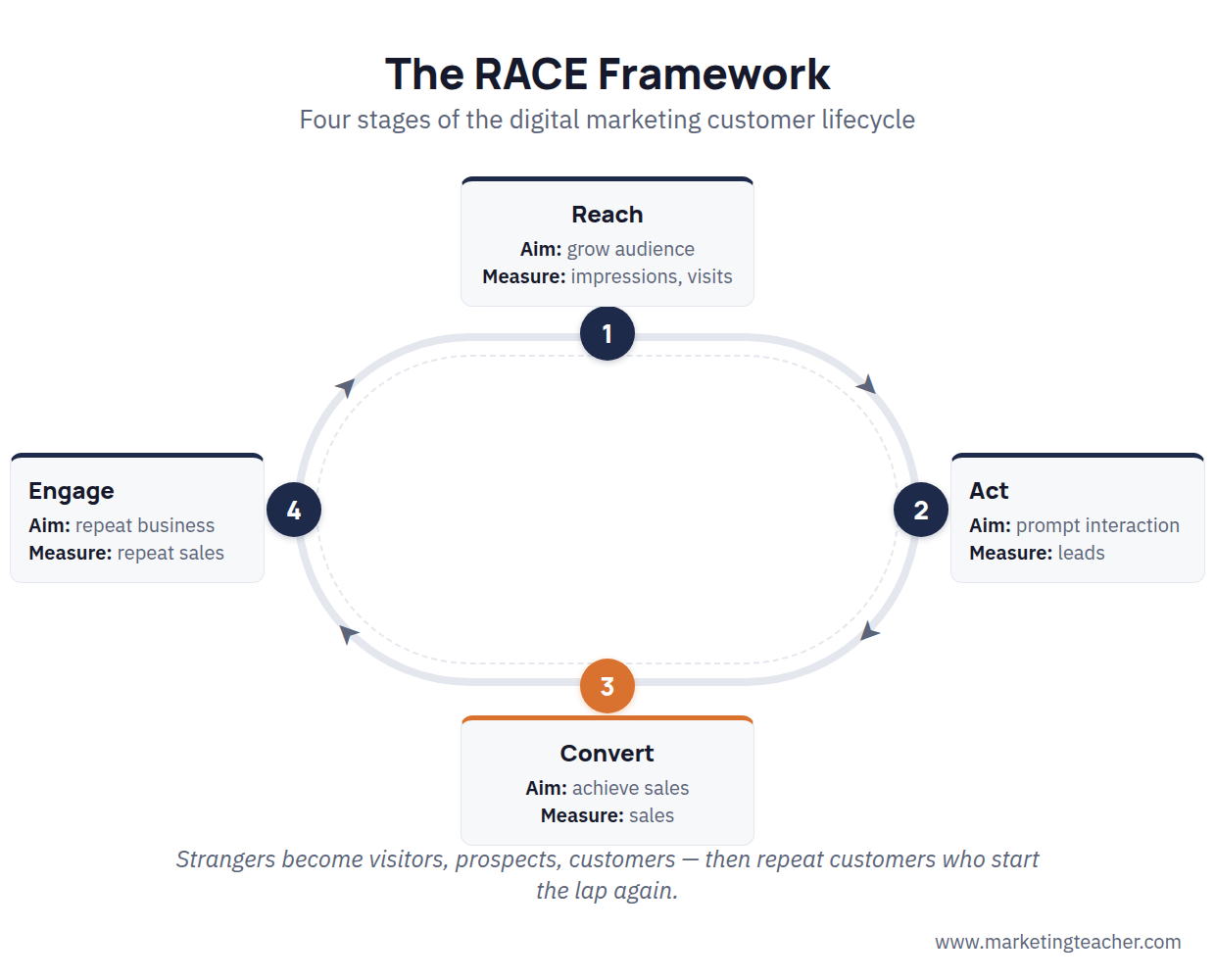
At the Reach stage, the aim is to grow an audience using paid, owned and earned media – search marketing, social content, PR, and content marketing that earns visits on its own merit – and the people reached are, at this point, still strangers becoming visitors. Success here is measured simply in impressions and visits, usually pulled straight from a site’s own web analytics (Chaffey & Ellis-Chadwick, 2022).
The Act stage prompts an interaction: getting a visitor to explore a website or app, sign up, or otherwise hand over a way to be contacted again. In many sectors this is really lead generation – permission to keep marketing to that person by email, text or app notification – and the visitor becomes a prospect, measured by the number of leads generated.
Convert is the stage most marketing reporting still stops at: turning a prospect into a paying customer, online or offline, measured in sales.
Engage is the stage a simple sales funnel leaves out altogether. Its aim is to turn a one-off customer into a repeat one, through onboarding, loyalty schemes, customer service and social advocacy – measured in repeat sales and customer satisfaction, not just the first transaction. A repeat customer’s value over time – its customer lifetime value – is usually far higher than a single sale, which is the commercial reason Engage gets its own goal, its own activities and its own metric rather than being folded into Convert as an afterthought.
Where RACE Came From
RACE did not appear from nothing. Chaffey and Ellis-Chadwick (2022) present it as an evolution of an earlier framework, REAN – Reach, Engage, Activate, Nurture – originally developed by Xavier Blanc and popularised by Steve Jackson in his 2009 book Cult of Analytics. Chaffey adapted this into a simpler four-step version, first published in 2015 and refreshed in 2021, designed specifically to help marketers set goals, measure performance and manage activities across the whole customer lifecycle rather than just the top of it. The label is also a small piece of marketing in itself: a memorable acronym that borrows the energy of an actual race to describe what is, underneath, a fairly dry planning exercise in goals and metrics.
Using RACE to Plan, Not Just Report
Because RACE assigns a distinct goal, activity set and measure to each stage, it doubles as a benchmarking tool: an organisation can compare its own performance, stage by stage, against competitors, rather than relying on a single vanity metric like total traffic (Chaffey & Ellis-Chadwick, 2022). It is also a reminder that digital channels rarely work alone. Traditional offline media still has a job to do – usually at Reach and Act, building awareness of an online presence – while customers at Convert and Engage often still prefer to deal with a real person, so the framework is meant to guide an integrated plan, not a digital-only one. A marketing team can use the same RACE goals, activities and measures column by column to audit a competitor’s visible activity – their search presence and content at Reach, their sign-up and lead-capture mechanics at Act, their offers and checkout at Convert, their loyalty and service touchpoints at Engage – and see exactly where their own plan is thin.
Summary
The RACE framework breaks digital marketing into four measurable stages – Reach, Act, Convert and Engage – matching the real stages a customer moves through, from stranger to repeat customer. Developed by Dave Chaffey as an evolution of the earlier REAN framework, RACE gives marketers a shared structure for setting goals, choosing activities and picking metrics at each stage, and for benchmarking performance against competitors rather than judging a campaign by a single number.
The slides, worksheet, lesson plan and poster for this lesson are free to download and free to use in your course — no sign-up, no permission needed. See the teacher resources →
Assign this lesson to your class:
Using Canvas, Blackboard or Moodle? Copy the link and paste it into your course page or assignment. More ways to add lessons to your LMS.

