
What Is the 7-P Framework for International Marketing?
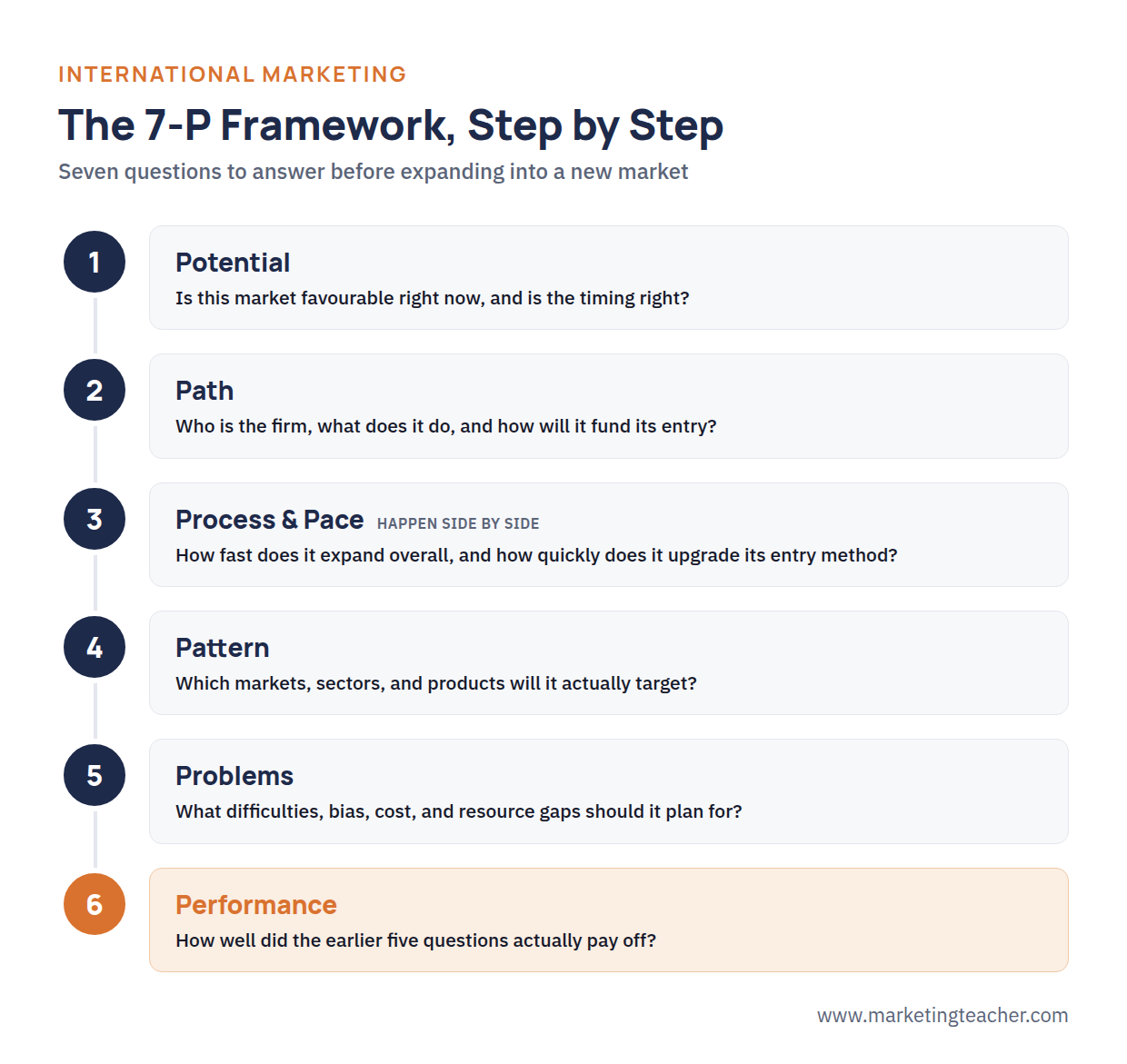
Expanding into an international market is a much bigger step than it looks from the outside. A business that has succeeded for years at home can still misjudge a new market badly, entering too early, choosing the wrong entry method, or expanding faster than its resources can support. The 7-P framework is a planning tool that organises international expansion into seven connected questions, taken roughly in order, so a business thinks through the whole decision deliberately rather than reacting one problem at a time (Paul & Mas, 2020). The seven Ps are Potential, Path, Process, Pace, Pattern, Problems, and Performance.
The Seven Ps, In Sequence
Potential comes first: what opportunities and conditions exist in a candidate foreign market that make it favourable, or unfavourable, for a newcomer right now? Timing matters as much as the market itself, since political and economic conditions can open a door for a period and then close it again, regardless of how well a firm has planned everything else.
Path asks who the firm is and what it actually does, and how it will fund and enter the new market as a result. Many businesses begin cautiously, exporting a product before committing any real infrastructure abroad, and only move toward a local partnership, joint venture, or a fully owned local operation once they have evidence the market is worth the deeper investment.
Process and Pace sit together because they happen side by side (Paul & Mas, 2020). Process is the overall speed of internationalisation: does the business expand gradually, market by market, learning as it goes, or move aggressively into several markets at once from the very start? Pace, within that broader approach, is the specific speed at which the firm switches from one way of operating in a market to a more committed one, for example moving from a simple export relationship to a full local subsidiary within a couple of years rather than a couple of decades.
Pattern covers firm structure, sector, and specifically where a product or service ultimately gets sold. Some firms expand outward step by step into markets that are geographically or culturally close to home, where the learning curve is gentler; others aim directly at the single largest or most profitable market regardless of how far away or different it is.
Problems is the point at which a business should honestly plan for the difficulties it is likely to face once it goes international: a bias among local consumers against products from a country or brand they don’t yet recognise, the extra hidden costs of lacking on-the-ground knowledge of regulations and customs, and the plain reality of usually having fewer resources, in capital, people, and brand reputation, than the competitors already established in that market.
Performance is the final P, and it isn’t really a separate step so much as the outcome of all six before it. How thoroughly a business has answered the earlier questions largely predicts how well its international expansion actually performs, which is also why a disappointing result is worth tracing back through the earlier Ps rather than treated as simple bad luck.
Why the Order Matters
It’s tempting to jump straight to the exciting parts of international expansion, choosing a flashy target market or a bold entry method, without properly working through Potential and Path first. But Pattern and Pace are much harder to get right if a business hasn’t honestly assessed the market’s real potential or figured out what kind of entry actually suits its resources. Working through the Ps roughly in order doesn’t guarantee success, but it does mean each later decision is being made with the right groundwork already in place, rather than being improvised under pressure once the business is already committed.
Summary
The 7-P framework breaks international market expansion into seven connected questions (Paul & Mas, 2020): Potential (is this market favourable, and is the timing right?), Path (who is the firm and how will it fund its entry?), Process and Pace (how fast will it expand, and how quickly will it upgrade its entry method?), Pattern (which markets and sectors will it actually target?), Problems (what difficulties should it plan for?), and Performance (how well did all of this actually work?). Taken together, the framework helps a business plan international expansion as a deliberate sequence of decisions rather than a single leap into the unknown.
Quiz

The slides, worksheet, lesson plan and poster for this lesson are free to download and free to use in your course — no sign-up, no permission needed.

