
How Do Ideas Actually Travel Through Social Media?
A brand can post the same message on the same day to two different audiences and get wildly different results — one post disappears, the other spreads for a week. The difference rarely comes down to the content alone. It comes down to the structure of the network it lands in, and whether the right people pick it up and pass it on. Understanding that structure is what separates a marketer who gets lucky occasionally from one who can engineer reach deliberately.
Networks, Nodes and Flows
A social network is a set of socially relevant nodes connected by one or more relationships (Tuten & Solomon, 2018). A node can be a person, a business, or even an article; the connections between nodes, whether friendships, follows or professional ties, are what create the network. Social network sites formalise this structure online: Boyd and Ellison (2007) define them as web-based services that let people construct a public or semi-public profile, articulate a visible list of connections, and view and traverse those connections and the connections of others.
What actually moves value through a network are flows — the exchanges of information, resources or influence that pass between connected nodes (Tuten & Solomon, 2018). When you share a friend’s post, recommend a product, or simply reply to a comment, you create a flow. These flows are the reason the network effect matters so much in social media marketing: a platform, and a piece of content within it, becomes more valuable as more of the right nodes are connected to it and willing to pass things along.
Why Some People Have More Influence Than Others
Not every node carries equal weight. Opinion leaders, also called influencers, are people others view as knowledgeable, trustworthy sources on a given topic, and their recommendations carry disproportionate weight in a network (Tuten & Solomon, 2018). Where does that weight actually come from? French and Raven’s (1959) classic typology of social power gives marketers a useful vocabulary for it. Reward power is the ability to give people something they want; coercive power is the ability to punish; legitimate power comes from an official position or title; referent power comes from people wanting to identify with or please someone; expert power comes from recognised knowledge or skill; and information power comes from controlling access to information itself. An effective influencer typically draws on several of these at once — expert power because they know the subject, and referent power because their audience wants to be like them.
Social media has also given rise to a newer category: the microcelebrity, or micro-influencer, who builds a smaller but often more engaged following — typically somewhere between one thousand and one hundred thousand people — by cultivating a sense of intimacy and authenticity with their audience (Tuten & Solomon, 2018). Because a micro-influencer’s audience tends to be more homophilous (similar to the influencer in background, values and interests), their recommendations often land as more credible than a celebrity endorsement with a much larger reach but far less personal connection.
How a Message Cascades Through a Network
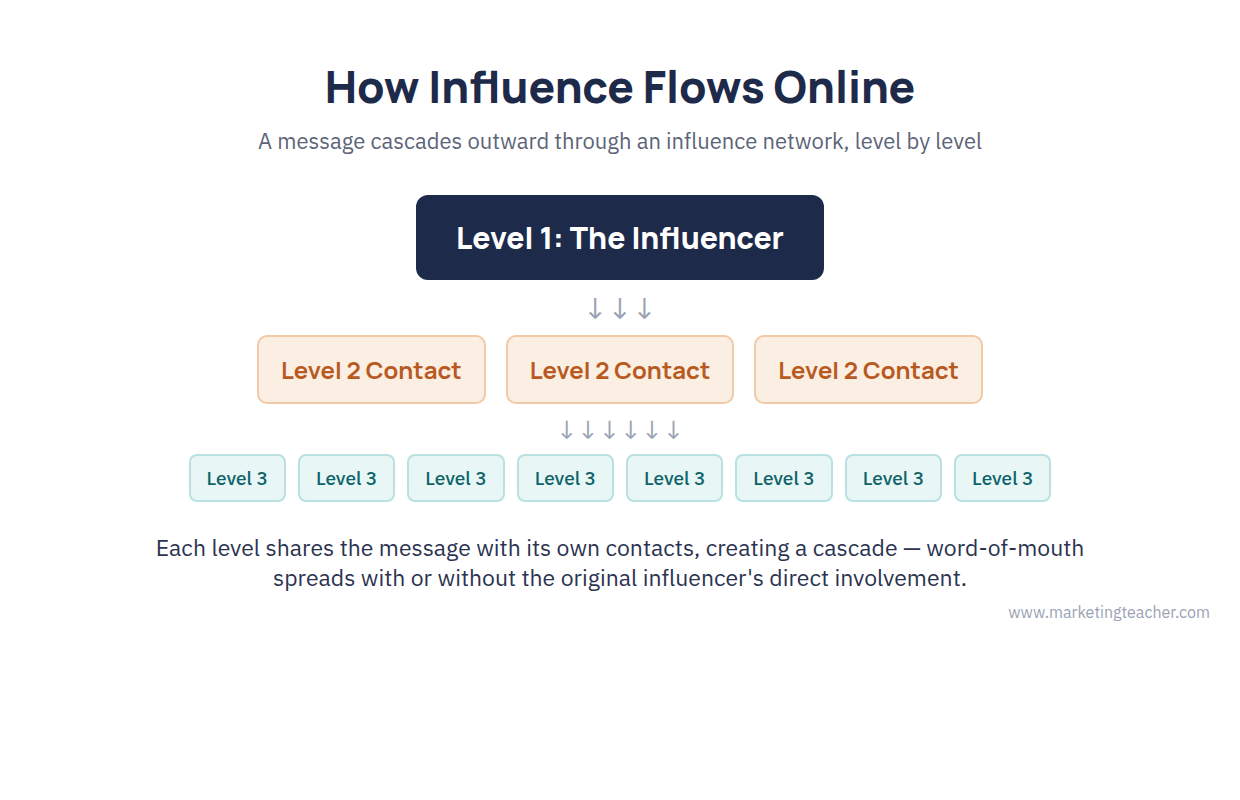
Early research on influence proposed a two-step flow: a message travels from media to a small number of opinion leaders, who then pass it on to everyone else. Tuten and Solomon (2018) explain that more recent research has refined this picture into a cascade model. A message originates with an influencer at Level 1, travels outward to that person’s direct contacts at Level 2, and from there travels further outward as those contacts share it with their own networks at Level 3 — each step multiplying the reach, much like an avalanche gathering size as it moves downhill.
Word-of-Mouth: Still the Most Trusted Channel
When product information passes from person to person this way, it is called word-of-mouth (WOM) communication, and Tuten and Solomon (2018) note that online WOM is the preferred information source for the large majority of shoppers making a purchase decision, often outranking search engines and promotional emails. WOM tends to carry more weight when the person sharing it is seen as similar to the person receiving it — which is exactly why homophily matters so much to influencer selection.
WOM cuts both ways. Positive word-of-mouth can move products off shelves, but negative word-of-mouth spreads at least as readily, and research on online reviews and consumer trust reinforces how heavily people weigh what other customers say before buying (Joshi et al., 2023). A brand that ignores its social conversations is not avoiding the risk of negative WOM — it is simply choosing not to hear it.
Summary
Social media value flows through networks of connected nodes (Tuten & Solomon, 2018), formalised by social network sites as defined by Boyd and Ellison (2007). Influence within these networks is unevenly distributed, resting on the sources of power identified by French and Raven (1959), and it spreads through cascades that can carry a message far beyond an influencer’s immediate contacts. Because word-of-mouth remains one of the most trusted forms of marketing communication (Tuten & Solomon, 2018; Joshi et al., 2023), identifying and earning the attention of the right nodes is one of the highest-leverage activities in social media marketing.

