
Why Does a Social Media Strategy Need a Plan at All?
It is tempting to treat social media as the one area of marketing where you can simply start posting and see what sticks. Many organisations do exactly that. But Tuten and Solomon (2018) define strategic planning as the process of identifying objectives, deciding how to accomplish them through specific strategies and tactics, implementing those actions, and measuring how well the plan actually met its objectives — and social media marketing benefits from that discipline just as much as any other channel. Planning does not kill spontaneity. It ensures that the spontaneous, reactive parts of social media sit inside a structure that is actually moving a business somewhere.
The Three Phases of Social Media Marketing Maturity
Tuten and Solomon (2018) describe organisations as moving through three phases as their social media marketing matures. In the trial phase, a brand experiments with platforms without really considering how social media fits into the overall marketing plan — useful for learning the ropes, but risky if it never moves past this stage. In the transition phase, activity becomes more consistent and profiles are established, but strategy is still incomplete; a common symptom is over-reliance on automated scheduling and canned replies that customers can spot instantly, sometimes dismissively called “social media zombies.” In the strategic phase, an organisation runs a formal process with clear objectives and metrics, and social media becomes a genuine, integrated component of the overall marketing plan rather than a side activity.
Most organisations sit somewhere between trial and transition, which is exactly why a repeatable planning process is worth learning properly rather than improvising every time.
The Seven-Step Strategic Planning Process
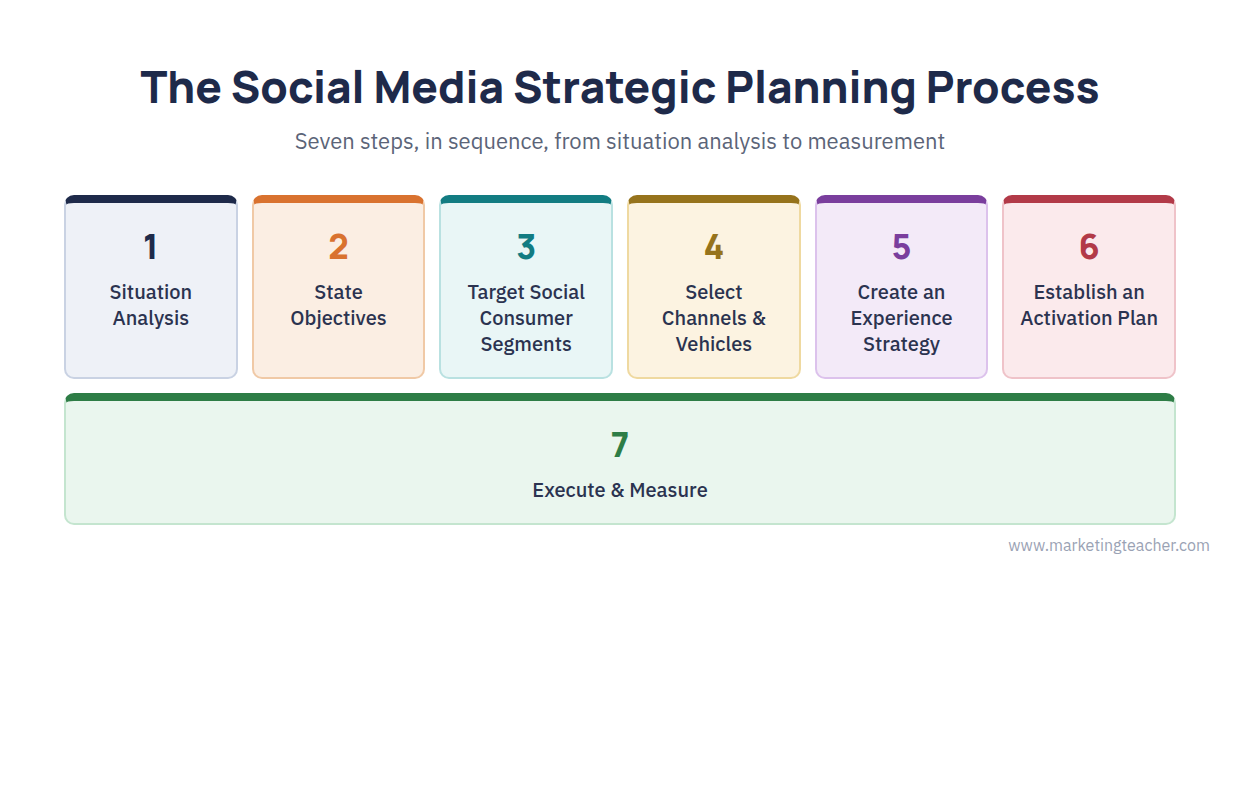
Tuten and Solomon (2018) lay out social media strategic planning as seven sequential steps, each building on the one before it.
1. Conduct a situation analysis. Research the industry, competitors, product category and consumer market, typically including a social media audit of the brand’s own past activity (consistency, frequency, responsiveness, engagement) and a competitive analysis of what rival brands are doing in the same channels.
2. State objectives. Translate the situation analysis into specific, measurable goals the social media effort needs to achieve.
3. Target social consumer segments. Decide which audience segments — drawing on everything covered in Lesson 2 — the campaign is actually trying to reach.
4. Select channels and vehicles. Choose which platforms, and which specific formats within them, best reach the targeted segments and suit the objectives.
5. Create an experience strategy. Decide what the audience will actually see, do and feel when they encounter the campaign.
6. Establish an activation plan. Line up any other promotional tools — paid media, influencer partnerships, in-store tie-ins — needed to support the social media effort.
7. Execute and measure. Launch the campaign and track it against the objectives set in step two, feeding results back into the next planning cycle.
Who Owns Social Media Inside an Organisation?
Even a well-designed seven-step plan needs someone accountable for running it. Tuten and Solomon (2018), citing research by industry analyst Jeremiah Owyang, describe five common ways organisations structure themselves for social media. In a centralised structure, a senior social media team reports directly to a CMO or CEO and owns all activations — efficient, but at risk of disconnecting social media from functions like customer service. In an organic structure, no single team owns it; every employee represents the brand, which demands a strong social media policy to keep messaging on-brand. The hub-and-spoke (or coordinated) model, currently the most widely used, places a cross-functionally trained core team at the centre, feeding out to specialists across departments. Larger organisations with multiple business units sometimes extend this into a “dandelion” model, essentially several hub-and-spoke structures layered together, while a holistic structure — the least common of the five — empowers every employee to use social media according to a shared strategy, without a dedicated central team at all.
None of these structures is universally correct; the right choice depends on organisational size, culture, and how tightly the brand needs to control its voice. What matters for the strategic planning process is that step six, the activation plan, and step seven, execution, both need a clear owner or they simply will not happen consistently.
Bots and the Limits of Automation
One caution belongs squarely inside this planning process: automation used carelessly can undermine even a well-planned strategy. Tuten and Solomon (2018) note that bots — algorithms acting within social networks — now generate a significant share of all social media activity, and a meaningful proportion of users cannot reliably tell a bot from a real person. Used transparently, bots can handle simple customer service queries efficiently; used to fake engagement or manufacture the appearance of grassroots support (a practice known as astroturfing), they erode exactly the trust that a strategic social media plan is meant to build.
Summary
Social media marketing earns a genuine strategic role in an organisation once it moves beyond the trial and transition phases into a formally planned, measured process (Tuten & Solomon, 2018). The seven-step strategic planning process — situation analysis, objectives, targeting, channel selection, experience strategy, activation, and execution with measurement — gives that process a repeatable shape, while awareness of automation’s limits keeps the resulting campaigns genuinely trustworthy rather than just efficient.

