
What Is a Micro-community?
A micro-community is a small, tightly focused group of people connected by a specific shared interest, identity, or activity, rather than a broad demographic segment. In marketing terms, it is the modern, platform-native version of what researchers have long called a “brand community” – a group whose members feel a structured social relationship to each other around a shared interest in a brand, product, or activity, rather than simply being individual customers who happen to buy the same thing. A micro-community might be a niche subreddit for a specific hobby, a small Discord server for players of one particular game mode, or a tightly focused group chat of people training for the same type of event – the defining feature is depth of shared identity within a small group, not size of audience.
Why Brands Are Shifting Attention Toward Them
The shift is largely a reaction to declining organic reach on mainstream social platforms. Algorithmic feeds increasingly reward broad, high-engagement, often entertainment-led content, which makes it progressively harder and more expensive for a brand’s own page to reach its audience through unpaid, organic posting. Inside a micro-community, by contrast, authenticity and relevance drive engagement more than reach ever could: a brand that shows up with genuinely useful, specific value for that community’s shared interest can be seen and trusted by a small, highly engaged group, in a way a generic broadcast post to a general follower base cannot match. Industry analysts describe this as a structural shift in social media marketing – away from maximising broad organic reach, toward building authentic presence and advocacy inside smaller, more defined groups of genuinely interested people (Kantar, 2026).
The Risk: Communities Notice Being Used
Micro-communities are, by definition, small enough that members can tell the difference between a brand participating in good faith and a brand extracting value from the group. A community that senses it is being treated purely as an unpaid audience for advertising, rather than a group worth genuinely engaging with, tends to react faster and more visibly than a broad social media following would, precisely because its members know and trust each other and can coordinate a negative reaction quickly. This makes the entry approach unusually important: showing up to observe and contribute value before promoting anything, being transparent about being a brand representative rather than posing as an ordinary member, and accepting that useful engagement in a micro-community is measured in relationships and trust built over time, not in the impression counts that measure a traditional paid campaign.
Measuring Success Differently
Because the goal is depth of relationship rather than breadth of reach, standard vanity metrics such as follower counts or impressions are poor measures of micro-community success. More useful signals include the ratio of genuine replies and shares within the community relative to its small size, direct evidence of members independently recommending the brand to each other without prompting, and longer-term indicators such as repeat purchase or advocacy specifically traceable back to community members, rather than broad brand awareness figures that a micro-community strategy was never designed to move.
Micro-communities vs. Micro-influencers
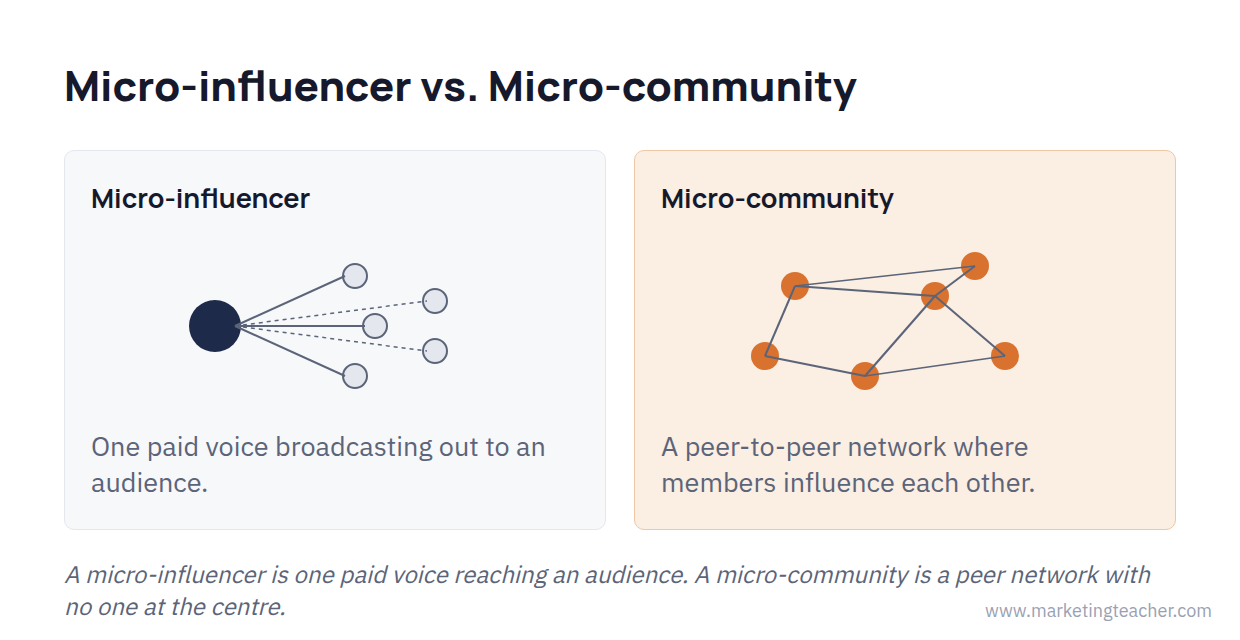
These two terms are often confused but describe different things. A micro-influencer is an individual content creator with a relatively small but engaged personal following, and working with one is fundamentally an endorsement transaction – paying or gifting one person to say something positive to their audience. A micro-community has no single person at its centre to pay; it is a peer-to-peer network where members primarily talk to and influence each other, and a brand’s role is closer to that of a respected guest than a paying sponsor. The two can overlap – a micro-influencer may be an active, respected member of a relevant micro-community – but a strategy built around paying individual creators does not automatically translate into acceptance inside the community those creators belong to.
Summary
Micro-communities are small, tightly bonded groups sharing a specific interest, and they matter to marketers because declining organic reach on broad social platforms has made authentic engagement inside smaller, trust-based groups comparatively more valuable. Success requires genuine, patient participation rather than promotional shortcuts, and it should be measured through relationship-based signals such as organic advocacy and repeat engagement, not the reach-based metrics that suit broad social media campaigns.

