
What Is an Advertising Agency?
An advertising agency is an external organisation that plans, creates and places some or all of a client’s advertising and wider marketing communications on its behalf (Belch and Belch, 2021). Agencies range enormously in size, from a handful of people working for local clients to global networks with many thousands of staff serving multinational accounts. Historically, agencies were paid through a commission taken from the media the client’s advertising was booked into, so an agency’s income rose with how much media spend it placed; today, fee-based and hybrid payment arrangements, agreed directly with the client rather than taken invisibly from media owners, are increasingly common, largely because clients wanted more transparency over exactly what they were paying for (De Pelsmacker, Geuens and Van den Bergh, 2021).
The Client-Agency Relationship
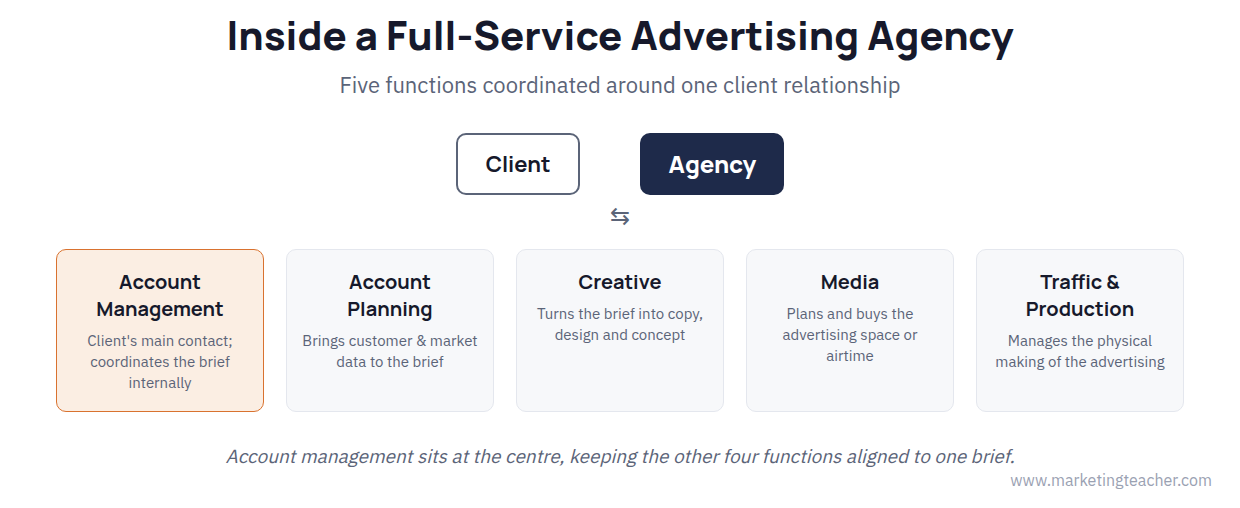
Because an agency is entrusted with a client’s brand and budget, the working relationship between the two matters as much as the technical skill either side brings. A dedicated account manager sits at the centre of this relationship, working closely enough with the client that they are sometimes described as functioning like an extra member of the client’s own marketing team. The account manager is responsible for making sure the brief the client gives the agency is understood correctly, for coordinating the agency’s internal teams around that brief, and for managing timelines and budget so nothing is lost in translation between what the client asked for and what the agency delivers.
The Main Functional Teams Inside an Agency
A full-service agency is typically organised around five functions (Belch and Belch, 2021). The account management team, described above, is the client’s main point of contact and internal coordinator. The creative team turns the client’s brief into an actual idea, the “creative concept”, expressed through copy (the words) and design or layout (the images and visual treatment) produced by copywriters and designers working together. The media team plans and buys the advertising space or airtime itself, deciding which media to use, which slots to book, and how many times to run the advert, drawing on media-planning software and audience data to get the best return for the client’s budget. The account planning team represents the customer’s perspective inside the agency, feeding the creative team insight and data, often drawn from syndicated research sources, about what is actually happening in the market the advertising will run into. The traffic and production team manages the physical and logistical side of making the advertising happen: commissioning scripts, actors and film crews for a television advert, or managing print production and sign-off for press and poster work.
Types of Advertising Agency
Not every client needs, or can afford, a full-service agency handling every function described above. A full-service agency takes on an entire campaign end to end, as in the Ferngate example. An à la carte agency instead offers specific functions individually, media buying alone, for instance, allowing a client to assemble a bespoke mix of specialist suppliers rather than buying a complete package from one firm. A specialist agency focuses narrowly on one aspect of marketing communications or one type of market, digital and search advertising being a common specialism today, and tends to be smaller and more tightly focused than a full-service agency (De Pelsmacker, Geuens and Van den Bergh, 2021). Which type of agency a business chooses generally comes down to the scale of its advertising activity, how much in-house marketing capability it already has, and how much value it places on having one agency accountable for an entire campaign versus assembling best-in-class specialists itself.
Working Well With an Agency
Because so much of an agency’s value comes from creative judgement, the working relationship benefits from a degree of trust that a purely transactional supplier relationship wouldn’t need. Creative teams are, by the nature of their role, expected to bring artistic and sometimes unconventional ideas to a brief, and clients who treat early creative work purely as a target for line-by-line correction, rather than as a starting point for constructive discussion, tend to get less ambitious work back over time. That does not mean creative output should go unchallenged, only that the most useful challenge tends to be framed around whether the idea serves the brief, rather than personal taste.
Summary
Advertising agencies exist because planning, creating and placing advertising well draws on several distinct skill sets, account management, creative, media, account planning and production, that are rarely all strong inside one client organisation (Belch and Belch, 2021). Agencies can be engaged as full-service partners, à la carte specialists in one function, or narrow specialists in one market or medium, and are paid through commission, fees, or a hybrid of the two depending on the arrangement agreed with the client (De Pelsmacker, Geuens and Van den Bergh, 2021). Understanding this structure helps a marketer brief an agency more effectively and get better creative and media results from the relationship.
The slides, worksheet, lesson plan and poster for this lesson are free to download and free to use in your course — no sign-up, no permission needed. See the teacher resources →
Assign this lesson to your class:
Using Canvas, Blackboard or Moodle? Copy the link and paste it into your course page or assignment. More ways to add lessons to your LMS.

