
What Is Advertising?
Advertising is any paid form of non-personal communication about an organisation, product, service or idea, placed through media by an identified sponsor and directed at a defined target audience (Kotler and Armstrong, 2018). Two features separate it from other elements of the marketing communications mix: it is non-personal, meaning the message travels through mass media rather than face to face, and the sponsor is identified, which is what distinguishes advertising from, say, unpaid word-of-mouth or a news story about the same brand. Because it reaches large numbers of people with a single, controlled message, advertising is often the most cost-efficient way to build broad awareness, even though the return on any single advert is harder to trace to an individual sale than, for example, personal selling.
Above-the-Line and Below-the-Line Advertising
Advertising activity is often split into “above-the-line” and “below-the-line” work, a distinction that grew out of how advertising agencies have historically charged for their services (Belch and Belch, 2021). Above-the-line covers media bookings, television, national press, radio, cinema, where an agency traditionally earned a commission from the media owner for placing the client’s advert. Below-the-line covers activity billed to the client directly at a transparent fee rather than through a hidden commission, historically including local press bookings and a wide range of sales-promotion and direct-marketing work. The line between the two has blurred considerably as digital media and transparent fee-based agency contracts have become the norm, but the terminology is still used as a shorthand for mass-media advertising versus more targeted, directly billed activity.
Planning an Advertising Campaign
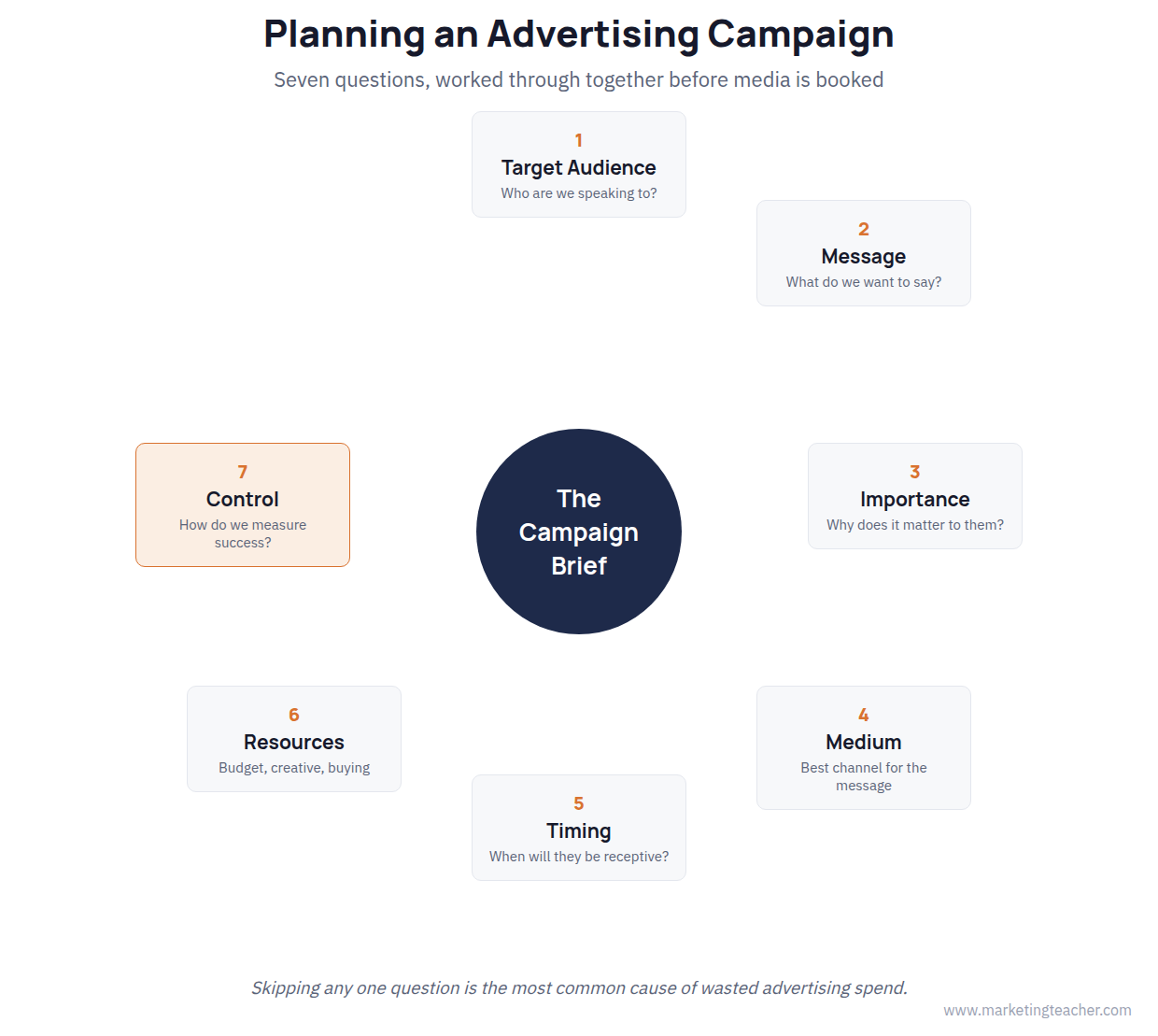
Whatever the medium, advertisers and their agencies work through broadly the same set of planning questions before a campaign is booked (Belch and Belch, 2021). Who is the target audience for the advert? What message needs to be communicated to them? Why is that message important to them specifically, rather than to people in general? What medium best suits that message and that audience? What timing gives the campaign the best chance of reaching people when they’re receptive? What resources, budget, creative and media buying, does the campaign actually need? And finally, how will the business control and monitor the campaign once it’s running, so that it can tell whether the spend achieved anything? Skipping any one of these questions tends to show up later as wasted spend: a well-made advert aimed at the wrong audience, or a well-targeted message delivered through the wrong medium, rarely performs as well as one where every stage was thought through together.
Choosing an Advertising Medium
The right medium depends heavily on the answers to the planning questions above, particularly audience and budget. Television and national press reach very large audiences but at a high absolute cost, and suit messages that benefit from broad, repeated exposure. Outdoor advertising and transport advertising work well for simple, highly visual messages seen by people on the move. Radio and local press suit more geographically targeted campaigns. Digital media, mobile advertising and search advertising allow far more precise targeting and much finer-grained measurement of response than traditional mass media, which is one reason digital’s share of total advertising spend has grown steadily. No single medium is inherently best; the right choice is the one that reaches the defined target audience with the chosen message at a cost the campaign’s budget can support.
What Advertising Can and Cannot Do
Advertising’s core strength is control: the advertiser designs the message, chooses the medium, and can reach a very large number of people with a single, consistent piece of communication, at a relatively low cost per person reached. It is also fast compared with building an entire personal-selling operation or a public relations campaign, since a media booking can go live far more quickly than recruiting and training a sales team. What advertising is generally weaker at is closing an individual sale or handling an individual customer’s specific objections, the strengths of personal selling, or building the kind of third-party credibility that public relations can generate. Most marketing communications plans use advertising alongside these other tools rather than instead of them, precisely because each element of the mix is suited to a different part of the customer’s journey.
Summary
Advertising directs a controlled, sponsor-identified message at a large audience through paid media, split loosely into above-the-line and below-the-line activity depending on how it is booked and billed (Belch and Belch, 2021). A sound campaign works through a defined sequence of planning questions, audience, message, importance, medium, timing, resources, and control, before choosing among the many available media types (Kotler and Armstrong, 2018). Used well alongside the rest of the marketing communications mix, and organised through an advertising agency where the business doesn’t run the work in-house, advertising remains one of the fastest ways to build broad awareness at a low cost per person reached.
The slides, worksheet, lesson plan and poster for this lesson are free to download and free to use in your course — no sign-up, no permission needed. See the teacher resources →
Assign this lesson to your class:
Using Canvas, Blackboard or Moodle? Copy the link and paste it into your course page or assignment. More ways to add lessons to your LMS.

