
Advertising in Cinemas and Theatres
Why Consider the Local Cinema?
A local cinema or movie theatre can be a genuine gathering point for a business’s target customers, and the same targeting logic that applies to radio and newspaper advertising applies here too: the advertising only works if it reaches people who are actually likely to become customers. A restaurant might choose to advertise on an early-evening screening, so its advert reaches an audience who could plausibly eat there straight after the film, while a toy store gets far more value from advertising before a children’s film, where the audience is not the children themselves but the parents who will actually make the purchase.
What Makes Cinema Advertising Different
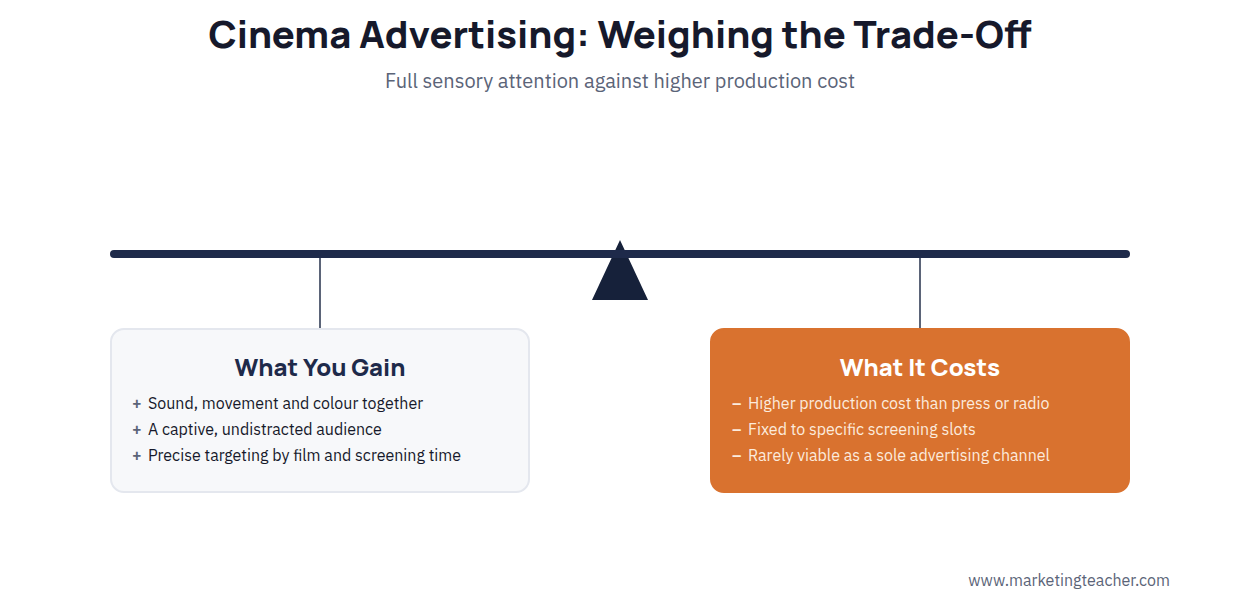
As a creative medium, cinema advertising has sound, movement and colour together, on a large screen, in a room where the audience is not scrolling past on a phone or reaching for a remote control. That combination of full attention and full production values is also cinema advertising’s main drawback for a small business: producing a cinema advert to a professional standard is relatively expensive compared with a static press advert or a simple radio spot, since it usually calls for filming, editing and a soundtrack rather than just text and a photograph. Belch and Belch’s (2012) treatment of media planning makes the same general point about broadcast-style media: the format’s strength, in this case full sensory attention, comes bundled with a materially higher production cost that has to be weighed against the size of the audience it reaches.
Keeping Production Costs Under Control
A small business does not need a full television-style production to advertise in a cinema. Many local production companies, and often the cinema itself, can build a perfectly effective advert from a series of basic photographs and text, over-dubbed with a short spoken commentary, at a fraction of the cost of filming original footage. The right approach depends on the business’s available budget and how much it needs to communicate: a simple photograph-and-voiceover advert is usually enough to build awareness of an offer or a new opening, while a business with a more complex message, or a larger budget, may want the fuller production values that filmed footage provides.
Matching the Format to the Audience
Because cinema advertising is sold against specific films and specific screening times, a small business gets much more precision than it would from a general local newspaper or radio slot. Targeting is less about which cinema and more about which film and which showing: an advert placed before a big family film reaches parents and children together, while one placed before a late-evening screening reaches a very different audience, typically adults without children in tow. This makes the choice of screening at least as important as the choice of cinema itself, and it is worth asking the venue directly which of its screenings draw the audience a particular business is actually trying to reach.
Deciding Whether It Is Worth It
Cinema advertising rarely makes sense as a business’s only advertising channel, given its higher production cost relative to press or outdoor advertising, but it can be a strong complement to other channels for a business whose customers plausibly visit a cinema as part of a wider evening or weekend out. The decision ultimately comes down to the same trade-off that applies to any media choice: whether the audience the venue can deliver, at the times relevant to the business, is large and well-matched enough to justify the higher up-front production cost. Talking directly to the local cinema about its audience numbers by screening, and being upfront about the advertising budget available, is usually the fastest way to find out.
A Resource-Constrained Decision
Carson, Cromie, McGowan and Hill’s (1995) research on marketing in smaller firms makes a point that applies directly here: entrepreneurial marketing decisions are shaped as much by limited resources as by textbook theory, so the right answer for a small business is often the simplest version of a channel that still reaches the right audience, not the most polished one a larger competitor could afford. For cinema advertising, that usually means negotiating directly with the venue rather than a national sales agency, accepting a shorter or less frequent run of screenings, and treating the advert itself as something to refine over time rather than getting right on the first attempt.
Summary
A local cinema can put a small business’s advertising in front of a genuinely captive audience, but the format’s production cost is higher than press or radio, so targeting matters more than usual: the film and the screening time chosen should match the business’s actual customers, not just the venue’s general footfall. Keeping production simple, a series of photographs with a voiceover rather than filmed footage, lets a small business access the format without the budget required for a full commercial, while still benefiting from cinema’s unmatched combination of sound, movement and colour on a large screen.
The slides, worksheet, lesson plan and poster for this lesson are free to download and free to use in your course — no sign-up, no permission needed.

