
What Makes Radio a Distinct Advertising Medium?
Radio is a sound-only medium, which is usually described as a limitation compared with television or video, but it can also be an advantage. Because radio gives a listener no fixed image to look at, MacInnis and Price’s (1987) research on imagery in information processing helps explain why a well-written radio advert can prompt a listener to construct their own vivid mental picture, often called radio’s “theatre of the mind.” A carefully chosen sound effect, voice or piece of music can trigger imagery that a listener finds more personally engaging than a fixed image would, because it is partly their own imagination doing the work rather than an image simply being shown to them.
How Radio Advertising Is Bought and Priced
Radio advertising is sold in spots, short blocks of airtime, typically 15 to 30 seconds long, bought in packages across a station’s schedule. Pricing is usually quoted as a cost per thousand listeners (CPM), which varies enormously by daypart, the segment of the day a spot airs in. Breakfast and evening drive-time slots, when the largest audiences are listening while commuting, command the highest CPM, while overnight or midday slots are considerably cheaper for the same length of advert. Production costs for a radio advert are also typically far lower than for video, since there is no filming, casting or editing of visuals involved, which makes radio an accessible medium even for a business with a modest advertising budget.
How Often Should an Advert Run?
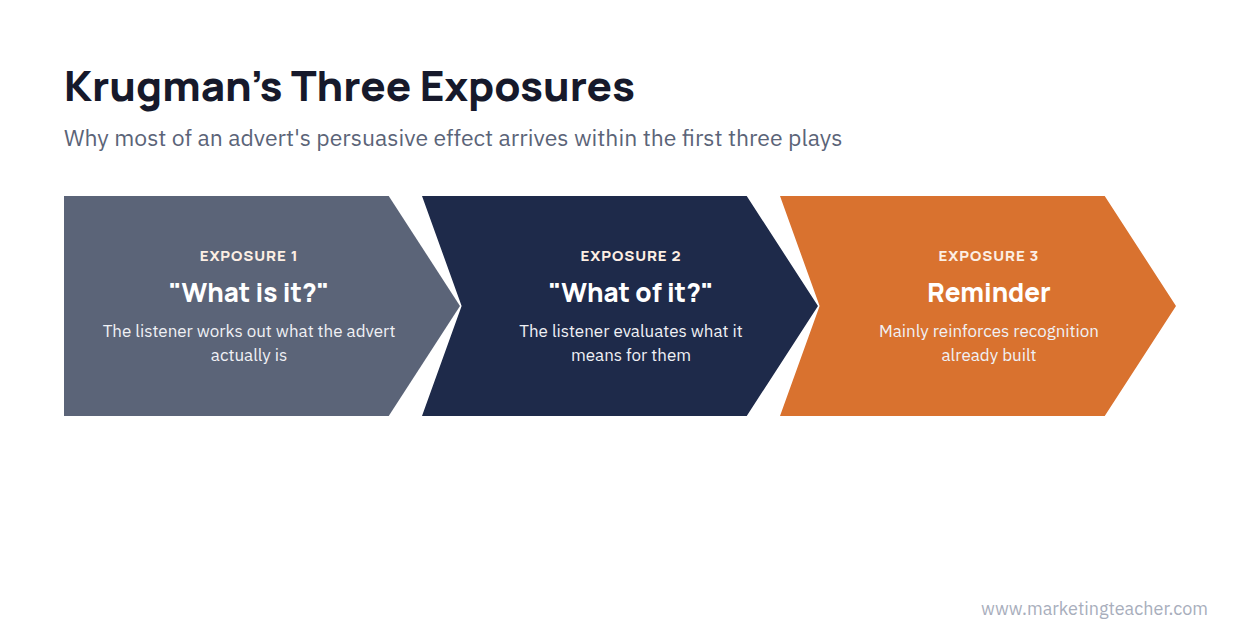
Krugman (1972) proposed that a listener’s response to an advert changes across a small number of exposures rather than building indefinitely with every additional repeat. On the first exposure, the listener’s dominant reaction is simply working out what the advert is. On the second exposure, having already identified it, the listener evaluates what it means for them personally. By the third exposure, the advert functions mainly as a reminder, and Krugman argued that additional exposures beyond this point add comparatively little further persuasive value, though they can still be useful for keeping a brand top of mind over a longer campaign. This is a useful planning discipline for a smaller advertiser choosing between running fewer adverts on more stations, or the same advert more frequently on one station that reaches its actual target audience.
Writing for the Ear, Not the Eye
A radio advert has no second chance for a listener to look back at a missed detail, unlike a printed advert or a webpage, so its message needs to be simple enough to follow on a single listen. Repeating the brand name and the core offer more than once within a single advert, rather than assuming a listener caught it the first time, meaningfully improves recall precisely because there is nothing visual to fall back on. A distinctive sound signature, whether a short jingle, a particular voice, or a recognisable sound effect used consistently across every advert in a campaign, also helps a listener identify the brand instantly on future exposures, reinforcing the recognition that Krugman’s model shows builds gradually over repeated listens.
Digital Audio: Radio’s Expanding Definition
Terrestrial broadcast radio is no longer the whole picture. Streaming radio, podcast advertising, and on-demand audio platforms have all grown into significant advertising channels in their own right, often reaching more tightly defined audiences than a traditional broadcast station can, since a listener’s chosen podcast or streaming station says a great deal about their specific interests. Many of these formats also allow far more precise targeting and measurement than traditional radio, tracking listens and completions directly rather than relying on survey-based audience estimates. Choosing between traditional broadcast radio and digital audio now depends mainly on which one the target audience actually listens to, rather than one being a simple upgrade of the other.
Summary
Radio advertising works through imagery a listener constructs themselves (MacInnis & Price, 1987), sold as spots priced by daypart and audience size, with drive-time commanding the highest rates. Krugman’s (1972) three-exposure principle offers a practical guide to how often an advert needs to run, since most of its persuasive effect arrives within the first three exposures to a genuinely well-targeted audience. As measuring the success of your campaign covers, tracking a specific call to action is what turns a radio schedule from a guess into a plan that can be judged and repeated.
The slides, worksheet, lesson plan and poster for this lesson are free to download and free to use in your course — no sign-up, no permission needed.

