
What Is Internal Marketing?
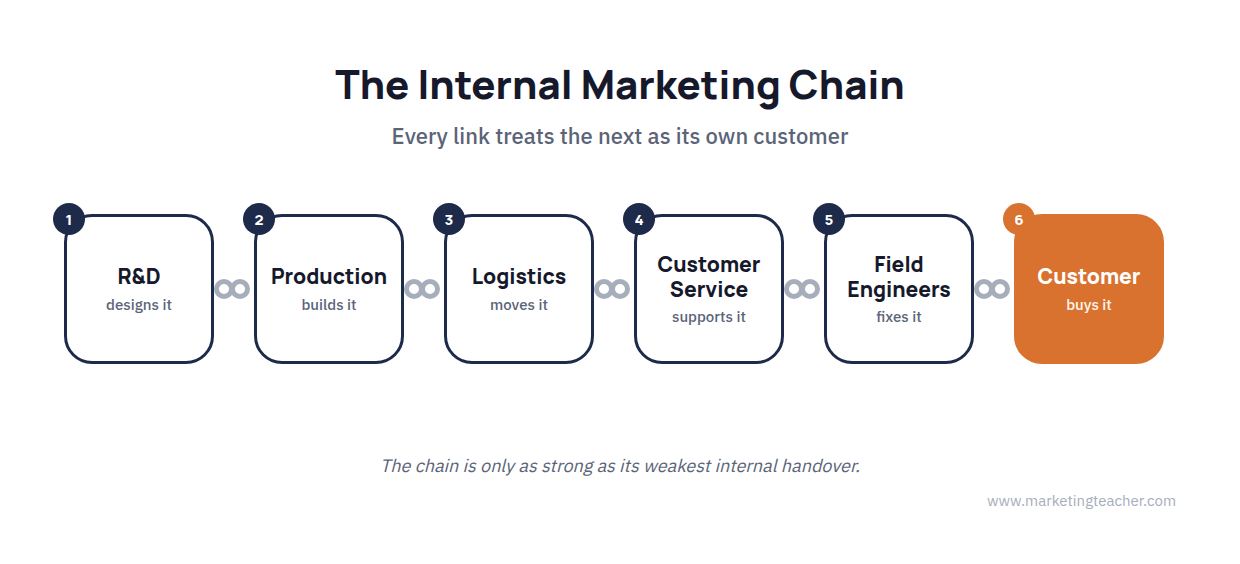
Internal marketing turns the basic tools of marketing inward, using them on a business’s own employees before those tools ever reach the paying public. Berry (1981) was among the first to frame this clearly, arguing that a service business should treat its jobs as products and its employees as an internal market whose needs must be satisfied before the business can hope to satisfy anyone else. The same ideas that shape external marketing apply here: the marketing concept, the marketing exchange process, and customer satisfaction are all just as relevant to an employee as they are to a paying customer, only the “product” on offer is the job itself, and the “customer” is the person doing it.
Who Are a Business’s Internal Customers?
An internal customer is simply the next person, team or department in the chain who receives the output of someone else’s work before the final product or service ever reaches an external customer. A logistics team treats customer service as its internal customer, since customer service depends on stock arriving correctly and on time. Customer service, in turn, treats field engineers as its internal customer, passing on the information those engineers need to do their jobs well. Further back in the chain, a research and development team treats the manufacturing team as its internal customer, since manufacturing can only build what R&D hands over cleanly. This relationship runs in both directions, up and down the supply chain, and it means that quality and service standards inside a business are ultimately what determine the quality external customers experience once whatever is being made or delivered finally reaches them. A failure at any single link, however far removed it seems from the paying customer, tends to surface eventually at the front line, since the employee who deals with the external customer is usually the last in a long line of internal handovers, not the first point at which quality could have gone wrong.
Building an Internal Marketing Programme
A working internal marketing programme usually rests on three related activities. The first is recruitment: hiring people who are already motivated by what the business does, rather than hoping enthusiasm can be trained in afterwards. The second is training and internal communication, making sure every employee understands the company’s vision, mission and brand promise well enough to represent it consistently, not just the employees who deal with customers directly. The third is reward and retention: recognising and keeping the people who deliver on that promise, since a programme that trains people well only to lose them to high turnover achieves very little. None of the three works well in isolation: recruiting the right people without training them properly leaves good intentions with no practical outlet, and training people well without rewarding or retaining them simply hands a competitor the benefit of the investment once they leave. Kotler and Armstrong (2018) describe the overall aim succinctly: internal marketing means a service firm must orient and motivate its customer-contact employees and supporting service people to work as a team to provide customer satisfaction.
Why Internal Marketing Matters for External Customers
The connection between how a business treats its own people and how satisfied its final customers end up is well established. Heskett, Jones, Loveman, Sasser and Schlesinger (1994) proposed the “service-profit chain”, showing that internal service quality drives employee satisfaction, employee satisfaction drives employee retention and productivity, and both of those in turn drive the external service value that shapes customer satisfaction and loyalty. Seen this way, internal marketing is not an optional extra alongside customer-facing activity: it is one of the main levers that determines whether customer satisfaction is achievable at all, since employees who feel undervalued rarely deliver a customer experience that feels valued either. A related, more detailed approach to embedding this thinking across a whole organisation is covered in strategic internal marketing.
Summary
The slides, worksheet, lesson plan and poster for this lesson are free to download and free to use in your course — no sign-up, no permission needed. See the teacher resources →
Assign this lesson to your class:
Using Canvas, Blackboard or Moodle? Copy the link and paste it into your course page or assignment. More ways to add lessons to your LMS.

