
What Is the Business Environment, and Why Scan It?
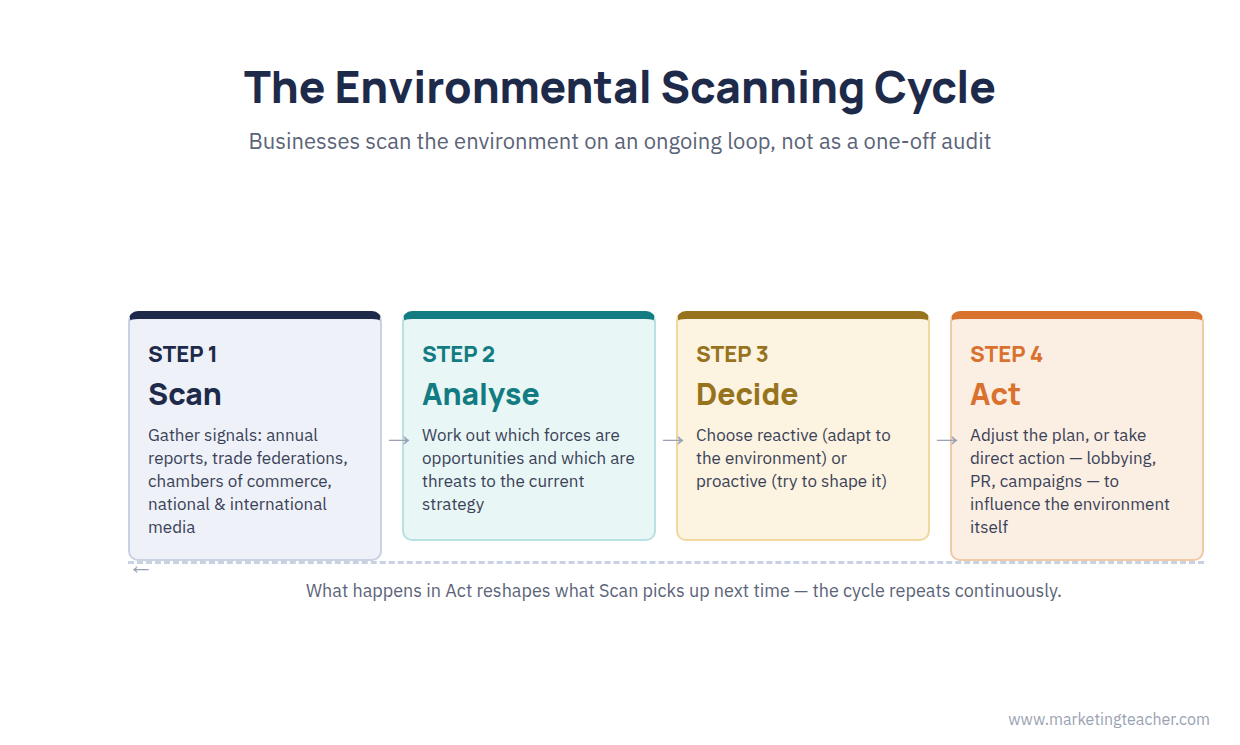
The business environment is simply the microenvironment and macroenvironment considered together, in practical terms: the forces outside a business’s direct control that shape what it can sell, how, and to whom (Kotler & Armstrong, 2018). Knowing the theory behind PESTEL or the six actors in the microenvironment is only useful if a business actually keeps watch on how those forces are changing in the real world. That ongoing watching is called environmental scanning, and it is not a one-off exercise carried out before a plan is written — it is a continuous habit that feeds every later decision.
Where the Information Comes From
Scanning means deliberately going looking for signals rather than waiting for change to arrive unannounced. In practice, that means drawing on real, checkable sources: corporate annual reports and accounts (a company’s own and its competitors’), local Chambers of Commerce and business groups, professional and trade federations such as the American Marketing Association and the Chartered Institute of Marketing, and national and international media — outlets like the Financial Times, The Wall Street Journal, and Japan’s Nihon Keizai Shimbun, each of which surfaces different regional and sector-specific signals a single domestic newspaper would miss. Kotler and Armstrong (2018) stress that marketers who track demographic, economic, natural, technological, political and cultural trends closely are the ones best placed to convert a shifting environment into an opportunity rather than a surprise. No single source tells the whole story: an annual report shows how a specific competitor sees its own year, a trade federation newsletter flags an issue sweeping an entire sector, and international media catches a shift — a new regulation, a supply disruption, a currency swing — well before it reaches a purely domestic news cycle. Building the habit of checking more than one type of source is what keeps scanning from turning into a narrow, one-sided picture.
Reactive or Proactive: Two Ways to Respond
Once the scanning turns up a real signal, a business has a choice in how it responds. Kotler and Armstrong (2018) describe most companies as reactive: they treat the environment as something largely outside their control, analyse the forces at play, and design a strategy that avoids the threats and captures the opportunities on offer. That is a perfectly sound approach for forces genuinely beyond influence — no single company is going to shift a country’s demographic structure or its economic cycle.
A smaller number of companies take a proactive stance instead. Rather than treating the current environment as a fixed boundary, they actively try to shape it: lobbying to influence legislation, staging media events to shift press coverage, using social media and blogs to shift public opinion, pursuing legal action to keep competitors in line, or forming contractual agreements that give them more control over their own distribution. Kotler and Armstrong (2018) point to companies whose products effectively created new industries — the kind of proactive move that redraws the environment rather than simply reacting to it.
Building Scanning Into an Ongoing Habit
The diagram above sets scanning inside a loop rather than a straight line, because the environment doesn’t hold still once a plan is written. A business scans for signals, analyses which ones matter, decides how to respond, and acts — and whatever happens as a result of that action becomes part of what the next round of scanning has to notice. A company that scans once a year, at planning time, is really running the same audit on a stale picture; a company that treats scanning as continuous catches a rumour, a new competitor, or a shifting regulation while there is still time to do something about it.
Summary
The business environment is the microenvironment and macroenvironment put into practice: real external forces a business tracks through sources like annual reports, trade federations, and national and international media (Kotler & Armstrong, 2018). Once a genuine signal is found, a business can respond reactively, adapting its strategy to the forces it cannot change, or proactively, actively working to shape the environment itself — and treating the whole process as a continuous cycle, rather than a one-off audit, is what keeps a business ahead of the change rather than caught out by it.
The slides, worksheet, lesson plan and poster for this lesson are free to download and free to use in your course — no sign-up, no permission needed. See the teacher resources →
Assign this lesson to your class:
Using Canvas, Blackboard or Moodle? Copy the link and paste it into your course page or assignment. More ways to add lessons to your LMS.

