
What Is the Science of Shopping?
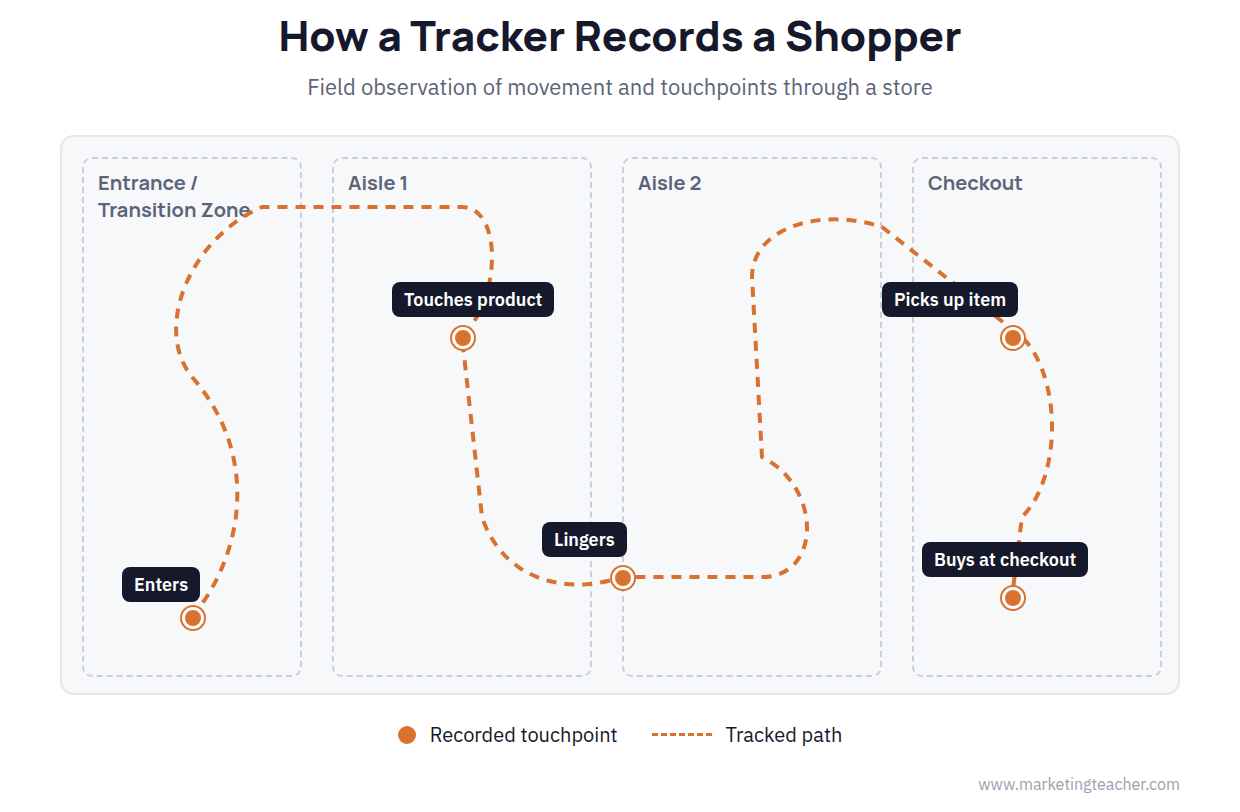
Shopping looks casual from the outside, but a substantial body of retail research treats it as something that can be observed, measured and improved almost like any other applied science. Underhill (1999) pioneered much of this field by sending researchers into real stores to record, in careful detail, exactly what shoppers do rather than relying on what shoppers say they do afterward in a survey. The gap between the two is often large: shoppers are not always aware of, or able to accurately describe, the small physical behaviors that actually shape their purchase decisions.
Trackers: Observing Shoppers in the Field
The central research tool in this field is the “tracker,” a field researcher who follows a shopper inconspicuously through a store and records virtually everything they do: which way they turn on entry, how long they linger in a given area, which products they pick up, and where they eventually stop or abandon a purchase (Underhill, 1999). Trackers are trained to notice details that a normal employee would walk past without a second thought, such as a display that consistently gets touched but never bought from, or a shelf that shoppers routinely walk past without looking at. This kind of unglamorous, repetitive field observation is what turns shopping from a guessing game into something retailers can actually test and improve.
The Butt Brush Effect
One of the best-known findings from this research is what Underhill (1999) called the Butt Brush Effect, discovered during an early study of a New York department store. A camera positioned near a busy entrance recorded shoppers browsing a tie rack placed close to the doorway. Repeatedly, a shopper who was bumped from behind by other customers moving through the entrance would abandon the rack and leave without buying, even if they had seemed interested moments earlier. Once the store moved the display further from the busy entrance, sales from that display rose quickly. The underlying principle, that shoppers dislike being physically crowded or brushed from behind while browsing, has since shaped how countless stores position their most-touched displays.
Retail Anthropology
This kind of research is sometimes described as retail anthropology, a branch of behavioral science devoted specifically to studying how people interact with retail environments, from stores and restaurants to banks. It examines every part of that environment: entrances, aisles, checkout lines, parking lots, and every rack and display in between. What makes this research distinctive is not sophisticated technology but patient, systematic observation, applied consistently across thousands of hours of watching real shoppers make real decisions.
The Language Trackers Use
Tracker research has produced its own working vocabulary for describing what happens on a store floor. The “interception rate” measures how often a shopper is approached and helped by an employee, and a higher interception rate reliably predicts a higher chance of purchase (Underhill, 1999). The “transition zone” is the stretch of floor just inside the entrance, where shoppers are still adjusting to the store and rarely absorb anything a display is trying to tell them, which is why placing key merchandise there so often underperforms. The “capture rate,” the percentage of shoppers who actually notice a given product on the shelf, is closely tied to the “boomerang rate,” the percentage of shoppers who turn back before walking the full length of an aisle. Together, these terms give retailers a precise, shared language for describing behavior that would otherwise be dismissed as simply “how people shop.”
From Observation to Store Design
The value of tracker research lies in what happens after the observation stage. Once a pattern like the Butt Brush Effect is documented across enough stores and enough shoppers, it stops being an interesting anecdote and becomes a design principle: keep high-touch, browsing-heavy displays away from high-traffic doorways and narrow pinch points. Retailers who apply findings like this are not guessing at what might work; they are applying evidence gathered directly from watching how real shoppers actually behave, rather than how store planners assume they behave.
Summary
The science of shopping applies careful, systematic field observation to a behavior most people assume is simple and habitual. Trackers record shoppers’ real behavior in stores rather than relying on self-reported surveys, and findings such as Underhill’s (1999) Butt Brush Effect show how a small physical detail, like proximity to a crowded doorway, can significantly change whether browsing turns into buying. This research is part of a wider field of retail anthropology that studies how people interact with retail environments of every kind. The lasting value of this approach is that it turns store design from guesswork into something that can be tested, measured and improved based on how shoppers genuinely behave.
The slides, worksheet, lesson plan and poster for this lesson are free to download and free to use in your course — no sign-up, no permission needed. See the teacher resources →
Assign this lesson to your class:
Using Canvas, Blackboard or Moodle? Copy the link and paste it into your course page or assignment. More ways to add lessons to your LMS.

