
Why Do Shopping Habits Repeat?
Most shopping behavior is remarkably predictable. Underhill (1999), whose retail research firm spent years directly observing shoppers in stores, found that people tend to repeat the same physical and psychological patterns trip after trip, largely without noticing they are doing it. Retailers have learned to work with these patterns rather than against them, shaping store layouts and product placement around habits that are already there instead of trying to invent new ones.
Touch and the Likelihood to Buy
One of the clearest patterns Underhill (1999) documented is the connection between physically touching a product and the likelihood of buying it. A shopper who picks an item up, turns it over, or tries it on has already moved further toward a purchase decision than one who only looks. This is why easily reached, touchable displays consistently outsell identical products kept behind glass or stacked out of comfortable reach, and why stores dedicate so much shelf space to items positioned at hand height rather than high above or low below eye level.
Recognizable Shopper Patterns
Anyone who has spent time watching shoppers will recognize a few familiar patterns. Some shoppers pick something up and buy it almost immediately, drawn in by touch and impulse. Others move slowly through every aisle, treating the visit itself as the point rather than any single purchase. A third group waits until the last possible moment, then moves quickly and decisively once the deadline is unavoidable, often around a holiday or a specific event. None of these patterns is fixed to one person forever, since the same shopper can behave in all three ways depending on the trip, but recognizing them helps explain why identical stores see very different behavior from one customer to the next.
Impulse Purchases vs. Unplanned Purchases
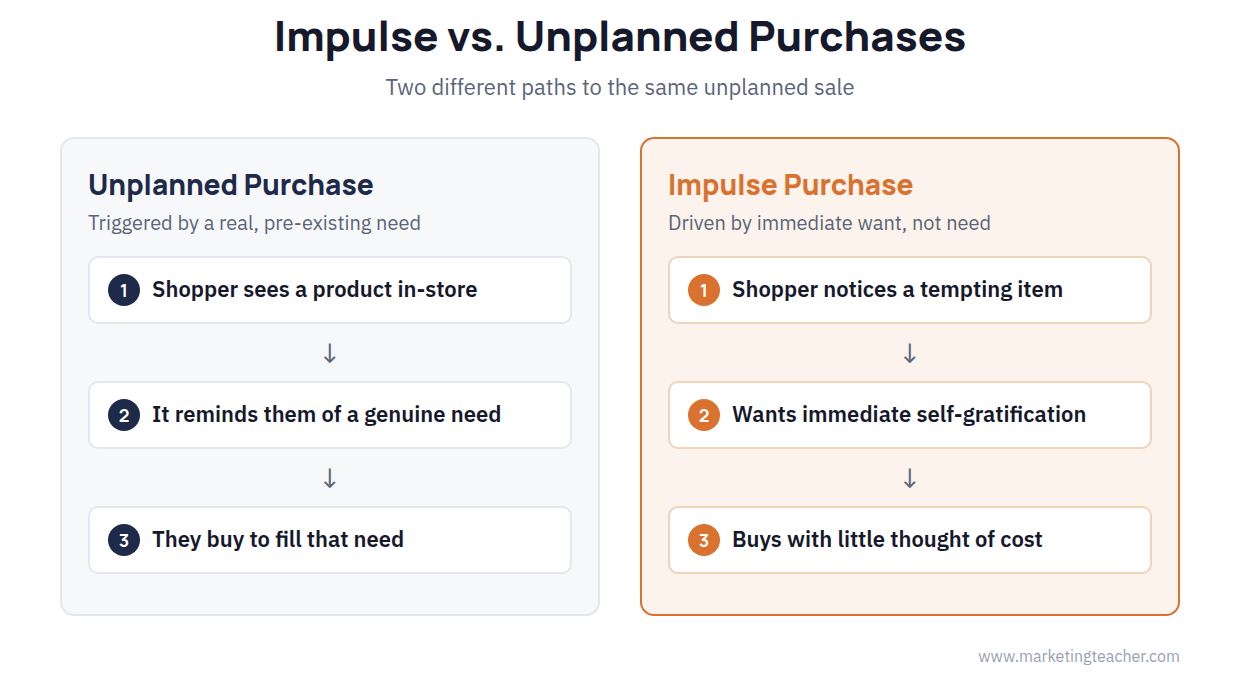
Not every purchase a shopper did not plan in advance is the same kind of decision. An unplanned purchase is usually triggered by a genuine reminder: seeing a product in the store reminds the shopper of a real, pre-existing need, such as noticing air freshener on the shelf and remembering the current one has run out. An impulsive purchase, by contrast, is made spontaneously and with little regard for cost or consequence, driven more by a want for immediate satisfaction than by any underlying need. Both feel similar in the moment, since neither appeared on a shopping list, but they come from different psychological places and respond to different retail tactics.
How Retailers Design for Impulse
Retailers use several deliberate tactics to encourage both kinds of unplanned buying. Placing complementary products near each other, such as positioning dips next to snack chips, prompts shoppers to remember items they might otherwise forget. Staff trained to suggest a small add-on, like a matching accessory alongside a larger purchase, capture sales that would not have happened without the prompt. Reducing the friction of paying, through fast checkout lanes or one-click purchasing online, gives a shopper less time to reconsider before completing the transaction. None of these tactics forces a purchase, but each removes a small barrier that would otherwise have given the shopper a moment to change their mind.
How Much Time in a Store Matters
The longer a shopper spends inside a store, the more they tend to buy, simply because more time means more exposure to displays, more products handled, and more chances for a reminder or an impulse to take hold. This is part of why retailers design layouts that encourage a longer, winding path through the store rather than a short, direct one: sightlines are often deliberately broken up so that shoppers cannot see the checkout or the exit from every point in the store, and popular destinations such as the pharmacy counter or the bathroom are placed at the back rather than near the door. None of this is accidental, and once a shopper knows to look for it, the underlying logic of a store’s floor plan becomes much easier to read.
Summary
Shopping habits are far more predictable than most shoppers realize, and Underhill’s (1999) retail research shows that simple physical behaviors, especially touching merchandise, strongly influence whether a purchase actually happens. Recognizable shopper patterns, from quick impulse buyers to slow browsers to last-minute rushers, describe the same underlying behavior showing up differently depending on the situation. Distinguishing unplanned purchases, triggered by a genuine reminder of need, from impulsive purchases, driven by a want for immediate satisfaction, helps explain why retailers place complementary products together, train staff to suggest add-ons, and make checkout as fast and frictionless as possible.
The slides, worksheet, lesson plan and poster for this lesson are free to download and free to use in your course — no sign-up, no permission needed. See the teacher resources →
Assign this lesson to your class:
Using Canvas, Blackboard or Moodle? Copy the link and paste it into your course page or assignment. More ways to add lessons to your LMS.

