
Why Consumers Shop Online
Online shopping removes several barriers that limit physical retail. A consumer can browse and buy from home, on a commute, or from anywhere with a connection, without depending on a store being physically nearby. Beyond simple convenience, online shopping gives consumers faster communication with sellers and other buyers, a far wider choice of products and retailers than any single physical location could offer, and the ability to compare prices almost instantly. Many consumers also value the greater control online shopping gives them over exactly what they buy, from size and color to delivery timing, and the customization it allows, since a company selling online can often make and ship a product built to a specific order rather than stocking every possible variation in advance.
The 7Cs Framework for Website Design
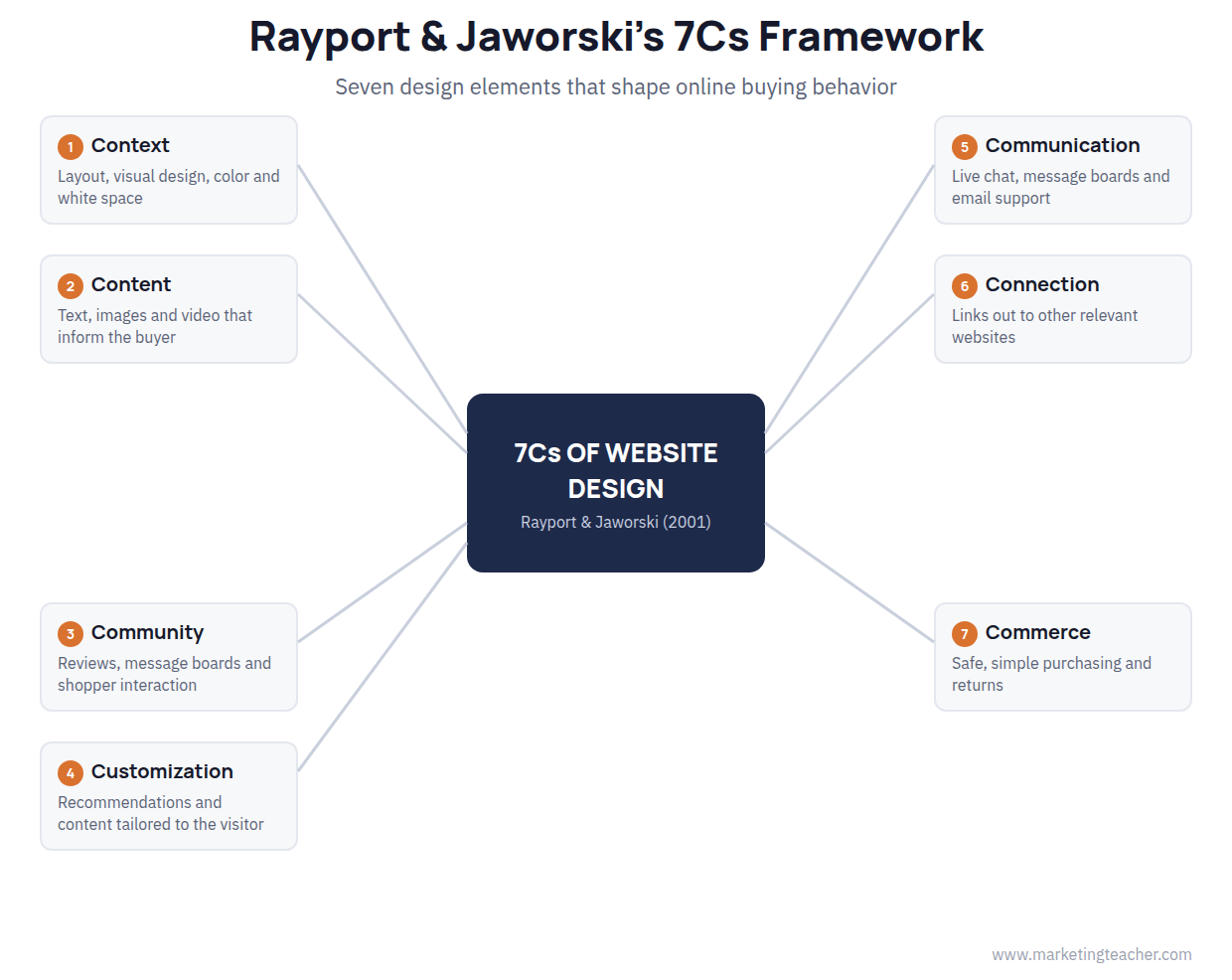
Rayport and Jaworski (2001) proposed a framework of seven design elements, known as the 7Cs, that together determine whether an e-commerce website succeeds in converting visitors into buyers: context, content, community, customization, communication, connection, and commerce. Each element addresses a different part of the online shopping experience, and a website that gets most of them right tends to feel trustworthy and easy to buy from, while one that neglects several tends to lose shoppers before they ever reach checkout.
Context and Content
Context refers to a website’s layout, visual design and use of color, white space and graphics, all of which need to work together to create a coherent theme appropriate to the company and its products. Content covers the actual text, images, video and other material a site uses to inform and persuade a shopper, from product descriptions to demonstration videos. A site can have excellent content buried inside confusing context, or a beautifully designed layout with thin, unconvincing content, and either mismatch tends to undermine the shopper’s confidence in the purchase.
Community and Customization
Community describes a website’s ability to let customers interact with each other, whether through message boards, reviews or comment sections, which gives shoppers social proof beyond whatever the retailer says about its own products. Customization is the site’s ability to tailor itself to an individual visitor, such as recommending products based on past purchases or letting a shopper filter out information they do not need. A retailer that gets customization right can make a large, impersonal catalogue feel like it was assembled specifically for one shopper.
Communication, Connection and Commerce
Communication covers how a site allows dialogue between the company and the shopper, whether through live chat, a message board, or simple email support, and a shopper who cannot easily ask a question is far more likely to abandon a purchase out of uncertainty. Connection refers to a site’s links to other relevant websites, which can extend a shopper’s research without losing them entirely from the retailer’s ecosystem. Commerce is the most direct of the seven: the site’s actual ability to let a shopper complete a purchase safely, and to make a return if needed. A site can excel at context, content and community, but if commerce itself is clumsy or feels insecure, all of that groundwork is wasted at the final step.
Why Online and Physical Behavior Differ
A shopper’s behavior online is not simply their in-store behavior transplanted onto a screen. Without a salesperson standing nearby, a shopper relies far more heavily on content and community to answer questions a human would normally answer. Without the physical cues of touch and proximity discussed elsewhere in this course, an online shopper depends more on customization and connection to feel that a retailer understands their specific needs. Retailers who simply copy their physical store’s approach onto a website, without accounting for these differences, often find that online conversion lags well behind their expectations.
Summary
Consumers shop online for convenience, choice, control and customization that physical retail cannot always match. Rayport and Jaworski’s (2001) 7Cs framework, context, content, community, customization, communication, connection and commerce, describes the design elements that together determine whether a website converts a visitor into a buyer. Because online shoppers cannot rely on a salesperson or the physical cues available in a store, websites that are weak on any one of the 7Cs tend to lose shoppers before checkout, while those that address all seven create the trust and ease of use that turns browsing into a completed purchase.
The slides, worksheet, lesson plan and poster for this lesson are free to download and free to use in your course — no sign-up, no permission needed. See the teacher resources →
Assign this lesson to your class:
Using Canvas, Blackboard or Moodle? Copy the link and paste it into your course page or assignment. More ways to add lessons to your LMS.

