
What Are Situational Influences?
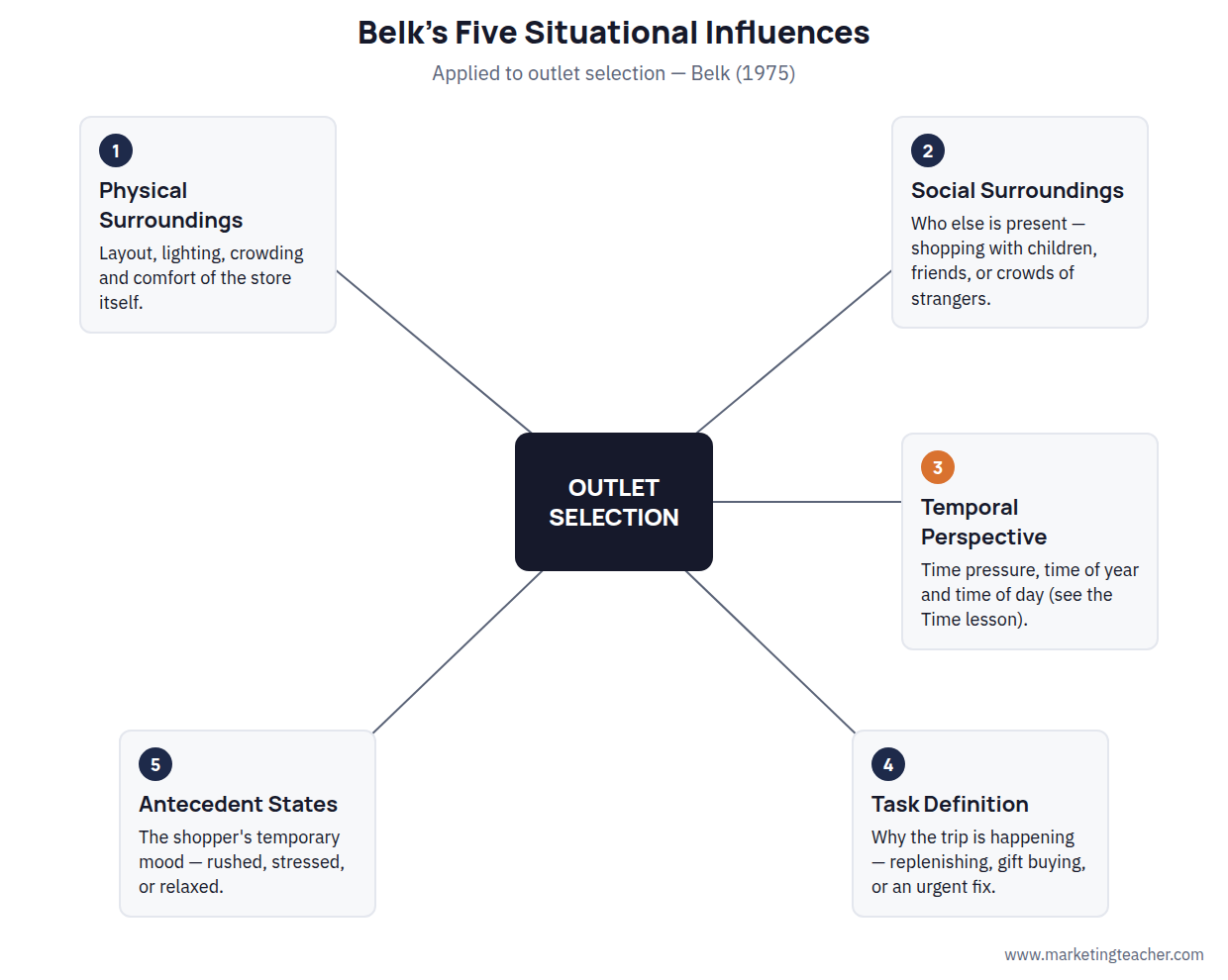
Shopping is something almost everyone does, but the same person can shop very differently from one occasion to the next, and the reason is rarely a change in who they are. Belk (1975) argues that a large part of consumer behavior is explained not by fixed personal traits but by the situation a consumer finds themselves in at the moment of the purchase. He identifies five situational variables: physical surroundings, social surroundings, temporal perspective (covered in depth in Consumer Behavior and Time), task definition, and antecedent states. Outlet selection, which store, website or venue a consumer actually chooses, is one of the clearest places to see these situational factors at work, since the “right” outlet for a given consumer changes constantly depending on what else is happening around and inside them.
Physical Surroundings and Outlet Choice
The physical environment of an outlet, its location, layout, lighting, music, temperature and even its smell, has a direct effect on whether a consumer chooses to shop there and how long they stay once inside. A store that is easy to reach, comfortable to move through and pleasant to spend time in has a real advantage over a cheaper but less accessible or less pleasant alternative, even when the products on offer are functionally identical. Crowding is a particularly strong physical factor: a consumer who finds a preferred outlet unpleasantly busy may switch to a less crowded, previously second-choice option purely because of the physical experience of shopping there that day.
Social Surroundings and Outlet Choice
Who else is present, or expected to be present, also shapes outlet selection. A consumer shopping with children may deliberately choose an outlet known for a faster, simpler layout over one with a wider but more overwhelming range. A consumer shopping with friends may pick a venue partly for its social atmosphere rather than purely for its prices or range. Even the presence of other shoppers, whether it signals a busy, popular outlet or an uncomfortably crowded one, changes how appealing that outlet feels in the moment, independent of anything about the products themselves.
Task Definition: Why Am I Shopping?
The reason behind a shopping trip, what Belk calls task definition, strongly affects which outlet feels appropriate. Buying a gift for someone else typically calls for a different outlet than replenishing a household staple, even if both items could technically be bought in the same store. A consumer stocking up for the week ahead is likely to choose a large outlet with a wide range and competitive prices, while a consumer picking up a single forgotten item is far more likely to choose whichever outlet is closest and quickest, regardless of its range or prices. The same person, with the same underlying preferences, can rationally choose two completely different outlets depending purely on the task at hand.
Antecedent States: Mood and Outlet Choice
Antecedent states are the temporary moods and conditions a consumer brings into the shopping situation, separate from their more stable personality. A consumer who is stressed, tired or in a hurry is far less likely to browse widely or seek out their usual preferred outlet, and far more likely to choose whichever option removes the task from their list fastest. A relaxed consumer with no particular time constraint, by contrast, may happily travel further or spend longer comparing outlets, even for a purchase that would otherwise seem routine. Because antecedent states shift from one shopping trip to the next, they help explain why a single consumer’s outlet choice can look inconsistent even though nothing about their long-term preferences has actually changed.
Bringing the Five Influences Together
No single situational influence acts alone. A rushed antecedent state, a task defined as “urgent replacement,” and an unpleasant physical environment at a preferred outlet can all combine on the same shopping trip, each pushing the consumer toward a different outlet than they would choose under calmer, more open-ended circumstances. Marketers who understand outlet selection only in terms of price and range are missing a large part of the picture; the physical and social environment, what the trip is actually for, and the mood the shopper brings with them all shape which door a consumer ultimately walks through.
Summary
Belk (1975) identifies five situational variables that shape consumer behavior beyond fixed personal traits: physical surroundings, social surroundings, temporal perspective, task definition, and antecedent states. Applied to outlet selection, physical factors such as layout and crowding, social factors such as who else is present, the specific task behind the shopping trip, and the shopper’s temporary mood all combine to determine which store, website or venue a consumer actually chooses on a given occasion. Recognising these situational forces helps marketers understand why loyalty to an outlet is rarely absolute, and why the same customer can be won or lost depending on the situation they are in when the decision is made.
The slides, worksheet, lesson plan and poster for this lesson are free to download and free to use in your course — no sign-up, no permission needed. See the teacher resources →
Assign this lesson to your class:
Using Canvas, Blackboard or Moodle? Copy the link and paste it into your course page or assignment. More ways to add lessons to your LMS.

