
What Is Customer Satisfaction?
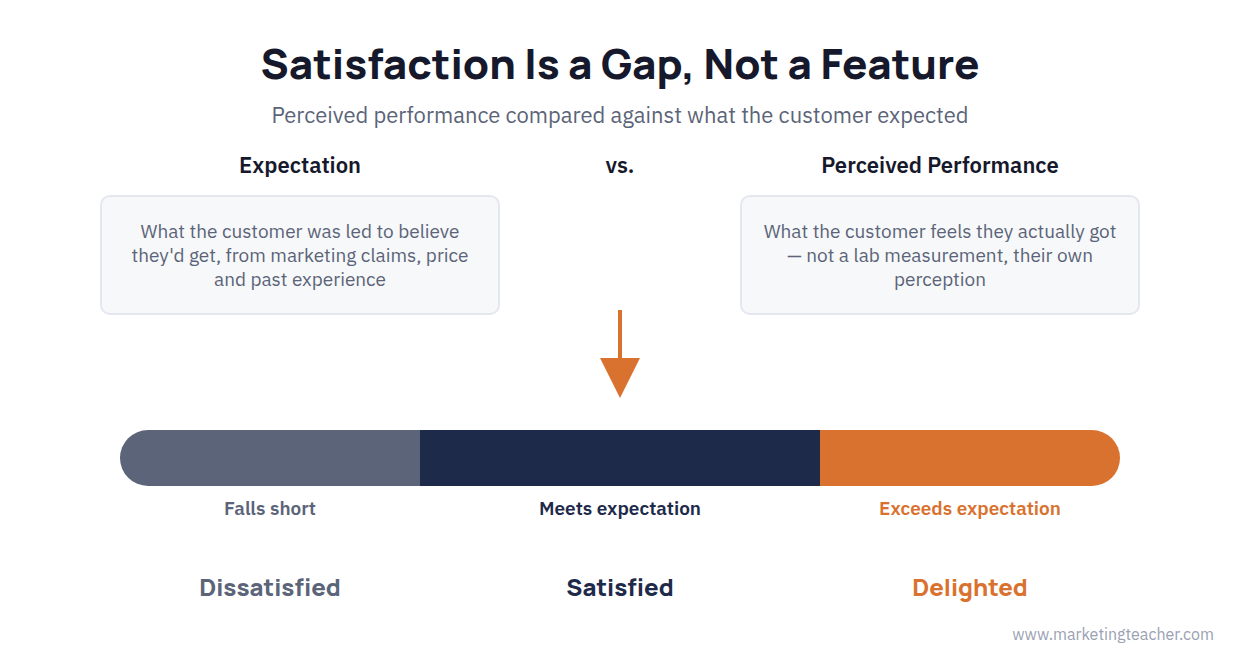
The purpose of marketing centres on creating value and a long-term customer relationship, and customer satisfaction is the concept that sits underneath both. Kotler and Armstrong define it as the extent to which a product’s perceived performance matches a buyer’s expectations (Kotler and Armstrong, 2010). Notice what this definition does not say: it does not say satisfaction depends only on how good the product actually is. It depends on the gap between what a customer expected and what they perceive they got, which is why two customers can experience the exact same product and come away with completely different levels of satisfaction.
Why Expectations Do Most of the Work
Oliver’s expectancy-disconfirmation model formalised this idea: satisfaction is essentially the outcome of comparing perceived performance against a prior expectation (Oliver, 1980). If perceived performance exceeds the expectation, the customer experiences positive disconfirmation and is satisfied, often highly so. If performance falls short, the customer experiences negative disconfirmation and is dissatisfied, regardless of how objectively good the product might be. This is why a budget airline that promises very little and delivers exactly that can generate high satisfaction scores, while a premium brand that overpromises can generate complaints even with a genuinely strong product. Managing the expectation is just as much a marketing job as managing the product, which is why advertising copy, sales conversations and even a website’s product photography all quietly shape satisfaction before a customer has used anything at all.
Setting the Level: Not Too Low, Not Too High
This creates a real balancing act. Set the expected satisfaction level too low, through cautious or underwhelming marketing claims, and customers who could have been won over will simply go to a competitor who promises more. Set it too high, through marketing claims the product or service cannot actually back up, and the resulting gap between promise and experience produces dissatisfaction even when the underlying offer is decent. The aim is to set an honest, achievable level of expectation and then, ideally, to exceed it slightly, since delighted customers are far more likely to return and to recommend the business than customers who are merely satisfied.
Satisfaction Isn’t the Same for Every Customer
Large organisations rarely aim for one single satisfaction level across their whole customer base, because different segments are paying for, and expecting, different things. A fictional car manufacturer, Alderney Motors, sells both a low-cost economy model and a premium executive model. A buyer of the economy model expects a no-frills, reliable car at a low price, and is satisfied once that basic expectation is met. A buyer of the executive model has paid a much higher price and expects a correspondingly higher standard of comfort, service and finish; the same basic level of reliability that satisfies the economy buyer would leave the executive buyer distinctly dissatisfied. Alderney prices and markets each model in line with the expectation it needs to create, which is also why raising satisfaction is never simply a matter of dropping the price or promising more. Both moves increase cost or risk to the business, and neither is a substitute for accurately understanding what a specific segment actually expects.
Perception Is Reality for the Customer
It is worth stressing that customer satisfaction depends on perceived performance, not performance measured objectively by the business. A product can perform exactly to specification and still leave a customer dissatisfied if their perception of the experience, shaped by service, communication, packaging or simply how a complaint was handled, falls short of what they expected. This is precisely why customer satisfaction is treated as a central, ongoing marketing responsibility rather than a one-off measurement taken after a sale: perception is built continuously, through every touchpoint a customer has with a business, not just through the core product itself. A late delivery, a confusing invoice or an unhelpful support call can undo the goodwill built by an otherwise excellent product, simply because each of those moments feeds directly into the customer’s overall perception of the experience.
Summary
The slides, worksheet, lesson plan and poster for this lesson are free to download and free to use in your course — no sign-up, no permission needed. See the teacher resources →
Assign this lesson to your class:
Using Canvas, Blackboard or Moodle? Copy the link and paste it into your course page or assignment. More ways to add lessons to your LMS.

