
What Is a Customer Relationship?
Every sale starts as an exchange: a customer gives up money, and in return receives a product or service. On its own, that single exchange is a transaction, not a relationship. A customer relationship exists when a company and a customer interact repeatedly over time, each side coming to expect value from the other beyond any one purchase. Grönroos (1997) frames marketing itself around this idea, describing it as the process of identifying, establishing, maintaining and enhancing relationships with customers and other stakeholders at a profit, so that the objectives of everyone involved are met.
From a Single Exchange to an Ongoing Relationship
A basic exchange relationship is satisfied the moment the transaction is completed: the customer gets the product, the seller gets paid, and neither side is obliged to interact again. Relationship marketing takes a longer view. Kotler and Armstrong (2018) note that the key to building lasting customer relationships is creating superior customer-perceived value and satisfaction — the gap between everything a customer gains from an offer and everything it costs them, compared with the alternatives on the market. A customer who perceives strong value from one transaction is far more likely to return for another, which is where a relationship begins to form.
Why the Relationship Creates Extra Value
Grönroos (2004) argues that a relationship adds value on top of whatever is exchanged in any single transaction. Once a customer trusts a supplier and a supplier understands a customer’s needs, both sides save time, reduce risk and communicate more efficiently than they could with a stranger. The customer benefits from reliability, personalisation and often better terms; the company benefits from repeat revenue, referrals and more accurate insight into what the customer actually wants next.
Not Every Relationship Looks the Same
Companies do not build every customer relationship the same way, and Kotler and Armstrong (2018) point out that the right level of relationship depends on the target market. A company selling a low-margin, high-volume product to millions of consumers cannot afford to build a personal relationship with each one individually — instead, it builds what is called a basic relationship, using consistent product quality, advertising and an easy brand experience to earn repeat purchases without one-to-one contact. At the other end of the scale, a company selling to a small number of high-value business customers can justify a full partnership, with dedicated account managers and close, ongoing collaboration. Most relationships sit somewhere between these two extremes.
Between those extremes, many companies use specific relationship-marketing tools to strengthen an otherwise basic relationship without the cost of full partnerships. Loyalty and frequency programs are the clearest example: an airline’s frequent-flyer scheme, a supermarket’s points card, or a hotel chain’s rewards app all give ordinary customers a reason to keep choosing the same company, and give the company a way to recognise and reward its best customers at scale. These tools do not replace the underlying value and satisfaction a company provides — they simply give an otherwise anonymous, high-volume relationship some of the recognition and reward that a full partnership would provide naturally.
What Keeps a Relationship Going
A relationship does not survive on goodwill alone. It depends on both sides continuing to give something the other values — information, convenience, trust, fair pricing, or genuine care when something goes wrong. When a company stops delivering value, or a customer stops finding the relationship worthwhile, the relationship weakens or ends. This is why building relationships is closely tied to internal marketing: employees who are trained, motivated and empowered to look after customers are what actually make a relationship strategy real on the ground, rather than just a phrase in a mission statement.
The Customer Relationship Loop
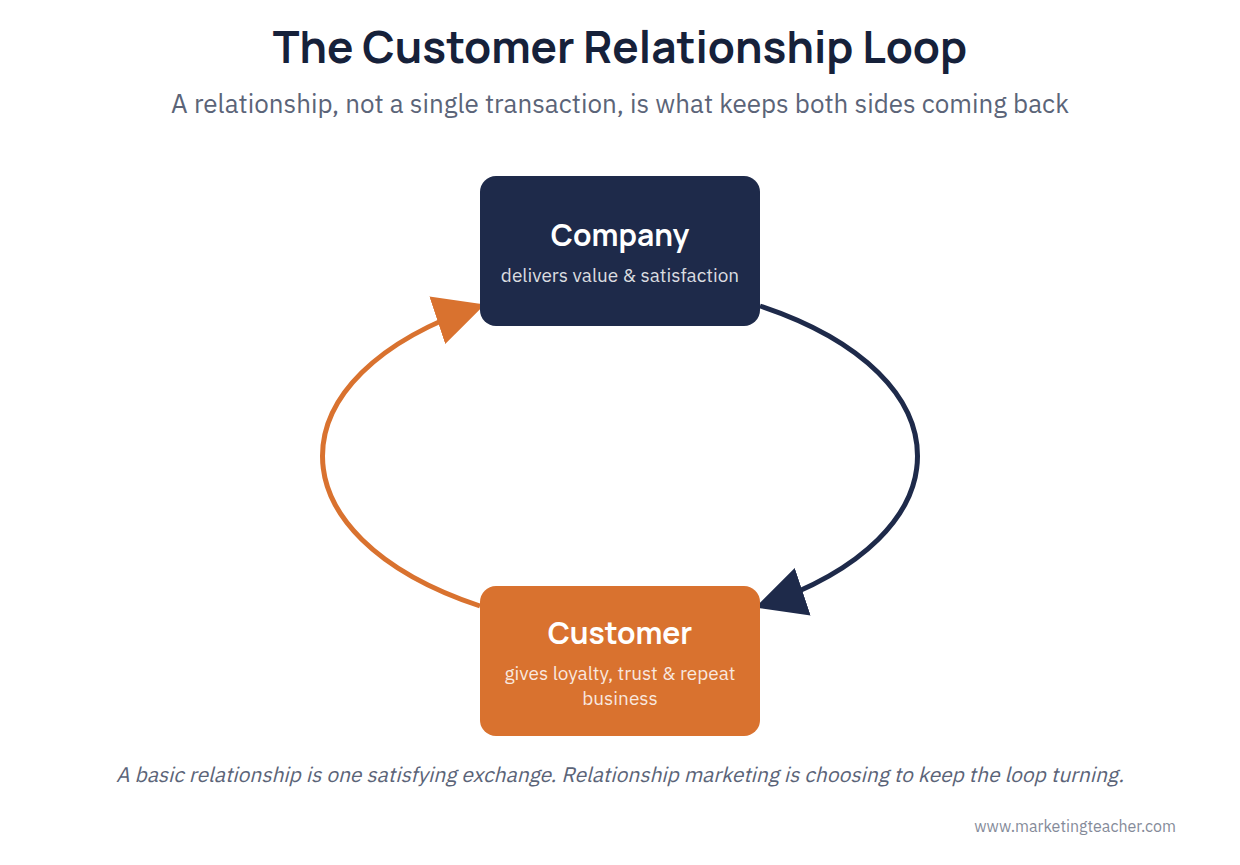
The diagram above shows why relationship marketing is described as a loop rather than a straight line. The company delivers value and satisfaction to the customer; in return, the customer gives loyalty, trust and repeat business back to the company. Each successful turn of the loop makes the next one more likely, which is exactly what a single, one-off exchange can never achieve.
Summary
A customer relationship is more than the sum of the transactions inside it. It begins with a single satisfying exchange, but it is sustained by the ongoing value, trust and satisfaction that both the company and the customer continue to give each other afterwards. Understanding this distinction is the foundation for everything else in customer relationship management, which is the set of tools and processes companies use to build, track and grow these relationships deliberately rather than leaving them to chance.
The slides, worksheet, lesson plan and poster for this lesson are free to download and free to use in your course — no sign-up, no permission needed. See the teacher resources →
Assign this lesson to your class:
Using Canvas, Blackboard or Moodle? Copy the link and paste it into your course page or assignment. More ways to add lessons to your LMS.

