
What Is an AI Chatbot, in a Marketing Context?
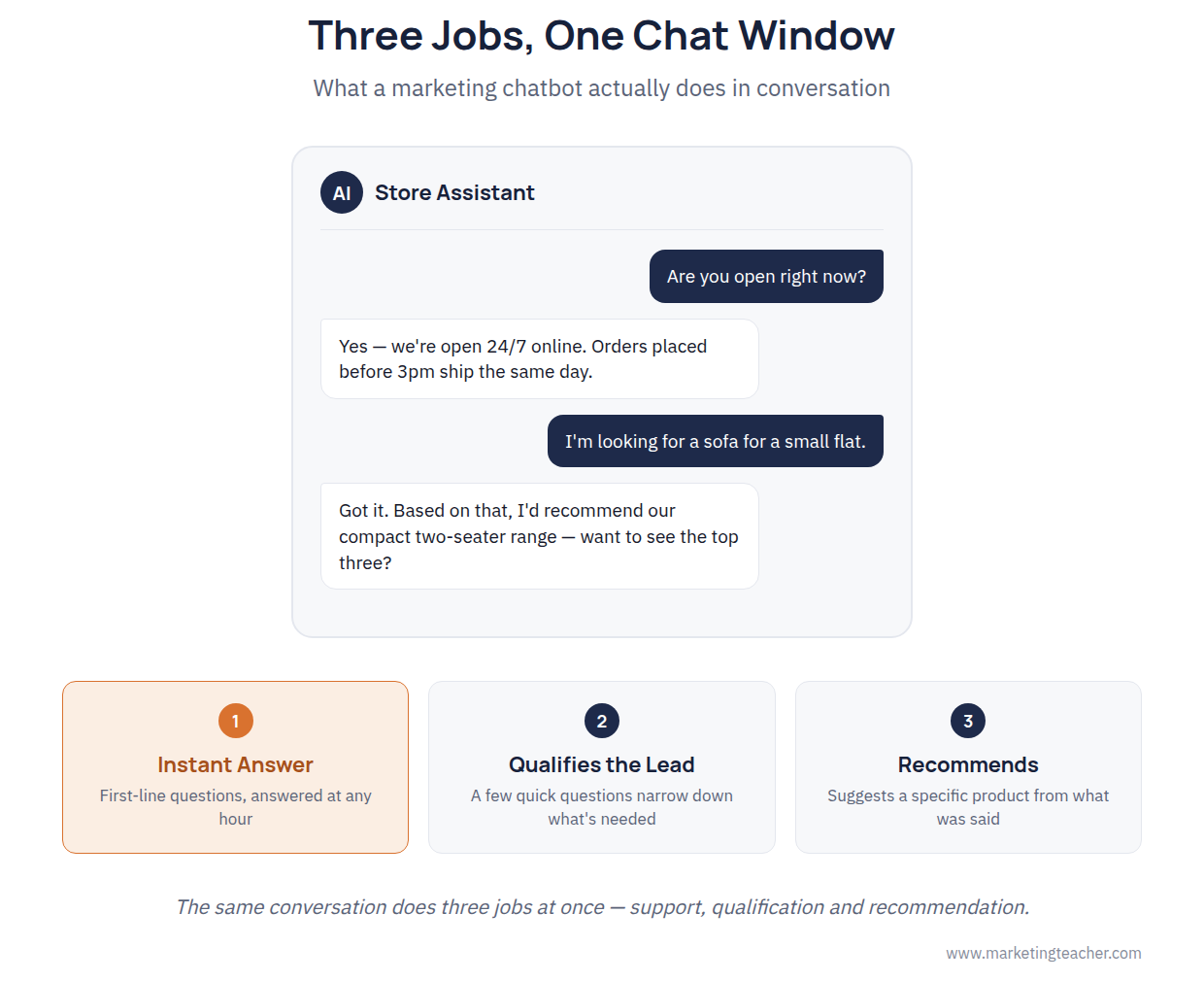
An AI chatbot is software that holds a conversation with a customer using natural language, interpreting what someone types (or says) and generating a relevant reply, rather than working from one rigid, pre-written script. In marketing terms, a chatbot is simply a new front door to the business — one staffed by software instead of a person, available on a website, an app or a messaging platform. A recent review of the academic literature on chatbots in marketing found the technology is now used across a wide range of jobs, from answering questions to guiding a customer toward a purchase (Ramesh and Chawla, 2022).
Three Marketing Jobs a Chatbot Can Do
Ramesh and Chawla’s (2022) review groups most marketing chatbot use around three practical jobs. The first is instant, first-line customer service: answering common questions about opening hours, order status or return policy immediately, at any hour, without a customer waiting in a queue. The second is lead qualification: asking a short series of questions to work out what a visitor actually needs and whether they are ready to buy, so that only genuinely promising leads get passed on to a human salesperson. The third is personalised recommendation: suggesting a specific product or service based on what a customer has just said they want, in much the same way a good shop assistant would.
Why Speed Has Become Part of the Offer
None of these jobs would matter much if customers were happy to wait. Industry research into conversational marketing has repeatedly pointed to speed of response as a major driver of chatbot adoption: businesses report that visitors who get an answer within a few minutes are far more likely to stay engaged than those left waiting for an email reply the next day (Drift, 2019). A chatbot cannot replace a skilled salesperson, but it can remove the single biggest reason a promising enquiry goes cold — the gap between a customer asking a question and someone answering it.
Where Chatbots Fit in the Customer Journey
A chatbot is rarely the right tool for every stage of a customer’s path to purchase — it earns its place at specific points along the customer journey, most obviously the early research stage (quick questions, product comparisons) and the post-purchase stage (order tracking, simple support). The stages that involve genuine persuasion, complex negotiation or emotional reassurance still tend to need a human, at least for now. Treating a chatbot as one well-placed tool among several, rather than a full replacement for the journey’s human touchpoints, is what separates a chatbot that helps from one that frustrates.
Setting the Scope Before Switching It On
The chatbots that disappoint customers most are usually the ones asked to do too much on day one. A narrow, well-defined scope — answer these specific questions, qualify leads on these specific criteria, recommend from this specific product range — tends to outperform an ambitious, general-purpose assistant that guesses at everything and gets a noticeable share of it wrong. Marketers introducing a chatbot for the first time generally get better early results by starting narrow, watching where real conversations go off-script, and expanding the chatbot’s scope gradually as those gaps become clear, rather than trying to anticipate every possible question in advance.
The Limits of a Chatbot
A chatbot works from patterns in language and, increasingly, from customer data the business already holds — which is also where its personalisation ability connects to the broader move toward AI-driven personalisation across marketing more generally. But a chatbot has no real judgement of its own: it can misread an unusual question, mishandle a genuinely upset customer, or confidently offer an answer that happens to be wrong. The businesses that use chatbots most successfully build in an easy, visible route to a human being the moment a conversation goes somewhere the bot isn’t equipped to handle — treating the chatbot as the first line of a conversation, never the only line.
Summary
An AI chatbot is conversational software that gives marketers a new, always-available front door for customers, used mainly for instant first-line support, lead qualification and personalised recommendations. Its appeal rests heavily on speed: closing the gap between a customer’s question and a useful answer before their interest cools. It works best at specific points in the customer journey rather than across all of it, and it works best of all alongside a clear, easy hand-off to a human whenever a conversation runs past what the software can actually judge.
The slides, worksheet, lesson plan and poster for this lesson are free to download and free to use in your course — no sign-up, no permission needed. See the teacher resources →
Assign this lesson to your class:
Using Canvas, Blackboard or Moodle? Copy the link and paste it into your course page or assignment. More ways to add lessons to your LMS.

