
What Is Activity-Based Costing?
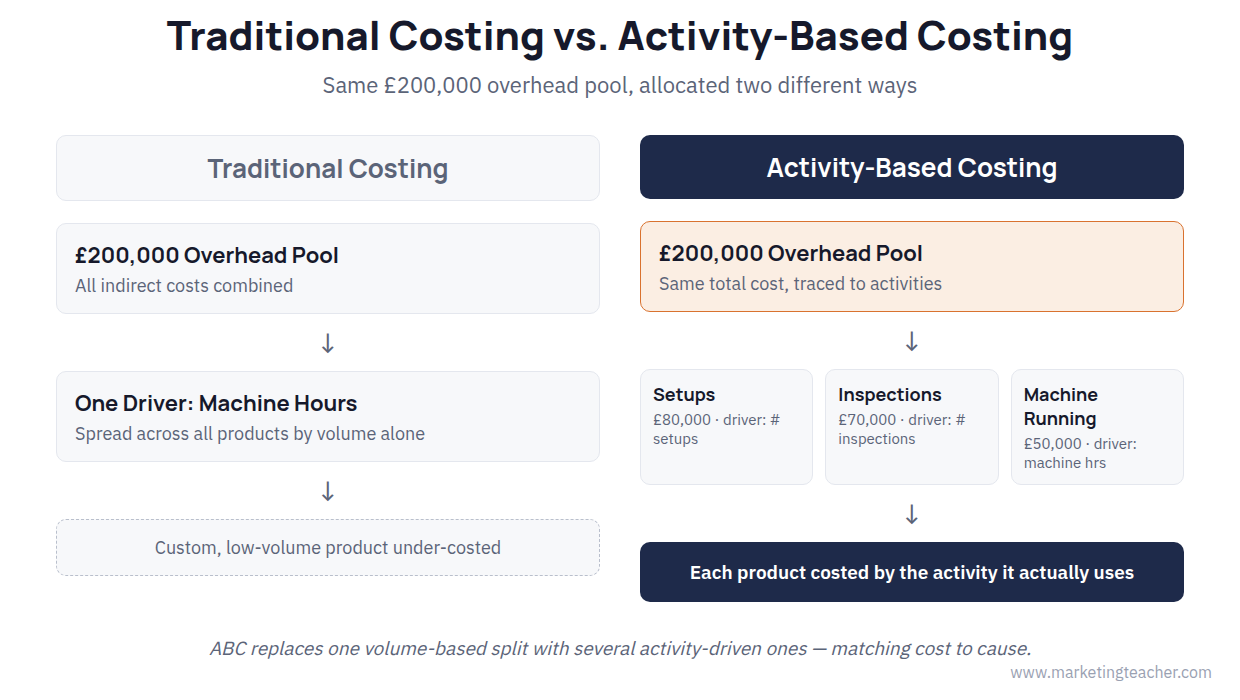
Activity-Based Costing, usually shortened to ABC, is a method of assigning a business’s indirect costs (its overhead) to specific products or services based on the activities that actually cause those costs, rather than spreading overhead across everything using one broad, volume-based measure such as machine hours or direct labour hours (Garrison, Noreen and Brewer, 2020). The idea took hold in management accounting from the late 1980s onward, once it became clear that traditional costing methods were badly distorting the picture for businesses making a mix of high-volume and low-volume products. ABC was developed and popularised as a coherent management framework by Kaplan and Cooper (1998), who argued that a costing system should mirror the way a business actually consumes resources, not the way it happens to be easiest to measure.
Why Traditional Costing Falls Short
A traditional costing system typically picks one single measure of volume, often machine hours or labour hours, and uses it to spread all overhead across every product in proportion to how much of that one measure each product consumes. This works reasonably well when a business makes similar products in similar volumes. It works badly when products differ sharply in how much attention, setup, handling or quality-checking they actually need. A high-volume, simple product that barely touches most support activities can end up absorbing a large, unearned share of overhead simply because it runs through more machine hours, while a low-volume, complex product that generates a disproportionate amount of setup time, engineering support and small-batch handling gets under-costed. The result is a familiar and costly trap: the “simple” product looks less profitable than it is, the “complex” product looks more profitable than it is, and pricing or product-mix decisions get made on the wrong information.
The Four Basic Steps of ABC
ABC breaks this single-measure approach apart into a more accurate sequence. First, the business identifies the main activities that consume resources across the organisation, things like machine setup, order processing, quality inspection, or customer support. Second, it estimates the cost of each of these activity pools by tracing the resources (staff time, equipment, utilities) that go into them. Third, it identifies a cost driver for each activity pool, a measurable factor that explains why the activity’s cost rises or falls, such as the number of setups, the number of purchase orders, or the number of inspections carried out. Fourth, it uses each cost driver to allocate that activity pool’s cost onto the products or services that actually caused the activity to happen, in proportion to how much of the driver each one used.
Choosing Cost Drivers That Actually Explain Cost
The accuracy of an ABC system depends entirely on choosing cost drivers that genuinely explain why an activity’s cost rises or falls. A driver that is easy to measure but doesn’t track actual cause is no better than the single-measure system ABC is meant to replace. Number of setups is a good driver for setup cost because more setups directly cause more setup labour and machine downtime; number of units produced would be a poor driver for the same activity, because setup cost doesn’t rise smoothly with unit volume, it rises with how often a line has to stop and reconfigure. Businesses adopting ABC generally start with a small number of well-chosen activity pools rather than trying to trace every conceivable activity, since the administrative cost of running a very granular ABC system can outweigh the accuracy gained, a trade-off the same cost-versus-benefit logic that applies more broadly to direct and indirect cost classification.
Why This Matters for Marketing Decisions
Product costing might look like a purely accounting concern, but it feeds straight into decisions that sit squarely in marketing’s territory. Pricing a product below its true cost erodes margin without anyone noticing until the damage is done; deciding to expand, shrink or discontinue a product line on the basis of a distorted contribution figure can mean dropping a genuinely profitable line or doubling down on one that is quietly losing money. A marketer who understands roughly how a product’s overhead was built up is in a far stronger position to sense-check a costing figure before it becomes a pricing decision, and ABC’s activity-driver logic connects directly to the kind of margin thinking used in contribution analysis, where an accurate cost baseline is just as essential.
Summary
Traditional costing spreads overhead using one broad volume measure, which can badly distort the true cost of products that differ in complexity, batch size, or support needs. Activity-Based Costing, developed and popularised as a formal management framework by Kaplan and Cooper (1998), fixes this by tracing overhead into activity pools and allocating each pool using the cost driver that actually explains it (Garrison, Noreen and Brewer, 2020). For marketers, the payoff is a costing figure that can actually be trusted when it feeds into pricing, product-line, and profitability decisions.
The slides, worksheet, lesson plan and poster for this lesson are free to download and free to use in your course — no sign-up, no permission needed. See the teacher resources →
Assign this lesson to your class:
Using Canvas, Blackboard or Moodle? Copy the link and paste it into your course page or assignment. More ways to add lessons to your LMS.

