
How Does the Family Influence What We Buy?
The family is the most important consumer-buying organisation in society, and it has been researched more extensively than almost any other influence on buyer behaviour (Kotler & Armstrong, 2018). Marketers who sell to households, rather than to individuals making a purchase entirely alone, need to understand the roles that a husband, a wife, and children each play in a purchase — because those roles vary widely by product category and by stage in the buying process, and getting the target wrong means the marketing message never reaches whoever actually decides.
Husband-Wife Roles Are Shifting
Traditional assumptions about who buys what inside a household are increasingly out of date. The wife was once considered the default purchasing agent for food, household products, and clothing, but rising numbers of women in full-time work and a greater willingness among men to take on household purchasing have changed that picture substantially (Kotler & Armstrong, 2018). Kotler and Armstrong report that a large share of men are now their household’s primary grocery shopper and handle most of the household’s laundry, while a meaningful share of women now outspend men on new technology purchases and are the dominant influence behind new car purchases — a complete reversal of the old assumption that cars and electronics are “his” purchases and groceries and laundry are “hers.”
This shift carries a direct marketing consequence: companies that have traditionally sold only to women or only to men — whether in groceries, personal care, cars, or consumer electronics — are increasingly targeting the opposite sex as well, and some now deliberately show both parents sharing household and parenting tasks in their advertising rather than defaulting to a single traditional shopper. A marketer who still assumes only one parent makes the decision is targeting half the household that might actually be holding the wallet.
These shifting roles connect to a broader idea Kotler and Armstrong call roles and status: a person’s position in any group, including their own family, comes with a role — the activities others expect of them — and a status, the general esteem attached to that role (Kotler & Armstrong, 2018). A parent who spends the workday as a manager, the evening as a parent doing the school run, and the weekend as an enthusiastic member of a local sports club is really occupying three different roles, and often buying quite differently in each one. Purchasing roles inside a household are simply one more set of roles layered on top of everything else a person is juggling.
Children’s Growing Influence
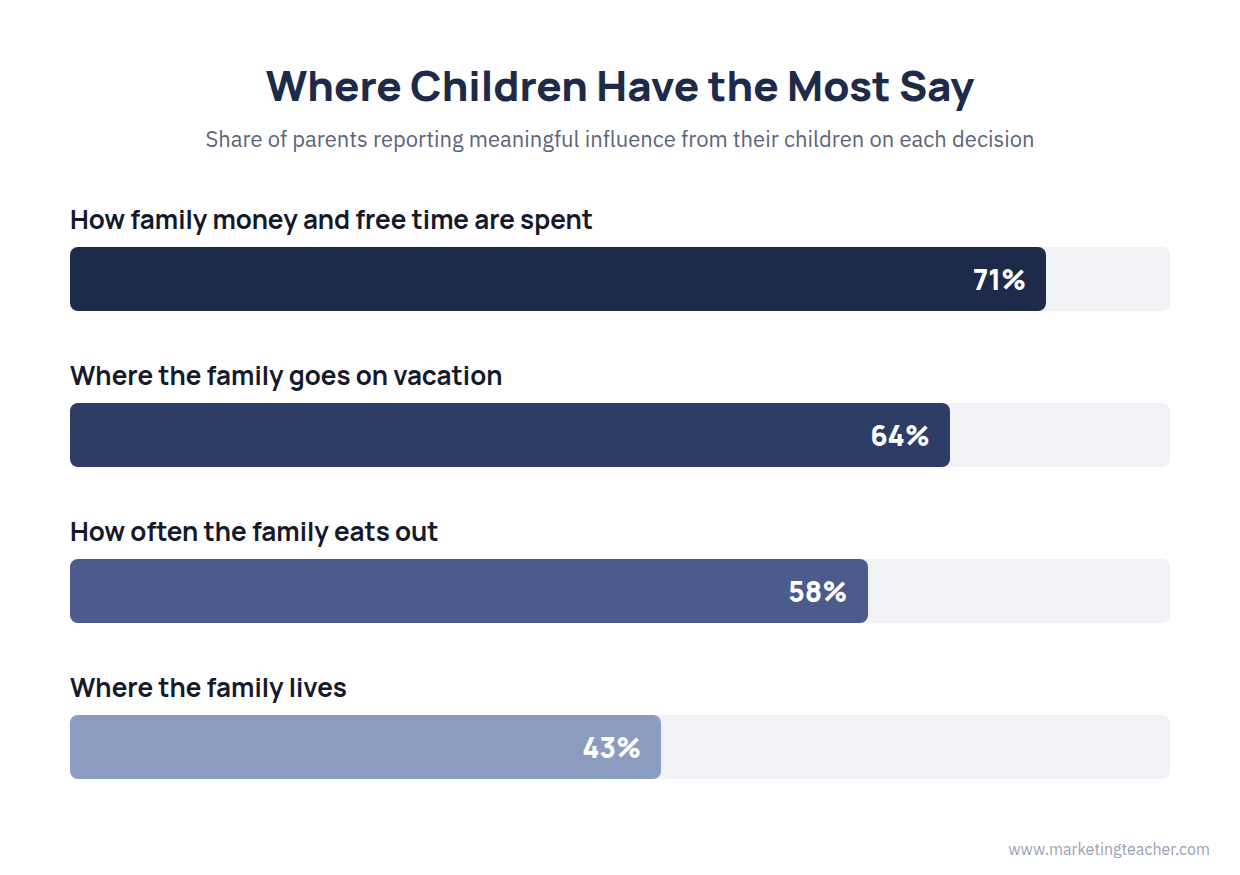
Children are not passive bystanders in family purchase decisions either. A global survey cited by Kotler and Armstrong (2018) found that children exert real influence over how family money and free time are spent, where the family goes on vacation, how often it eats out, and even where it lives — and most parents surveyed felt their own children now influence family purchases more than they themselves did when they were growing up. That last point matters as much as the raw percentages: it suggests children’s influence over family spending is a genuine generational trend, not a one-off survey finding.
None of this means children are placing the order themselves. It means a purchase that looks, on paper, like “a parent decision” is often really a negotiation inside the household, with a child supplying part of the pressure or the preference that shapes the outcome.
What This Means for Marketing Strategy
The practical lesson for marketers is to stop assuming a single “head of household” buyer and instead ask, category by category, who actually decides, who pays, and who has enough influence to veto or redirect the choice. A grocery run, a family car purchase, and a holiday booking can each involve a completely different mix of husband, wife, and children holding the real influence, even inside the same household. Advertising, packaging, and even store layout can all be shaped by getting this mix right — and shaped badly by assuming it never changes.
Summary
The family is the most-researched buying unit in consumer marketing precisely because its internal roles keep shifting (Kotler & Armstrong, 2018). Husband-wife purchasing roles have moved well past old assumptions about who buys groceries and who buys cars, and children exert real, growing influence over decisions many marketers still treat as purely adult ones, from vacations to how often a family eats out. Treating “the family” as one undifferentiated buyer, rather than a small group of people who each pull the decision in different directions, is the single easiest way to misjudge who a marketing message actually needs to reach.
The slides, worksheet, lesson plan and poster for this lesson are free to download and free to use in your course — no sign-up, no permission needed. See the teacher resources →
Assign this lesson to your class:
Using Canvas, Blackboard or Moodle? Copy the link and paste it into your course page or assignment. More ways to add lessons to your LMS.

