
What Is Culture, and Why Does It Matter to Marketers?
Culture is the most basic cause of a person’s wants and behaviour. It is the set of basic values, perceptions, wants, and behaviours learned by a member of society from their family and other important institutions (Kotler & Armstrong, 2018). Growing up in a society, a child absorbs values, habits, and assumptions about the world so gradually that most of them are never consciously taught — they simply become “how things are done.” Because culture is learned rather than instinctive, it also shifts over time: a cultural move toward greater health-consciousness, for example, has created entire industries around fitness services, exercise equipment, and organic food that barely existed a generation ago (Kotler & Armstrong, 2018). Marketers who track these shifts early can spot genuinely new product opportunities; those who don’t can find a product that fit perfectly five years ago quietly falling out of step with the market.
How Cultures Differ: Hofstede’s Dimensions
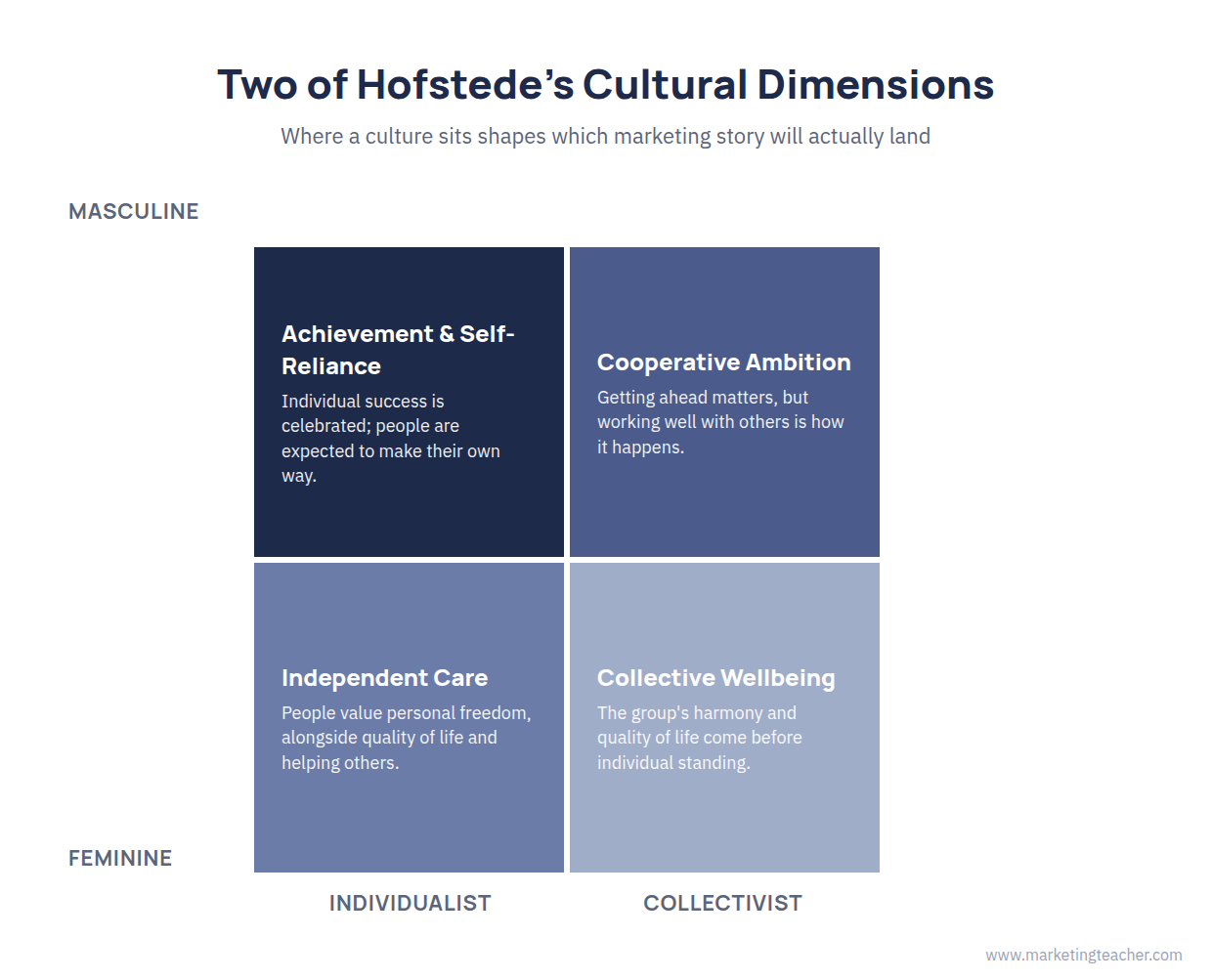
Cultures vary in ways that go well beyond language and cuisine, and one of the most widely used frameworks for comparing them comes from Geert Hofstede’s research into national culture (Hofstede, 1980). Two of Hofstede’s dimensions are especially useful for marketers:
- Individualism versus collectivism — in a more individualist culture, people are expected to look after themselves and their immediate family; in a more collectivist culture, people see themselves as part of a wider group and often prioritise that group’s interests over their own.
- Masculinity versus femininity — a more “masculine” culture tends to prize achievement, assertiveness, and material success; a more “feminine” culture places relatively more value on cooperation, quality of life, and caring for others.
Hofstede identified further dimensions too, including how comfortable a culture is with uncertainty and how much it values long-term planning over short-term results. None of these dimensions labels one culture as better than another — they simply describe different, internally consistent ways of organising a society, and a message or product design that lands well in one place can easily misfire in another if these differences are ignored. An advertisement that celebrates a single high-achieving individual, for instance, tends to resonate strongly in a more individualist culture, while the same advert reframed around a family or community achieving something together often performs better in a more collectivist one — the underlying product hasn’t changed at all, only the story told about it.
Subcultures
Within any broad culture there are subcultures — groups of people with shared value systems based on common life experiences and situations, such as a shared nationality, religion, or region (Kotler & Armstrong, 2018). Subcultures often make up genuinely important market segments in their own right, and many marketers design products and campaigns tailored to a specific subculture’s needs and preferences rather than assuming one national campaign will resonate equally everywhere. Recognising a relevant subculture is not about stereotyping every member of it identically; it is about noticing a real, shared pattern of preference that a one-size-fits-all campaign would otherwise miss entirely. A single country can easily contain dozens of meaningful subcultures at once, defined by any combination of ethnicity, religion, region, or generation, and a subculture that matters enormously for one product category (a shared cuisine, say) may be almost irrelevant to another (a shared taste in music) — so the first step is always working out which subculture, if any, is actually relevant to the specific product being marketed.
Why Marketers Can’t Ignore Culture
Whatever a person consumes says something about their place in their own society, and consumption choices that clash too openly with cultural expectations carry a real social cost for the person making them — which is exactly why culture shapes demand so powerfully even when no law forces the issue. A menu, an advertising message, a product’s packaging, or even a brand name can carry a completely different meaning once it crosses a cultural boundary. Successful international marketing rarely means exporting a domestic formula unchanged; it means researching the target culture properly beforehand and being willing to adapt the parts that don’t translate, while keeping whatever made the brand work in the first place.
Summary
Culture is the set of values, perceptions, and behaviours a person learns from their society, and it is one of the most powerful forces shaping what people buy (Kotler & Armstrong, 2018). Frameworks such as Hofstede’s cultural dimensions (Hofstede, 1980) help explain why the same product or message can land completely differently in different societies. Subcultures add a further layer of variation within a single culture, and recognising them lets a marketer serve a real, distinct group rather than a flattened national average. Ignoring any of this rarely ends well: culture shapes demand whether a marketing plan accounts for it or not.
The slides, worksheet, lesson plan and poster for this lesson are free to download and free to use in your course — no sign-up, no permission needed. See the teacher resources →
Assign this lesson to your class:
Using Canvas, Blackboard or Moodle? Copy the link and paste it into your course page or assignment. More ways to add lessons to your LMS.

