
What Is the Marketing Exchange Process?
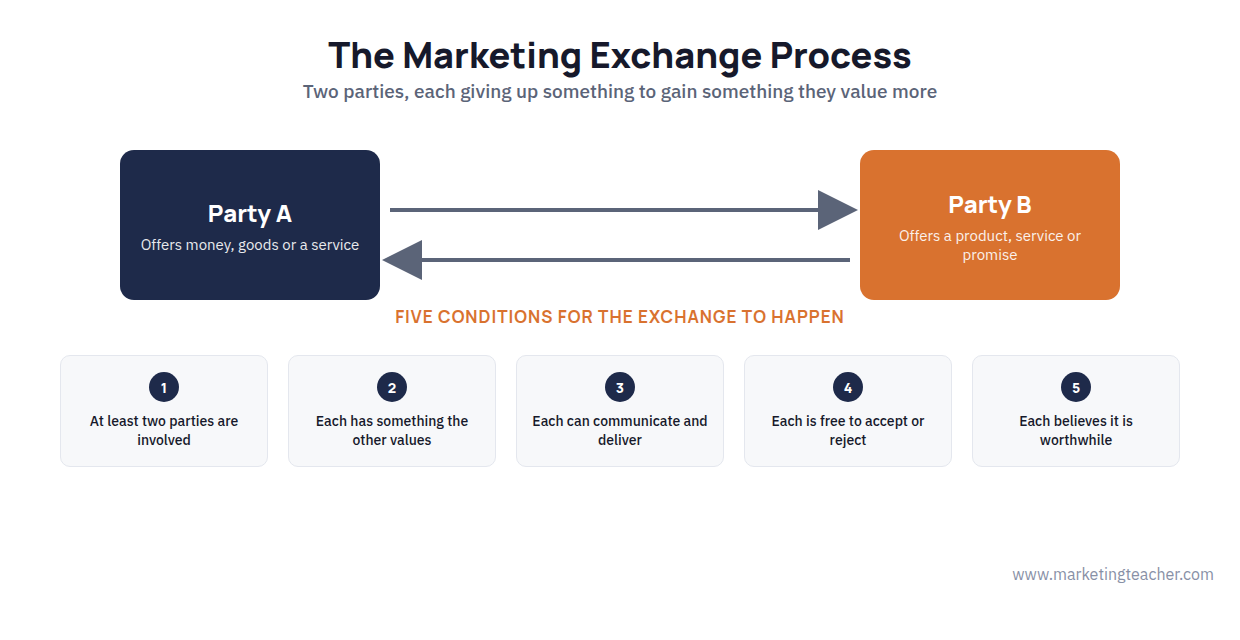
At the start of any marketing course it is worth appreciating how exchange actually works, because it sits underneath almost every other marketing concept that follows. Kotler and Armstrong (2009) define exchange as the act of obtaining a desired object from someone by offering something in return. It is a simple idea in principle, and it happens constantly: paying for a meal, buying an app with a stored card, donating blood in response to a newspaper appeal, or voting for a candidate after watching their campaign are all exchanges, even though only some of them involve money changing hands.
The Conditions for an Exchange to Happen
Not every interaction between two parties counts as an exchange. For a genuine exchange to take place, several conditions need to hold: there must be at least two parties, each party must have something the other values, each party must be capable of communication and delivery, each party must be free to accept or reject the offer, and each party must believe that engaging in the exchange is worthwhile. Remove any one of these conditions and the exchange either does not happen or is not really voluntary. A business that pressures a customer into a purchase, or a customer who cannot actually pay, has broken one of these conditions, and marketing exists largely to make sure enough of these conditions are genuinely met, willingly, on both sides.
From a Single Exchange to a Relationship
A single successful exchange is often just the beginning rather than the end goal. Relationship marketing takes the same basic mechanism and extends it deliberately over time: rather than treating each transaction as a one-off, a business aims to keep delivering enough value that the customer chooses to exchange with it again and again, building a longer-term relationship rather than a single sale. This is the foundation that later ideas like customer relationship management build on, and it explains why so much modern marketing effort goes into what happens after a purchase, follow-up communication, loyalty schemes, ongoing service, rather than stopping the moment the transaction is complete.
Why the Exchange Has to Be Judged by Both Sides
A common mistake is judging whether an exchange is fair or attractive only from the seller’s point of view: does the price cover costs, does the margin look healthy, is the promotion within budget. But an exchange only actually happens when the other party also judges it worthwhile from their own perspective, and that perspective is frequently different from what the seller assumes. A customer might value convenience or reassurance far more than the objective quality difference between two products, which is why two businesses selling near-identical goods at near-identical prices can have very different success rates: one has simply understood what the customer values in the exchange better than the other has. This is also why marketing research into customer needs and perceptions sits so close to the exchange concept, since getting the exchange wrong from the customer’s side, offering something the seller values highly but the customer does not, means no exchange takes place at all, however good the underlying product might genuinely be.
Exchange Beyond Goods and Services
It is easy to think of exchange only in terms of buying physical products, but the underlying process applies far more broadly. A government campaign asking people to stop smoking is trying to exchange a behaviour change for the promise of better health. A charity appeal is trying to exchange a donation for a sense of contribution or belonging. A political campaign is trying to exchange a vote for a set of promised policies. None of these involve a traditional product, yet all of them rely on the same basic structure: two parties, each believing they are getting something worthwhile from the interaction. Recognising exchange as the common thread running underneath all of these very different situations is what makes it such a foundational concept rather than a narrow one.
Summary
The marketing exchange process is the act of obtaining something desired by offering something of value in return (Kotler & Armstrong, 2009), and it requires two parties, mutual value, the ability to communicate and deliver, freedom to accept or reject, and a genuine belief on both sides that the exchange is worthwhile. It applies well beyond conventional buying and selling, covering donations, votes, and behaviour change alike, and it forms the foundation that longer-term relationship marketing and customer relationship management are built on top of.
The slides, worksheet, lesson plan and poster for this lesson are free to download and free to use in your course — no sign-up, no permission needed. See the teacher resources →
Assign this lesson to your class:
Using Canvas, Blackboard or Moodle? Copy the link and paste it into your course page or assignment. More ways to add lessons to your LMS.

