
What Is Social Class, and Why Does It Matter to Marketers?
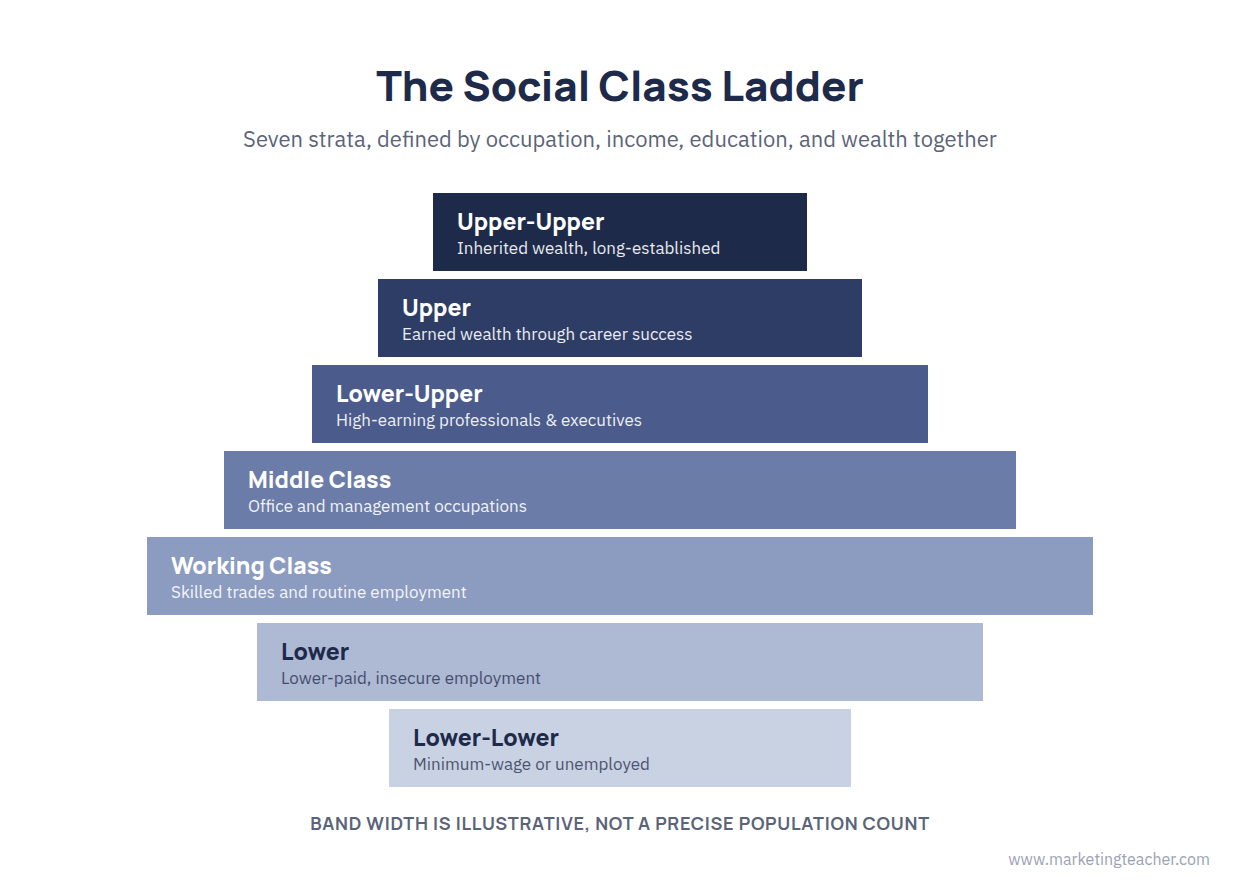
Almost every society has some form of social class structure — relatively permanent and ordered divisions whose members share similar values, interests, and behaviours (Kotler & Armstrong, 2018). Social scientists have identified seven broad American social classes, ranging from an upper-upper class down to a lower-lower class. Crucially, social class isn’t determined by a single factor such as income alone; it’s measured as a combination of occupation, income, education, wealth, and other variables together (Kotler & Armstrong, 2018). In the United States, the lines between classes aren’t fixed the way they can be in some other social systems — people can and do move to a higher class or drop into a lower one over a lifetime.
Marketers care about social class because people within a given class tend to show distinctly similar buying behaviour, particularly in areas such as clothing, home furnishings, travel and leisure, financial services, and cars (Kotler & Armstrong, 2018). Two households with an identical income can still make very different purchase decisions if they occupy different social classes, because class captures a broader pattern of values and taste that income alone doesn’t fully explain. A recent lottery winner and a long-established professional earning the same amount often furnish their homes, choose their holidays, and pick their cars quite differently — the extra income hasn’t erased the habits, tastes, and social expectations built up over years in a particular class.
How Reference Groups Shape Product and Brand Choices
Social class isn’t the only social factor at work. A consumer’s reference groups — the groups a person looks to when forming attitudes and behaviour, whether or not they belong to them — also shape purchase decisions, but not equally for every product. Bourne’s classic typology of reference-group influence (Bourne, 1957) sets out two questions that predict how strong that influence will be: is the product consumed publicly or privately, and is it more of a necessity or more of a luxury? Crossing these two questions produces four distinct patterns:
- Public necessity (for example, a fast-food lunch with colleagues) — group influence over which product to buy is weak, since almost everyone buys some version of it, but group influence over which brand is comparatively strong, because the brand is visible to others.
- Public luxury (for example, a yacht) — group influence is strong over both the product choice and the brand choice, since both the decision to own one at all and which one to own are highly visible.
- Private necessity (for example, bed sheets) — group influence is weak over both product and brand, since almost no one else ever sees the decision.
- Private luxury (for example, a home hot tub) — group influence is strong over the product choice (owning one signals something to a reference group when it does come up) but weak over the brand choice, since the specific brand is rarely visible even to guests.
Later research extended Bourne’s original model with more nuance (Bearden & Etzel, 1982), but the core lesson holds: a marketer’s first question about group influence should never be “how strong is it?” in the abstract, but “strong for the product decision, the brand decision, both, or neither?” — because the right marketing message is different in each of the four cases.
Putting the Two Together
Social class and reference-group influence work side by side, not separately. A marketer targeting a particular social class needs to know not just what that class tends to buy, but how visible the purchase is and how necessary it feels to that group — because that combination determines whether a campaign should focus on winning the category decision, the brand decision, or barely bother with group-based messaging at all. Segmenting by social class without also asking the public/private, necessity/luxury question risks getting the target right and the message wrong.
Summary
Social class is a combination of occupation, income, education, and wealth, not income alone, and it predicts real differences in buying behaviour across categories such as clothing, cars, and leisure (Kotler & Armstrong, 2018). Reference groups add a second, separate layer of influence, and Bourne’s public/private, necessity/luxury typology (Bourne, 1957; extended by Bearden & Etzel, 1982) predicts when that influence will fall on the product decision, the brand decision, both, or neither. Combining both lenses gives a much sharper picture of a target market than either one alone.
The slides, worksheet, lesson plan and poster for this lesson are free to download and free to use in your course — no sign-up, no permission needed. See the teacher resources →
Assign this lesson to your class:
Using Canvas, Blackboard or Moodle? Copy the link and paste it into your course page or assignment. More ways to add lessons to your LMS.

